
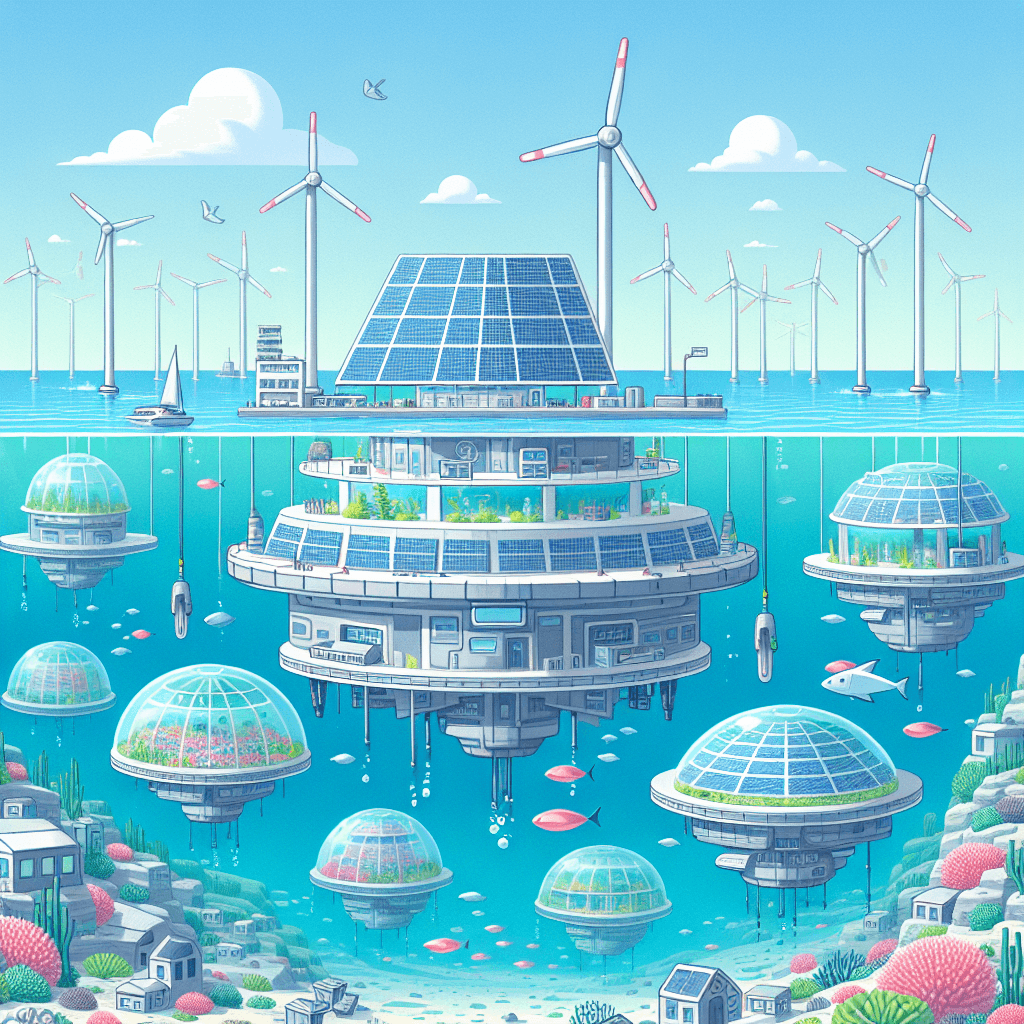
The Neptune Initiative: Designing Sustainable Cities on the Sea
Inquiry Framework
Question Framework
Driving Question
The overarching question that guides the entire project.If rising sea levels continue to threaten our coastal communities, how can we design and pitch a sustainable "Neptune Initiative" city that will use future technologies to balance the needs of humanity with the health of our planet?Essential Questions
Supporting questions that break down major concepts.- What are the correlations between climate change, rising sea levels, and the need for new human habitats?
- How will the Neptune Initiative use new technologies to provide food, water, and energy for its citizens?
- If we build cities on the ocean, what are the potential pros and cons for the environment and for human society?
- How will living in a floating city change the way humans interact with each other and the planet?
Standards & Learning Goals
Learning Goals
By the end of this project, students will be able to:- Master the use of future tense (will, shall, going to) and conditional structures (first and second conditionals) to describe hypothetical future scenarios and technological impacts.
- Analyze and articulate complex correlations between climate change data and its socio-economic impacts on human populations.
- Construct and deliver a persuasive oral presentation (pitch) that evaluates the pros, cons, and ethical considerations of a sustainable technological solution.
- Collaborate to design a multi-modal technical proposal for a floating city that addresses resource management (food, water, energy) and environmental sustainability.
Common Core State Standards (ELA)
WIDA English Language Development Standards
Next Generation Science Standards
Entry Events
Events that will be used to introduce the project to studentsThe Shrinking Classroom Simulation
Students enter to find blue painter's tape on the floor marking the 'shoreline.' Every 10 minutes, the teacher moves the tape further into the room, 'submerging' desks and supplies. Students must discuss in small groups: 'If the water reaches my desk, where will I go?' and 'How will our community change if we lose half our land?'Portfolio Activities
Portfolio Activities
These activities progressively build towards your learning goals, with each submission contributing to the student's final portfolio.Future Forecast: The If-Then Challenge
In this introductory activity, students will process the 'Shrinking Classroom Simulation' and begin to express their vision for the future using specific grammatical structures. For ELL students, this provides the linguistic foundation needed to discuss abstract concepts. They will focus on First Conditionals (real possibilities: 'If the water rises, we will...') and Second Conditionals (hypothetical situations: 'If we lived on the water, we would...').Steps
Here is some basic scaffolding to help students complete the activity.Final Product
What students will submit as the final product of the activityA 'Future Forecast' digital or physical poster featuring five conditional statements and five future tense predictions about the impact of rising sea levels.Alignment
How this activity aligns with the learning objectives & standardsAligns with CCSS.ELA-LITERACY.L.9-10.3 (using language to convey meaning in context) and WIDA Standard 1. This activity specifically scaffolds the grammar required to discuss hypothetical futures and cause-and-effect relationships.Correlation Architects: Mapping the Need
Students will act as urban planners researching the 'why' behind their city. They will analyze provided data charts on sea-level rise and population density to find correlations. They must use academic language to explain how these two factors influence the need for the Neptune Initiative. This activity bridges the gap between environmental science and persuasive writing.Steps
Here is some basic scaffolding to help students complete the activity.Final Product
What students will submit as the final product of the activityA 'Correlation Concept Map' that visually links climate data to specific city design requirements, supported by a written summary.Alignment
How this activity aligns with the learning objectives & standardsAligns with NGSS.HS-ESS3-4 (evaluating technological solutions) and CCSS.ELA-LITERACY.W.9-10.1 (supporting claims with evidence). It forces students to move beyond 'cool ideas' to data-driven justifications.The Innovation Inquiry: Pros, Cons, and Conundrums
Every great invention has a trade-off. In this activity, students will perform a 'Stress Test' on their proposed Neptune Initiative technology. They will analyze the 'Pros' (benefits to humanity) and the 'Cons' (environmental or social risks). This helps ELL students practice evaluative language and complex sentence structures involving 'although,' 'despite,' and 'on the other hand.'Steps
Here is some basic scaffolding to help students complete the activity.Final Product
What students will submit as the final product of the activityA 'Tech Evaluation T-Chart' and a 200-word 'Ethical Impact Statement' that weighs the benefits against the potential risks of their city design.Alignment
How this activity aligns with the learning objectives & standardsAligns with CCSS.ELA-LITERACY.W.9-10.1 (writing arguments and weighing evidence) and L.9-10.3. This activity builds the 'substance' of their final pitch by addressing counter-arguments.The Neptune Blueprint: Designing the Solution
Students will now synthesize their research and language work into a formal technical proposal. This isn't just a drawing; it’s a detailed explanation of how the city functions as a system. Students will use the 'Future Tense' to describe the city’s operations and 'Conditional Phrases' to explain safety measures and emergency protocols.Steps
Here is some basic scaffolding to help students complete the activity.Final Product
What students will submit as the final product of the activityA 'Neptune Blueprint'—a multi-modal presentation (Slides, Canva, or a physical model) that details the city's food, water, and energy systems.Alignment
How this activity aligns with the learning objectives & standardsAligns with WIDA Standard 1 and CCSS.ELA-LITERACY.SL.9-10.4. It focuses on the 'organization' and 'style' of presenting technical information to a specific audience.The Neptune Pitch: Selling the Future
In the final stage, students will 'pitch' their Neptune Initiative to a panel of 'Global Investors' (classmates and teacher). This requires them to speak clearly, use logical reasoning, and adapt their style to a formal audience. The pitch must incorporate the future tense, conditionals, and correlations developed in previous activities.Steps
Here is some basic scaffolding to help students complete the activity.Final Product
What students will submit as the final product of the activityA 3-5 minute persuasive oral presentation (The Pitch) accompanied by a visual aid and followed by a Q&A session.Alignment
How this activity aligns with the learning objectives & standardsAligns with CCSS.ELA-LITERACY.SL.9-10.4 (Presenting findings clearly and logically). This is the summative assessment of both the science concepts and the English language goals.Rubric & Reflection
Portfolio Rubric
Grading criteria for assessing the overall project portfolioThe Neptune Initiative: Comprehensive Assessment Rubric
Language and Grammar Mastery
Evaluation of the student's ability to use specific English grammatical structures (future and conditional) to communicate abstract and hypothetical concepts, aligned with WIDA and CCSS.ELA-LITERACY.L.9-10.3.Linguistic Precision: Tense & Conditionals
Measures the accurate and sophisticated use of future tense (will, shall, going to, future perfect) and conditional structures (1st and 2nd) to express hypothetical scenarios and future predictions.
Exemplary
4 PointsConsistently and accurately employs first, second, and future perfect conditionals to express complex hypothetical scenarios. Language use is natural and enhances the persuasive power of the argument. Transitions like 'furthermore' and 'consequently' are used flawlessly.
Proficient
3 PointsDemonstrates clear and correct use of first and second conditionals and future tense with very few errors. Successfully uses required transition words to link ideas and describe correlations. Meaning is always clear.
Developing
2 PointsAttempts to use conditional phrases and future tense, but with inconsistent accuracy. Errors in verb conjugation or sentence structure occasionally obscure meaning. Some reliance on simple present tense.
Beginning
1 PointsRarely uses conditional or future tense correctly. Sentences are mostly simple or fragmented. Struggles to communicate 'if-then' relationships even with sentence frames.
Scientific Reasoning & Data Application
Assessment of the student's scientific literacy and ability to use data as evidence for urban planning and environmental solutions, aligned with NGSS.HS-ESS3-4 and CCSS.ELA-LITERACY.W.9-10.1.Data Synthesis & Correlation Analysis
Evaluates the student's ability to interpret data sets (sea-level rise, temperature, population) and articulate the relationships between environmental change and human needs.
Exemplary
4 PointsExpertly synthesizes multiple data points to create a sophisticated 'Correlation Concept Map.' Explicitly links climate data to every aspect of the city design with nuanced reasoning and valid evidence.
Proficient
3 PointsIdentifies clear correlations between global temperature, sea levels, and population density. Uses these correlations to justify specific technological choices in the Neptune Initiative design.
Developing
2 PointsIdentifies basic correlations (e.g., 'water rises, land disappears') but struggles to connect this data specifically to the chosen technological solutions. Logic is present but lacks depth.
Beginning
1 PointsLists climate facts without identifying correlations. The design of the city seems disconnected from the data provided in the research phase.
Innovative Solution Design
Evaluation of the student's technical proposal for the Neptune Initiative, focusing on resource management and environmental technology.Sustainable Design Thinking
Measures the effectiveness, innovation, and sustainability of the floating city design, specifically regarding food, water, and energy systems.
Exemplary
4 PointsDesign presents highly innovative, self-sustaining systems (e.g., Algae-Power, Desalination) with a detailed blueprint. Operational descriptions reflect a deep understanding of resource management and waste reduction.
Proficient
3 PointsDesign includes functional systems for food, water, and energy. The blueprint is clearly labeled and multi-modal, demonstrating a logical approach to urban sustainability in a marine environment.
Developing
2 PointsDesign covers the three pillars (Food, Water, Energy) but lacks detail on how they function as a system. The blueprint is basic and may be missing key labels or technical descriptions.
Beginning
1 PointsCity design is missing major resource management components. The blueprint is disorganized or fails to address the unique challenges of a floating environment.
Critical Evaluation & Argumentation
Assessment of the student's ability to weigh evidence and argue for a solution while acknowledging its limitations, aligned with CCSS.ELA-LITERACY.W.9-10.1.Evaluative Argumentation & Ethics
Evaluates the student's ability to identify trade-offs, address counter-arguments, and produce a balanced ethical statement regarding their invention's impact on humanity.
Exemplary
4 PointsProduces a nuanced 'Ethical Impact Statement' that expertly balances 4+ pros/cons and proposes innovative 'fixes' for environmental risks. Demonstrates advanced critical thinking during the Socratic Smackdown.
Proficient
3 PointsIdentifies 4 clear pros and 4 cons in the T-Chart. The Ethical Impact Statement logically weighs benefits against risks and proposes a plausible technological fix for a negative impact.
Developing
2 PointsIdentifies fewer than 4 pros/cons or provides superficial risks. The ethical statement is present but lacks a strong synthesis of the 'trade-offs' involved in the invention.
Beginning
1 PointsFails to identify significant risks or cons. Argument is one-sided and lacks an understanding of the ethical complexities of large-scale technological intervention.
Communication & Public Speaking
Evaluation of the final summative oral presentation and the student's ability to communicate technical ideas to a formal audience, aligned with CCSS.ELA-LITERACY.SL.9-10.4.Persuasive Pitch & Oral Fluency
Measures the student's ability to deliver a persuasive, organized pitch with appropriate style, tone, and the ability to respond to spontaneous questions using conditional language.
Exemplary
4 PointsDelivers a compelling, professional pitch with exceptional fluency and tone. Expertly uses visuals to support the narrative. Handles 'Investor Questions' with sophisticated use of conditional phrases.
Proficient
3 PointsPresents information clearly and logically. Maintains good eye contact and uses the visual blueprint effectively. Responds to Q&A sessions using appropriate future and conditional structures.
Developing
2 PointsPitch is generally organized but relies heavily on notes or the script. Visual aids are present but not fully integrated. Responses to questions are brief or struggle with grammar.
Beginning
1 PointsPresentation is unorganized or difficult to follow. Minimal use of persuasive techniques. Struggles to answer questions or use the required language structures during the pitch.