
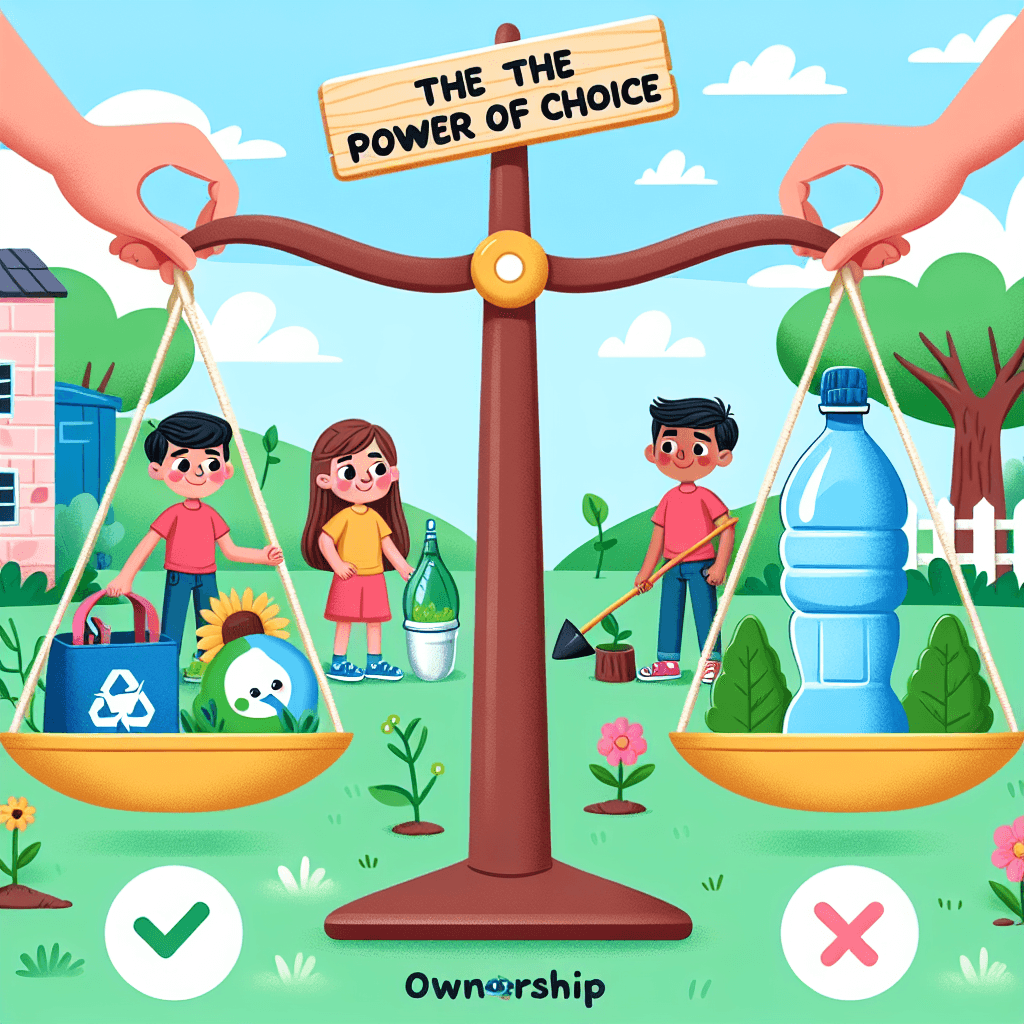
The Power of Choice: Incentives, Ownership, and Conservation
Inquiry Framework
Question Framework
Driving Question
The overarching question that guides the entire project.How can we design a plan using different types of rewards and the power of ownership to convince people to protect our community's natural resources?Essential Questions
Supporting questions that break down major concepts.- What is the difference between a reward we can touch (like money) and a reward we can feel (like pride or praise)?
- How do our choices change when the 'prize' for doing something changes?
- Why do people often take better care of things they own personally compared to things that everyone shares?
- How can owning a piece of land or a business help protect our trees, water, and minerals?
- If we want to stop people from wasting natural resources, should we use money as a reward or a different kind of incentive?
Standards & Learning Goals
Learning Goals
By the end of this project, students will be able to:- Identify and categorize examples of monetary incentives (e.g., cash, gift cards, fines) and non-monetary incentives (e.g., praise, status, personal satisfaction) within their community.
- Explain how a change in a specific incentive (like increasing a fine or offering a reward) directly influences a person's decision to conserve or waste a resource.
- Compare the care and maintenance of personally owned items versus shared/public resources to illustrate the economic concept of private property rights.
- Design a practical 'Incentive Plan' that uses both rewards and ownership strategies to address a specific local environmental issue, such as littering or water waste.
Voluntary National Content Standards in Economics
Common Core State Standards (History/Social Studies)
Common Core State Standards (Writing for History/Social Studies)
Entry Events
Events that will be used to introduce the project to studentsThe Great Snack Scramble: A Tale of Two Properties
Students enter to find the room divided: one side is 'The Public Park' (messy, snacks scattered, no rules) and the other is 'The Private Garden' (clean, snacks organized, 'owned' by specific students). They must discuss why the 'owners' protected their resources while the public area was depleted within minutes, sparking a debate on how ownership changes how we care for the earth.Portfolio Activities
Portfolio Activities
These activities progressively build towards your learning goals, with each submission contributing to the student's final portfolio.The Incentive Sort-O-Rama
In this introductory activity, students will explore the difference between tangible rewards (monetary) and intangible rewards (non-monetary). Using real-world examples relevant to their lives, such as earning a paycheck versus earning a 'thank you' from a friend, students will learn to categorize incentives. This provides the foundational vocabulary needed for the project.Steps
Here is some basic scaffolding to help students complete the activity.Final Product
What students will submit as the final product of the activityAn 'Incentive Gallery'—a visual poster or digital collage that categorizes at least 10 different incentives into 'Monetary' (money, gift cards, coupons) and 'Non-Monetary' (praise, extra free time, certificates).Alignment
How this activity aligns with the learning objectives & standardsThis activity aligns with Voluntary National Content Standard 4: Incentives, which focuses on identifying positive and negative incentives that influence behavior. It also targets the learning goal of categorizing monetary and non-monetary rewards.Mine, Yours, and Ours: The Property Power Trip
Following the 'Great Snack Scramble' entry event, students will investigate the concept of ownership. They will compare a 'Public Resource' (like a local park or the school hallway) to a 'Private Resource' (like their own bedroom or a family car). They will explore the economic idea that people take better care of things they 'own' because they have a personal stake in the resource's value.Steps
Here is some basic scaffolding to help students complete the activity.Final Product
What students will submit as the final product of the activityA 'Property Power' Comparison Chart and a short video or audio recording explaining why 'owners' are often better 'protectors.'Alignment
How this activity aligns with the learning objectives & standardsAligns with Voluntary National Content Standard 10: Role of Institutions, specifically focusing on how property rights shape incentives. It addresses the learning goal regarding the care of personally owned items versus shared resources.Resource Detectives: Local Legends
Students will now apply their knowledge to a real environmental resource. They will research a specific resource (e.g., a local forest, a river, or a community garden) and find out who 'owns' it and what incentives currently exist to protect it. They will look at photos, short news clips, or maps to gather information.Steps
Here is some basic scaffolding to help students complete the activity.Final Product
What students will submit as the final product of the activityA 'Resource Status Report'—a 1-page profile of a local resource including its owner, current condition, and the incentives (fines or rewards) currently in place to protect it.Alignment
How this activity aligns with the learning objectives & standardsAligns with CCSS.ELA-LITERACY.RH.11-12.7 (integrating multiple sources) and the goal of evaluating private property's role in conserving resources.The Green Guardian Action Plan
In this final activity, students become 'Environmental Designers.' They will use everything they've learned about monetary/non-monetary incentives and property rights to create a plan to save the resource they researched in Activity 4. They must propose one new reward and one way that 'ownership' (or a sense of ownership) could help the resource thrive.Steps
Here is some basic scaffolding to help students complete the activity.Final Product
What students will submit as the final product of the activityThe 'Green Guardian Action Plan'—a creative presentation (poster, slideshow, or speech) that outlines a specific problem, a proposed monetary reward, a proposed non-monetary reward, and a 'Property Solution' to protect the resource.Alignment
How this activity aligns with the learning objectives & standardsAligns with Learning Goal 4 (Design an Incentive Plan) and CCSS.ELA-LITERACY.WHST.11-12.4 (Produce clear and coherent writing). It also touches on Standard 10 regarding property rights as an institution.Rubric & Reflection
Portfolio Rubric
Grading criteria for assessing the overall project portfolioEconomics of Conservation: Incentives & Property Rights Rubric
Economic Foundations: Incentives
Focuses on the core economic principle that people respond to incentives in predictable ways.Incentive Classification (Monetary vs. Non-Monetary)
Ability to distinguish between tangible (money-based) and intangible (feeling-based) rewards and how they influence behavior.
Exemplary
4 PointsCorrectly categorizes 10+ diverse incentives and provides a sophisticated explanation of how each type uniquely motivates different behaviors in the community.
Proficient
3 PointsCorrectly categorizes at least 10 incentives into monetary and non-monetary groups with clear, accurate labels for each.
Developing
2 PointsCategorizes most incentives correctly but may have 2-3 errors or include fewer than 10 examples. Identification is basic.
Beginning
1 PointsStruggles to distinguish between monetary and non-monetary rewards; requires significant teacher support to complete the sort.
Predicting Behavioral Change
Understanding of how changes in the size or type of a reward or penalty lead to predictable changes in how people act.
Exemplary
4 PointsProvides a deep analysis of how specific changes (e.g., doubling a fine) would cause a measurable shift in community behavior regarding resources.
Proficient
3 PointsAccurately explains how increasing or decreasing a specific reward (incentive) directly influences a person's decision-making process.
Developing
2 PointsIdentifies that people respond to rewards but struggles to explain the 'predictable' nature of the change in behavior.
Beginning
1 PointsShows limited understanding of how rewards or penalties change behavior; views choices as random rather than incentive-based.
Property Rights & Resource Management
Evaluates the role of private property and ownership rights in economic decision-making and resource management.Private vs. Public Property Analysis
Ability to compare the care and maintenance of personally owned items (Private) versus shared/public resources (Public).
Exemplary
4 PointsDemonstrates a sophisticated understanding of 'personal stake,' explaining clearly how ownership creates a long-term incentive for conservation.
Proficient
3 PointsAccurately completes the Property Power chart, identifying clear differences in how private and public resources are treated and maintained.
Developing
2 PointsIdentifies some differences between private and public property but struggles to explain 'why' owners tend to take better care of things.
Beginning
1 PointsStruggles to differentiate between private and public property or does not see a connection between ownership and care.
Property as a Conservation Tool
Evaluating how ownership rights serve as an institution to protect natural resources like trees, water, and land.
Exemplary
4 PointsProposes an innovative ownership strategy (e.g., community land trust) that clearly addresses resource depletion through the incentive of ownership.
Proficient
3 PointsClearly explains how giving someone ownership of a resource (like a plot of land) provides an incentive to protect it from waste.
Developing
2 PointsMentions ownership as a solution but cannot clearly explain the economic link between owning a resource and saving it.
Beginning
1 PointsDoes not identify ownership as a tool for conservation; relies only on basic rules or punishments.
Application: The Green Guardian Action Plan
Assesses the student's ability to apply economic concepts to solve a real-world environmental problem.Incentive Plan Design
The ability to combine monetary incentives, non-monetary incentives, and ownership strategies into a cohesive plan.
Exemplary
4 PointsPlan is exceptionally creative and realistic, integrating all three economic concepts to solve a complex local environmental issue.
Proficient
3 PointsPlan includes one clear monetary reward, one non-monetary reward, and one ownership strategy that directly address the identified problem.
Developing
2 PointsPlan is missing one of the three required components or the components do not clearly relate to the environmental problem identified.
Beginning
1 PointsPlan is incomplete or identifies solutions that do not function as economic incentives (e.g., just saying 'don't litter').
Evidence-Based Argumentation
The use of evidence, research, and economic vocabulary to support the proposed action plan.
Exemplary
4 PointsUses economic terms (Incentive, Scarcity, Property Rights) fluently and supports the plan with specific research facts about the local resource.
Proficient
3 PointsUses key economic terms correctly and includes 2-3 accurate facts about the chosen local resource from the Resource Status Report.
Developing
2 PointsUses some economic terms correctly but relies on general knowledge rather than specific research facts about the resource.
Beginning
1 PointsPlan lacks economic vocabulary and does not incorporate research; ideas are purely opinion-based.