
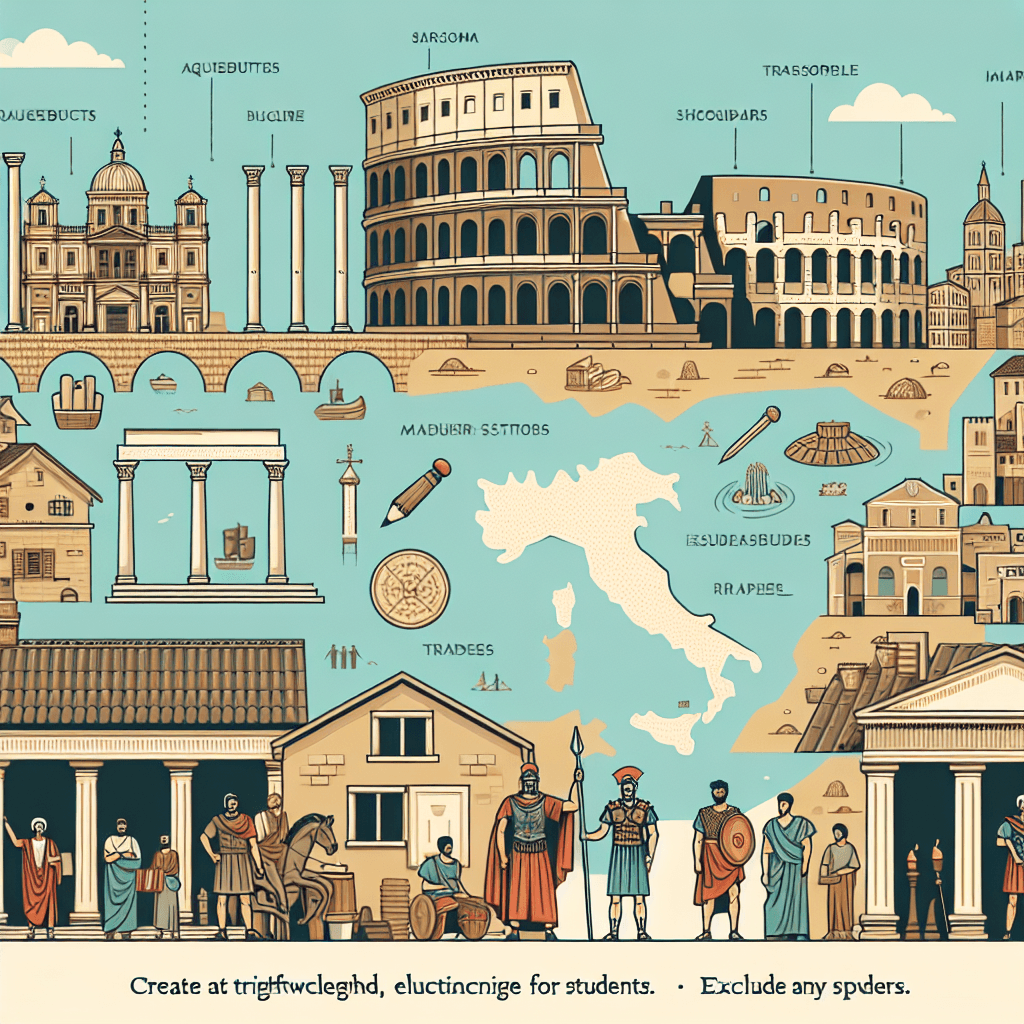
Inquiry Framework
Question Framework
Driving Question
The overarching question that guides the entire project.How did the various geographic, social, political, and cultural factors contribute to the expansion and daily life within the Roman Empire?Essential Questions
Supporting questions that break down major concepts.- What geographic factors contributed to the expansion of the Roman Empire?
- How did the hierarchical structure of Roman society impact daily life for its citizens?
- What role did political institutions play in maintaining control over the vast territories of the Roman Empire?
- In what ways did Roman innovations in architecture, law, and administration shape the areas they conquered?
- How did cultural exchanges within the Roman Empire influence religion, language, and customs?
Standards & Learning Goals
Learning Goals
By the end of this project, students will be able to:- Identify geographic factors that contributed to the expansion of the Roman Empire.
- Analyze the hierarchical structure of Roman society and its impact on daily life.
- Explain the role of political institutions in maintaining control of the Roman territories.
- Evaluate Roman innovations and their effects on conquered territories.
- Investigate the influence of cultural exchanges on religion, language, and customs within the Empire.
State Standards
Entry Events
Events that will be used to introduce the project to studentsCultural Exchange: A Day in the Life
Students participate in an immersive experience where they role-play as citizens of different regions under Roman rule (e.g., Gaul, Egypt). They explore how Roman innovations influenced local customs, architecture, and governance during a day in their role.Portfolio Activities
Portfolio Activities
These activities progressively build towards your learning goals, with each submission contributing to the student's final portfolio.Geographic Mapping of Rome
Students will explore the geographic factors influencing Roman expansion by creating a detailed map that highlights significant locations related to Rome’s growth and governance across the Mediterranean. This activity introduces students to the idea of geography as a tool for understanding historical events.Steps
Here is some basic scaffolding to help students complete the activity.Final Product
What students will submit as the final product of the activityA comprehensive map of the Roman Empire showcasing key geographical features and significant locations with descriptions and a legend.Alignment
How this activity aligns with the learning objectives & standardsAddresses history standards on examining geographic factors contributing to Rome's expansion.Roman Society Hierarchy Chart
In this activity, students will analyze the hierarchical structure of Roman society by creating a visual representation that categorizes different social classes and their roles. This helps students understand how this hierarchy impacted daily life in Rome.Steps
Here is some basic scaffolding to help students complete the activity.Final Product
What students will submit as the final product of the activityA visually engaging hierarchy chart of Roman society that includes class roles and impacts on daily life.Alignment
How this activity aligns with the learning objectives & standardsAligns with the curriculum standard on analyzing the hierarchical structure of Roman society.Political Institutions Role Play
Students will learn about the political institutions of the Roman Empire by engaging in role-play activities. They will take on roles such as Senators, Consuls, and the Emperor to understand their responsibilities and how they maintained control over the empire.Steps
Here is some basic scaffolding to help students complete the activity.Final Product
What students will submit as the final product of the activityA written reflection summarizing the role of each political institution and a journal of the simulation experience.Alignment
How this activity aligns with the learning objectives & standardsSupports explanation of political institutions and their control over the empire.Innovations and Architectures Showcase
Students will evaluate Roman innovations by researching and presenting one significant architectural or administrative invention of the Romans. This helps students understand how these innovations shaped conquered territories.Steps
Here is some basic scaffolding to help students complete the activity.Final Product
What students will submit as the final product of the activityA visual presentation showcasing a Roman innovation and its impact, along with individual written summaries of learning.Alignment
How this activity aligns with the learning objectives & standardsFocuses on evaluating how Roman innovations shaped conquered territories.Cultural Exchange in the Roman Empire Debate
Students will investigate the influence of cultural exchange in the Roman Empire through a structured debate. They will explore how interactions influenced religion, language, and customs, highlighting the diversity of the empire.Steps
Here is some basic scaffolding to help students complete the activity.Final Product
What students will submit as the final product of the activityA position paper reflecting on the debate topic and an evaluation of cultural exchange in the Roman Empire.Alignment
How this activity aligns with the learning objectives & standardsAddresses the investigation of cultural exchange influences within the Roman Empire.Rubric & Reflection
Portfolio Rubric
Grading criteria for assessing the overall project portfolioRoman Empire Comprehensive Learning Rubric
Geographical Analysis
Assessing students' ability to evaluate geographical information related to the Roman Empire.Identification of Key Locations
Ability to correctly plot key Roman locations on a map and explain their significance.
Exemplary
4 PointsAccurately plots all key locations with detailed explanations of their significance to Roman expansion.
Proficient
3 PointsCorrectly plots most key locations with clear explanations of significance.
Developing
2 PointsPlots some key locations with basic explanations of significance.
Beginning
1 PointsStruggles to plot locations and provide explanations.
Use of Geographical Tools
Demonstrates proficiency in using geographical tools such as maps and legends.
Exemplary
4 PointsUses maps and legends creatively to enhance understanding and presentation of data.
Proficient
3 PointsUses maps and legends effectively to present data.
Developing
2 PointsUses maps and legends, but with some inaccuracies or inconsistencies.
Beginning
1 PointsMinimal or incorrect use of maps and legends.
Social Structure Analysis
Evaluates student understanding of the social hierarchy within Roman society and its impact on daily life.Understanding of Social Classes
Demonstrates knowledge of different social classes and their roles in Roman society.
Exemplary
4 PointsProvides detailed descriptions of all social classes and expertly analyzes their societal roles.
Proficient
3 PointsOffers clear descriptions of most social classes and their functions.
Developing
2 PointsDescribes some social classes with limited analysis of their roles.
Beginning
1 PointsLimited ability to identify and describe social classes.
Impact on Daily Life
Ability to relate social structures to their impact on daily life.
Exemplary
4 PointsInsightfully connects social structures to daily life impacts with supporting examples.
Proficient
3 PointsAccurately links most social structures to daily life effects.
Developing
2 PointsMakes basic connections between some social structures and daily life.
Beginning
1 PointsStruggles to connect social structures to daily life outcomes.
Political Institutions Insight
Determines student understanding of Roman political institutions and their roles in governance.Role Identification of Institutions
Detailing the roles and responsibilities of the Senate, Consuls, and Emperor in Roman governance.
Exemplary
4 PointsThoroughly elucidates the roles of all political institutions with detailed insights.
Proficient
3 PointsClearly describes the roles of most political institutions with logical insights.
Developing
2 PointsDescribes basic roles of political institutions but lacks detailed insights.
Beginning
1 PointsLimited role identification effectiveness for political institutions.
Impact on Governance
Evaluates insights into how these institutions maintained control over the Empire.
Exemplary
4 PointsPresents a nuanced understanding of institutional governance methods with examples.
Proficient
3 PointsEffectively explains how institutions controlled most of the Empire with examples.
Developing
2 PointsProvides a basic outline of governance impacts with limited specificity.
Beginning
1 PointsHas difficulty articulating governance impacts of institutions.
Innovation & Cultural Exchange Analysis
Assesses student evaluation of Roman innovations and cultural exchange impact.Innovation Impact Assessment
Judging how Roman innovations reshaped conquered regions.
Exemplary
4 PointsProvides comprehensive assessments of multiple innovations and their broad impacts.
Proficient
3 PointsAnalyzes key innovations and describes clear impacts on regions.
Developing
2 PointsDiscusses a few innovations and their impacts with limited scope.
Beginning
1 PointsLimited discussion on innovations and their impacts.
Cultural Exchange Evaluation
Evaluates understanding of cultural exchanges' influence on the Roman Empire.
Exemplary
4 PointsExpertly details cultural exchange effects, backed by a range of examples and scholarly arguments.
Proficient
3 PointsDescribes significant cultural exchanges and associated influences with evidence.
Developing
2 PointsBasic description of culture exchanges with general evidence of influence.
Beginning
1 PointsMinimal depiction of cultural influences within the Roman context.