
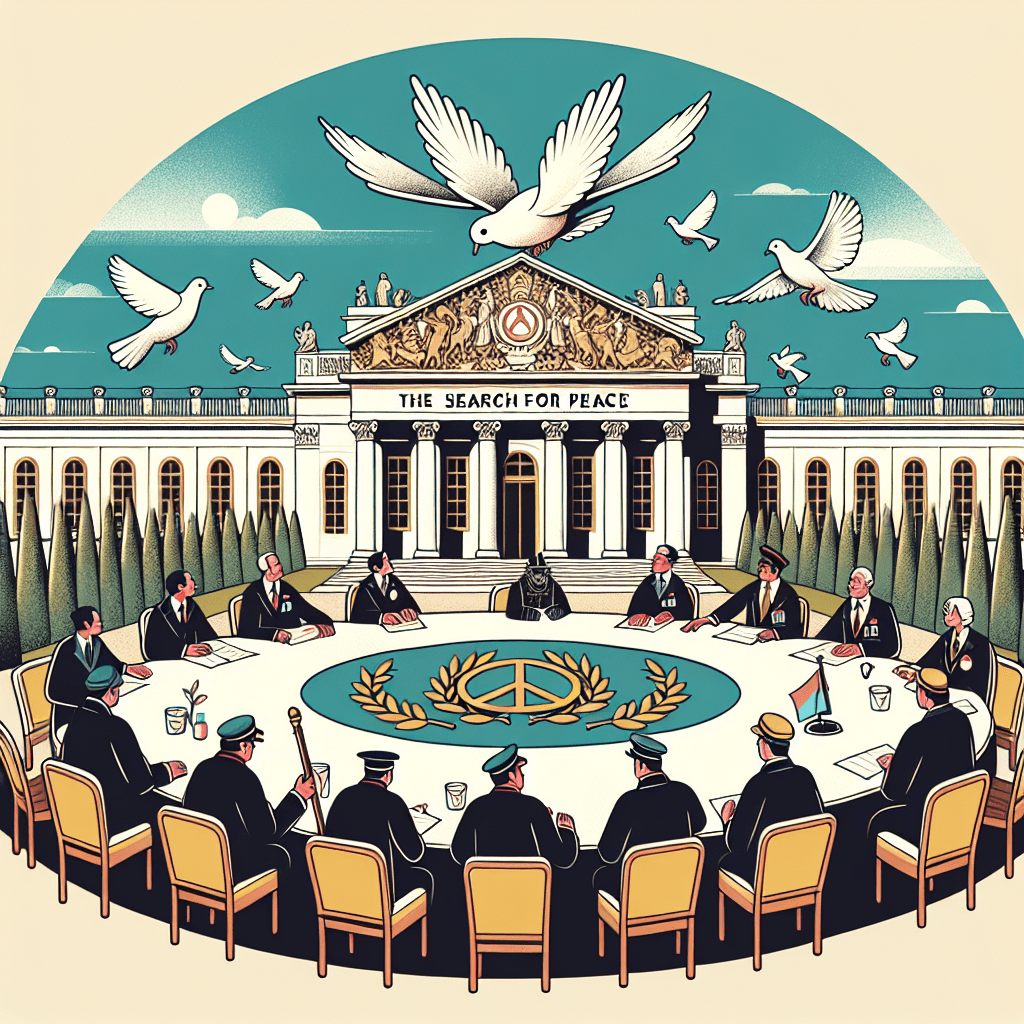
The Search for Peace: Versailles and the League of Nations
Inquiry Framework
Question Framework
Driving Question
The overarching question that guides the entire project.How did the conflicting goals of world leaders after World War I create a peace treaty that failed to prevent future global conflict?Essential Questions
Supporting questions that break down major concepts.- Can a peace treaty actually cause a future war?
- What did the 'Big Four' world leaders want, and why did they disagree on how to end the war?
- How was Woodrow Wilson’s 'Fourteen Points' different from the final Treaty of Versailles?
- Why did the United States decide to stay out of the League of Nations, and how did that change world history?
- Was the Treaty of Versailles a fair deal or a punishment?
Standards & Learning Goals
Learning Goals
By the end of this project, students will be able to:- Students will identify the primary goals of the 'Big Four' world leaders and explain how their conflicting national interests shaped the peace process.
- Students will compare and contrast Woodrow Wilson’s 'Fourteen Points' with the final terms of the Treaty of Versailles to understand the shift from diplomacy to punishment.
- Students will analyze the political and domestic reasons for the United States’ rejection of the League of Nations and evaluate the impact of this isolationism on global politics.
- Students will construct an evidence-based argument regarding whether the Treaty of Versailles was a successful peace settlement or a catalyst for future global conflict.
State History/Social Studies Standards
Common Core State Standards (History/Social Studies)
National Standards for History (MCREL)
Entry Events
Events that will be used to introduce the project to studentsThe Rigged Negotiation Simulation
Students enter a classroom 'divided' where one group is given all the supplies and snacks, while the other is handed a 'bill' for the cost of the room. This experiential simulation mirrors the 'Big Three' negotiations, forcing students to argue for fairness vs. revenge before they ever see the Treaty of Versailles.Portfolio Activities
Portfolio Activities
These activities progressively build towards your learning goals, with each submission contributing to the student's final portfolio.The Big Four Boardroom
Before diving into the documents, students need to understand the 'players' at the table. In this activity, students will assume the persona of one of the 'Big Four' world leaders (Wilson, Lloyd George, Clemenceau, or Orlando). Using simplified profile cards, they will identify what their country lost in the war and what they hope to gain from the peace treaty. This sets the stage for the 'conflicting goals' mentioned in the driving question.Steps
Here is some basic scaffolding to help students complete the activity.Final Product
What students will submit as the final product of the activityA 'Negotiator Profile Card' featuring the leader's photo, three 'Must-Haves' for the treaty, and a 'Mood Meter' indicating how angry or peaceful their nation feels.Alignment
How this activity aligns with the learning objectives & standardsThis activity aligns with standard HS.H3.1 (Explain the aims and negotiating roles of world leaders) and supports the learning goal of identifying the primary goals of the 'Big Four'. It focuses on understanding the diverse motivations—revenge, security, and idealism—behind the peace process.The Bill for the Great War
In this activity, students translate the complex terms of the Treaty of Versailles into a literal 'Bill' for Germany. They will identify the 'Price of War' by looking at the specific costs of reparations, the loss of coal mines (territory), and the reduction of the military. This concrete representation helps students understand the 'reasons for the treaty's failure' by seeing the weight of the burden placed on one nation.Steps
Here is some basic scaffolding to help students complete the activity.Final Product
What students will submit as the final product of the activityA 'War Invoice' for Germany that lists the specific financial, territorial, and military costs dictated by the Treaty.Alignment
How this activity aligns with the learning objectives & standardsThis activity aligns with WH.9-10.7.2 (The terms of the Treaty of Versailles) and CCSS.ELA-LITERACY.RH.9-10.1 (Cite specific textual evidence). It focuses on the specific economic and territorial punishments that later contributed to global instability.The Empty Chair: The U.S. and the League
Students will investigate why the U.S. Senate said 'No' to the League of Nations despite President Wilson’s efforts. Through analyzing a series of political cartoons and a short speech by Henry Cabot Lodge, students will identify the fear of 'foreign entanglements.' They will create a 'Senate Vote' poster that explains the domestic reasons for isolationism and the global effect of the U.S. being absent from the League.Steps
Here is some basic scaffolding to help students complete the activity.Final Product
What students will submit as the final product of the activityA 'Vote No!' or 'Vote Yes!' Campaign Poster that explains one major reason why the U.S. stayed out of the League of Nations.Alignment
How this activity aligns with the learning objectives & standardsThis activity aligns with HS.H3.1 (Causes and effects of the United States’s rejection of the League of Nations) and the goal of evaluating the impact of isolationism. It addresses why the 'solution' to war was rejected by the very country that proposed it.The Verdict: Peace or Powderkeg?
For the final portfolio entry, students will act as 'Historical Critics.' They will answer the driving question: 'Was the Treaty of Versailles a fair deal or a catalyst for future war?' Using the evidence collected in the previous four activities (The Profile, The T-Chart, The Bill, and the Poster), students will write a final verdict or record a 'History Channel' style news report.Steps
Here is some basic scaffolding to help students complete the activity.Final Product
What students will submit as the final product of the activityA 'History Verdict' Report (Written or Video) that uses three pieces of evidence to argue whether the peace treaty succeeded or failed.Alignment
How this activity aligns with the learning objectives & standardsThis activity aligns with the primary driving question and standard WH.9-10.7.2 (Impact of the war on the world). It serves as the cumulative assessment where students cite evidence from all previous activities to form a final argument.Vision vs. Reality: The 14 Points Challenge
Students will compare Woodrow Wilson’s vision for a fair world (The Fourteen Points) against the actual terms forced upon Germany in the Treaty of Versailles. Using a 'Vision vs. Reality' graphic organizer, students will highlight which of Wilson’s ideas were kept and which were thrown away in favor of punishing Germany. This visual comparison helps SPED students see the 'shift from diplomacy to punishment.'Steps
Here is some basic scaffolding to help students complete the activity.Final Product
What students will submit as the final product of the activityA 'Vision vs. Reality' Color-Coded T-Chart showing the differences between the Fourteen Points and the final Treaty terms.Alignment
How this activity aligns with the learning objectives & standardsThis activity aligns with CCSS.ELA-LITERACY.RH.9-10.9 (Compare and contrast treatments of the same topic in primary sources) and HS.H3.1 (Influence of the Treaty of Versailles and Woodrow Wilson’s Fourteen Points). It helps students see the shift from Wilson's 'Peace without Victory' to the harsher reality of the Treaty.Rubric & Reflection
Portfolio Rubric
Grading criteria for assessing the overall project portfolioThe Peace of Versailles & Global Conflict Portfolio Rubric
Historical Content & Analysis
This category evaluates the student's ability to analyze the diverse motivations of world leaders and compare the original peace visions with the final treaty outcomes.Leader Perspectives (Big Four)
Students demonstrate their ability to identify and represent the goals, motivations, and national interests of the 'Big Four' world leaders during the peace negotiations.
Exemplary
4 PointsThe student identifies more than three specific goals for their leader with a deeply insightful 'Mood Meter' and a profile card that perfectly captures the leader's historical motivation and national pressure.
Proficient
3 PointsThe student accurately identifies three specific goals for their leader and completes the 'Mood Meter' and profile card, reflecting a clear understanding of the country's needs.
Developing
2 PointsThe student identifies two goals and partially completes the profile card; the 'Mood Meter' is present but may not fully align with the leader's historical situation.
Beginning
1 PointsThe student identifies one goal or completes an incomplete profile card; the student needs significant support to understand the leader's perspective.
Comparative Analysis (14 Points vs. Treaty)
Students compare Woodrow Wilson’s Fourteen Points with the final Treaty of Versailles to understand the shift from diplomacy to punishment.
Exemplary
4 PointsThe T-chart shows a sophisticated comparison with clear color-coding that distinguishes between multiple vision vs. reality points, including a thoughtful summary of the shift from peace to punishment.
Proficient
3 PointsThe T-chart accurately matches three or more points from both documents using color-coding to show differences between Wilson's vision and the final Treaty.
Developing
2 PointsThe T-chart matches 1-2 points from the documents but the comparison is basic or the color-coding is inconsistent.
Beginning
1 PointsThe student attempts to match points but shows confusion between the two documents; the T-chart is mostly incomplete.
Consequences & Isolationism
This category focuses on the specific terms of the Treaty of Versailles and the subsequent political decisions made by the United States that shaped the interwar period.The Cost of Peace (War Invoice)
Students identify the specific economic, territorial, and military punishments placed on Germany and predict the domestic consequences.
Exemplary
4 PointsThe 'War Invoice' includes specific article numbers (231, 232), detailed territorial losses, and a powerful prediction of Germany's reaction that connects back to the concept of 'War Guilt.'
Proficient
3 PointsThe 'War Invoice' lists specific reparations and at least two territorial/military losses, with a clear sentence predicting how the German people would feel.
Developing
2 PointsThe 'War Invoice' lists general costs but misses specific details; the prediction of Germany's reaction is brief or vague.
Beginning
1 PointsThe student identifies only one cost or punishment and does not provide a prediction of the reaction.
US Isolationism & The League
Students analyze why the United States rejected the League of Nations and evaluate the impact of this decision on global isolationism.
Exemplary
4 PointsThe poster uses a compelling slogan and image that perfectly captures the complex fear of 'foreign entanglements' and explains both the US motive and the global consequence.
Proficient
3 PointsThe poster clearly states one major reason for the U.S. staying out of the League (e.g., isolationism) and uses an appropriate image and slogan.
Developing
2 PointsThe poster mentions the League of Nations but the reason for the 'No' vote is unclear or the slogan does not match the historical context.
Beginning
1 PointsThe poster is incomplete or focuses on a topic unrelated to the U.S. Senate's decision regarding the League of Nations.
Evidence-Based Argumentation
This category assesses the student's ability to use historical evidence to support a claim and draw conclusions about the long-term impact of the peace treaty.The Verdict: Argumentation
Students synthesize information from across the unit to construct a final argument regarding the success or failure of the Treaty of Versailles.
Exemplary
4 PointsThe 'Verdict' provides a sophisticated argument using 4+ pieces of evidence from previous activities, showing a deep understanding of the treaty as a catalyst for future conflict.
Proficient
3 PointsThe 'Verdict' uses three specific pieces of evidence to argue whether the treaty was fair or a 'powderkeg,' following the provided structure.
Developing
2 PointsThe 'Verdict' makes a claim but only uses one or two pieces of evidence; the argument is emerging but lacks full support.
Beginning
1 PointsThe student states an opinion without using evidence from the portfolio activities or does not complete the final report.