
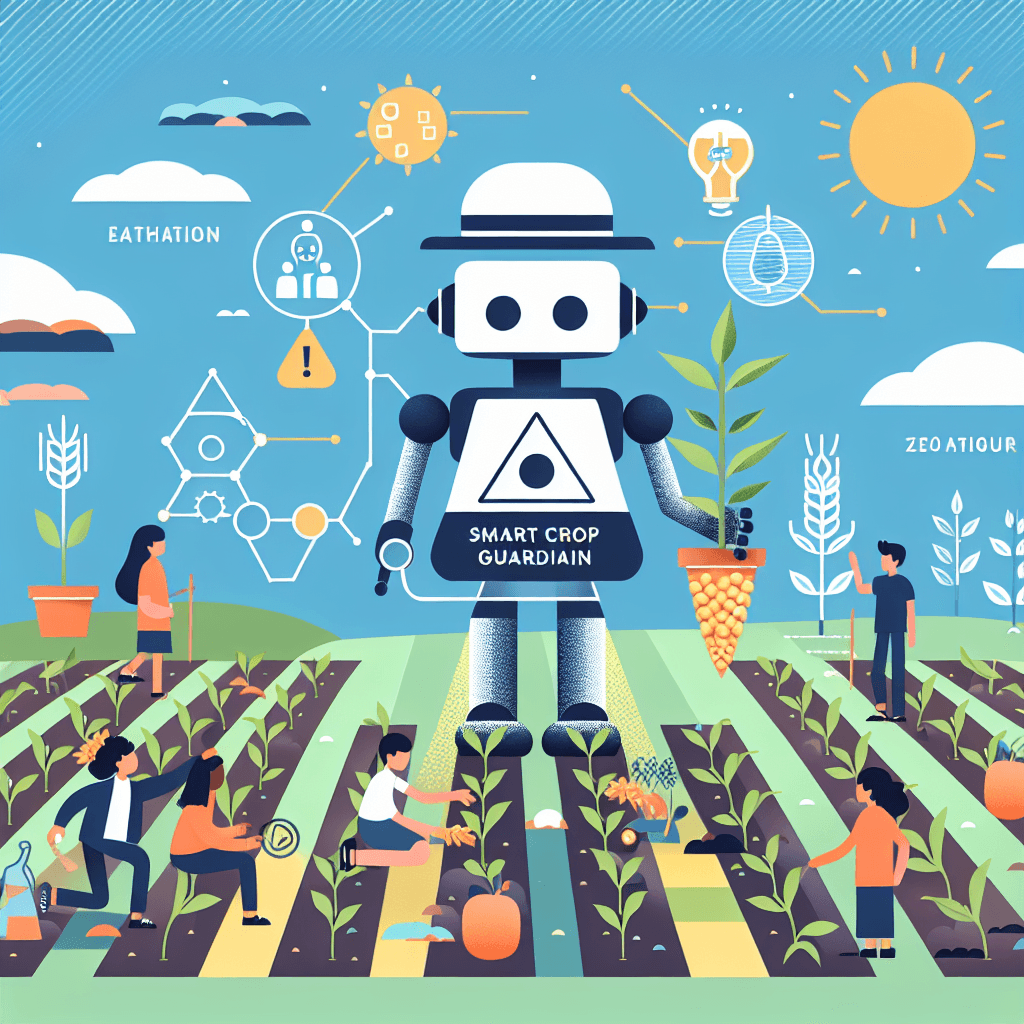
Grade 6: The Smart Crop Guardian: Ethical AI Solutions for Zero Hunger
Inquiry Framework
Question Framework
Driving Question
The overarching question that guides the entire project.How can we, as ethical tech-innovators, use AI to design a 'Smart Crop Guardian' prototype and produce a video that inspires our community to help solve SDG 2: Zero Hunger?Essential Questions
Supporting questions that break down major concepts.- Why does food insecurity persist in our local community, and how does SDG 2 provide a framework for change?
- How can we ethically use AI and climate data to predict which crops will provide the best nutrition in our specific environment?
- How do we use mathematical modeling and design principles to create a physical or digital prototype of a Smart Crop Guardian?
- How can we use digital storytelling and video production to communicate our research-based solution to a global audience?
- In what ways does human empathy and ethical decision-making ensure that AI technology serves everyone fairly in the fight against hunger?
Standards & Learning Goals
Learning Goals
By the end of this project, students will be able to:- Students will analyze local climate data (temperature, rainfall, sunlight) to determine the most suitable nutrient-dense crops for an urban garden environment.
- Students will use AI-powered design tools to generate and optimize garden layouts, demonstrating an understanding of the ethical considerations and limitations of using AI in decision-making.
- Students will apply geometric concepts to calculate area and perimeter to maximize the efficiency and yield of a physical or digital garden prototype.
- Students will evaluate the socio-economic causes of food insecurity in their local community and explain how their project aligns with the United Nations Sustainable Development Goal 2: Zero Hunger.
- Students will conduct a research-based design process to create a functional garden prototype that translates scientific data into a practical agricultural solution.
- Students will produce a persuasive digital video that synthesizes their research, prototype, and ethical findings to advocate for community-based solutions to food insecurity.
UN Sustainable Development Goals (SDGs)
Common Core ELA (Speaking & Listening)
Computer Science Standards
Mathematics
ELA (Writing)
Entry Events
Events that will be used to introduce the project to studentsThe 2030 Broadcast: A Call for Digital Guardians
Students receive a 'glitchy' video transmission from a (fictional) 'Global Food Security Network' in the year 2030. In the video, a digital activist explains that the world successfully reached SDG 2 (Zero Hunger) thanks to young 'Ethical AI Guardians' who documented their inventions. The transmission ends with a call to action: 'We need your story to show the world how technology and empathy saved our food supply.' A local media producer then enters the room to explain that the students' task is to research climate-resilient crops, build a 'Smart Crop Guardian' prototype, and star in a professional-grade advocacy video that proves AI can be used for good.The Ethical AI Film Festival Challenge
An invitation arrives from the 'Global Youth Tech-for-Good Film Festival.' The festival is looking for 6th-grade teams who can solve two problems: 1) Designing an AI-powered urban garden (The Smart Crop Guardian) and 2) Producing a persuasive video that teaches others how to use climate data ethically. Students watch a high-energy trailer for the festival and are told their final 'Smart Crop Guardian' prototype must be the centerpiece of their film. They realize that their research and math-based garden layouts aren't just for a grade—they are the 'script' for a video that could inspire a global audience.Portfolio Activities
Portfolio Activities
These activities progressively build towards your learning goals, with each submission contributing to the student's final portfolio.The Urban Hunger Hunt: Identifying Local Needs
Before designing a solution, students must understand the problem of food insecurity within their own community. In this activity, students investigate local 'food deserts' and the socio-economic barriers that prevent neighbors from accessing nutrient-dense food. They will use digital maps and local news sources to identify areas in need and connect these findings to the UN Sustainable Development Goal 2.Steps
Here is some basic scaffolding to help students complete the activity.Final Product
What students will submit as the final product of the activityA 'Community Food Security Profile' consisting of an annotated digital map and a 1-page summary of local barriers to nutrition.Alignment
How this activity aligns with the learning objectives & standardsAligns with SDG 2: Zero Hunger (understanding food security) and ELA Research Inquiry and Synthesis (conducting research to answer a question).Climate Detectives & Nutrient Heroes
Students act as 'Climate Detectives' to gather local environmental data (average rainfall, sunlight hours, and temperature ranges) for their specific zip code. They then cross-reference this data with a 'Nutrient Hero' database (plant growth charts) to select three high-yield, nutrient-dense crops that are most likely to thrive in their local urban conditions.Steps
Here is some basic scaffolding to help students complete the activity.Final Product
What students will submit as the final product of the activityA 'Crop Suitability Matrix' that matches local climate data points with specific plant requirements.Alignment
How this activity aligns with the learning objectives & standardsAligns with Science: Human Impact on the Environment (monitoring climate variables) and ELA Research Inquiry and Synthesis (drawing on sources).Plotting Productivity: The Geometry of Space
Using the crops selected in the previous activity, students must now design a physical layout for their garden. They will be given a specific urban 'plot' (a complex polygon shape, like an L-shaped rooftop or a triangular vacant lot). Students must calculate the total area and partition the space for their different crops based on required spacing for maximum yield.Steps
Here is some basic scaffolding to help students complete the activity.Final Product
What students will submit as the final product of the activityA scaled geometric blueprint of the garden plot with all area calculations shown and labeled.Alignment
How this activity aligns with the learning objectives & standardsAligns with Mathematics: Area and Geometry (finding area of polygons by composing/decomposing shapes).AI Co-Designer: The Ethical Auditor Lab
In this activity, students will use an AI image generator or a layout optimization tool to suggest improvements to their geometric blueprints. However, they must act as 'Ethical Auditors.' They will compare the AI's suggestions against their own research to see if the AI ignored local climate constraints or prioritized aesthetics over nutrient yield. They will also discuss the ethics of using AI in agriculture (e.g., who owns the data?).Steps
Here is some basic scaffolding to help students complete the activity.Final Product
What students will submit as the final product of the activityAn 'AI Audit Report' featuring the AI-generated layout, a list of corrections made by the student, and a reflection on the ethical use of AI.Alignment
How this activity aligns with the learning objectives & standardsAligns with Computer Science: Ethical Use of Technology (identifying bias and ethical concerns) and SDG 2 (using technology to solve hunger).The Guardian Blueprint: Final Prototype Reveal
Students will combine their research, math, and AI-assisted designs to create a final physical or 3D digital prototype of their 'Smart Crop Guardian.' This guardian is not just a garden; it's a system. The prototype must demonstrate how it uses data to protect crops and maximize yield to help the community achieve Zero Hunger. They will present their 'Guardian' to the Chef from the entry event.Steps
Here is some basic scaffolding to help students complete the activity.Final Product
What students will submit as the final product of the activityA physical 3D model (using recycled materials) or a detailed 3D digital model (using CAD software) of the 'Smart Crop Guardian' garden, accompanied by a pitch presentation.Alignment
How this activity aligns with the learning objectives & standardsAligns with all standards, specifically Research Synthesis and Science (designing a method to minimize environmental impact).Rubric & Reflection
Portfolio Rubric
Grading criteria for assessing the overall project portfolioThe Smart Crop Guardian: AI-Optimized Urban Agriculture & Advocacy Rubric
Integrated Project Performance
This category evaluates the core competencies required to complete the Smart Crop Guardian project, including research, math, science, ethical technology use, and digital communication.Community Research & SDG Alignment
Ability to investigate local food insecurity, identify 'food deserts' using GIS/mapping tools, and connect local findings to the UN Sustainable Development Goal 2: Zero Hunger.
Exemplary
4 PointsDemonstrates sophisticated understanding of local food insecurity; identifies complex socio-economic barriers and provides a comprehensive, highly detailed Community Food Security Profile that draws insightful connections to SDG 2.
Proficient
3 PointsDemonstrates thorough understanding of local food insecurity; identifies clear barriers and provides a complete Community Food Security Profile with direct alignment to SDG 2.
Developing
2 PointsShows emerging understanding of food insecurity; identifies basic barriers but the Community Food Security Profile lacks detail or shows inconsistent alignment with SDG 2 goals.
Beginning
1 PointsShows initial understanding; struggles to identify local barriers or use mapping tools effectively. The connection to SDG 2 is missing or unclear.
Mathematical Precision & Spatial Optimization
Accuracy and precision in calculating the area and perimeter of complex polygons (urban plots) by decomposing them into simpler shapes to maximize agricultural yield.
Exemplary
4 PointsFlawlessly decomposes complex polygons into triangles and quadrilaterals; all area calculations are precise and the layout maximizes every square inch for crop productivity with sophisticated spatial reasoning.
Proficient
3 PointsAccurately decomposes polygons into simpler shapes; area calculations are correct and the layout shows effective use of space for the selected crops.
Developing
2 PointsShows emerging ability to decompose shapes; calculations may contain minor errors or the spatial layout is only partially optimized for crop growth.
Beginning
1 PointsStruggles with geometric decomposition or area formulas; garden layout does not account for specific crop spacing requirements or total area.
Scientific Inquiry & Crop Selection
Effectiveness in synthesizing local climate data (sunlight, rainfall, temperature) with plant biology to select nutrient-dense crops that will thrive in specific urban conditions.
Exemplary
4 PointsProvides a comprehensive Crop Suitability Matrix with exceptional data-backed justification for 'Hero Crops,' showing a deep understanding of the relationship between climate variables and nutrient density.
Proficient
3 PointsProvides a clear Crop Suitability Matrix; selection of 'Hero Crops' is justified by local climate data and addresses the growth requirements of the plants.
Developing
2 PointsInconsistently matches plant needs with climate data; the selection of crops is only partially supported by research or data points.
Beginning
1 PointsMinimal evidence of climate research; crop selection appears random or lacks justification based on local environmental data.
Ethical AI Integration & Auditing
Ability to use AI as a collaborative tool while critically auditing its output for bias, errors, or environmental oversights; demonstrates the 'Human-in-the-Loop' philosophy.
Exemplary
4 PointsDisplays advanced critical thinking by identifying subtle AI errors or biases; provides a profound reflection on the human responsibility in technological decision-making and ethical data usage.
Proficient
3 PointsEffectively audits AI output to identify logical errors (e.g., plants in wrong zones); provides a clear reflection on why human oversight is necessary when using technology.
Developing
2 PointsIdentifies some basic AI errors but the critique lacks depth; reflection on the ethics of AI usage is present but demonstrates only a surface-level understanding.
Beginning
1 PointsUncritically accepts AI-generated designs without auditing; shows limited understanding of the ethical concerns or the role of the 'Human-in-the-Loop.'
Design Innovation & Synthesis (Prototype)
The quality, functionality, and communicative power of the final garden prototype; ability to synthesize all project components into a cohesive physical or digital solution.
Exemplary
4 PointsProduces an outstanding 3D prototype (physical or digital) that seamlessly integrates climate data, math, and AI insights; the design is visionary and clearly demonstrates a viable path to Zero Hunger.
Proficient
3 PointsProduces a high-quality prototype that accurately reflects the research and math from previous steps; the design clearly connects to identified community needs.
Developing
2 PointsThe prototype is functional but lacks detail or fails to represent some data points (e.g., climate or math); the design provides a basic solution but misses key synthesis elements.
Beginning
1 PointsThe prototype is incomplete or disconnected from the research; provides insufficient evidence of how the design solves the problem of urban hunger.
Video Advocacy & Digital Storytelling
Effectiveness in producing a persuasive digital video that synthesizes research, the prototype, and ethical findings to inspire the community and advocate for SDG 2 solutions.
Exemplary
4 PointsProduces a professional-grade advocacy video with a compelling narrative, seamless multimedia integration, and high-quality audio/visuals that powerfully inspire action for Zero Hunger.
Proficient
3 PointsProduces a clear, persuasive video that effectively communicates research and prototype features; includes relevant multimedia components and clear audio/visual delivery.
Developing
2 PointsThe video covers the project components but lacks a cohesive narrative or persuasive edge; technical issues (e.g., audio levels, editing) may distract the audience.
Beginning
1 PointsThe video is incomplete, lacks focus, or fails to synthesize the research and prototype; significant technical issues hinder the communication of the message.