
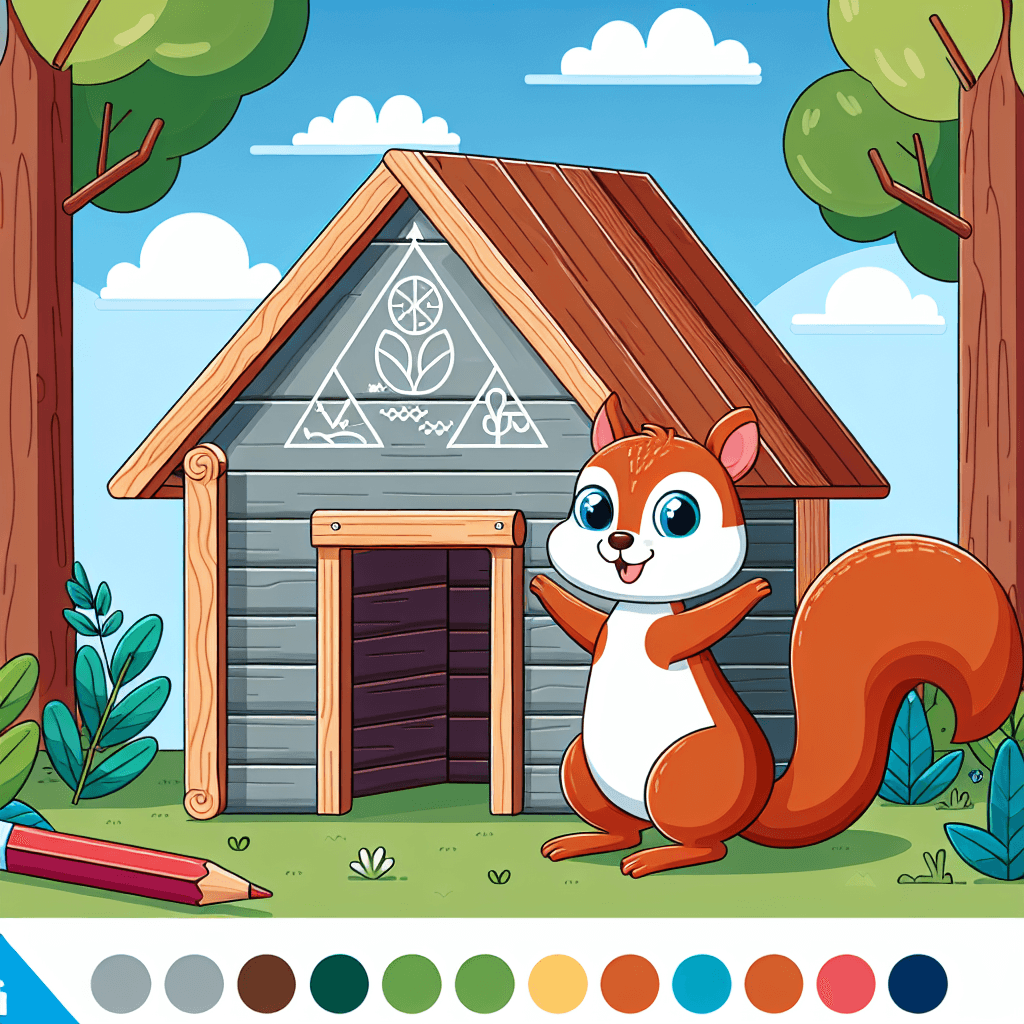
The Squirrel’s Dream Home: Engineering Weather-Proof Shelters
Inquiry Framework
Question Framework
Driving Question
The overarching question that guides the entire project.How can we design and build the best 'dream home' to keep our neighborhood animal friends safe and dry when the weather changes?Essential Questions
Supporting questions that break down major concepts.- What do the animals in our neighborhood need to stay safe and comfortable?
- How does weather like rain, wind, or cold change how an animal lives?
- Which materials work best to keep water out and keep a home dry?
- How can we use a model to show others how our 'Dream Home' solves a problem?
- How does listening to our friends' ideas help us make our own designs better?
Standards & Learning Goals
Learning Goals
By the end of this project, students will be able to:- Identify and describe the basic survival needs of local animals, specifically focusing on the requirement for shelter and protection.
- Observe and analyze how different weather conditions (rain, wind, heat, cold) impact the daily lives and habitats of local wildlife.
- Test and select materials based on their physical properties—such as strength and water resistance—to solve a specific design challenge.
- Construct a physical model of a 'dream home' that serves as a functional weather-proof shelter for a chosen animal.
- Communicate design choices and scientific findings through oral presentation and modeling, while practicing active listening and providing respectful feedback to peers.
Texas Essential Knowledge and Skills (TEKS)
Next Generation Science Standards (NGSS)
Common Core State Standards (ELA)
Entry Events
Events that will be used to introduce the project to studentsThe Case of the Soggy Suitcase
Students arrive to find a 'lost suitcase' belonging to Sammy the Squirrel, filled with soggy leaves, twigs, and a damp letter. The letter explains that Sammy’s home was destroyed in a rainstorm, and he needs 'Expert Human Engineers' to help him understand which materials will actually keep him dry next time.Portfolio Activities
Portfolio Activities
These activities progressively build towards your learning goals, with each submission contributing to the student's final portfolio.The Habitat Detective Safari
Before students can build a home, they must understand why animals need them. In this activity, students become 'Habitat Detectives' to observe where local animals live and how the weather might affect those spots. They will look for nests, burrows, or holes in trees and discuss how a rainy or windy day would feel in those locations.Steps
Here is some basic scaffolding to help students complete the activity.Final Product
What students will submit as the final product of the activityA 'Habitat Detective' Field Journal page featuring a drawing of a local animal and its current shelter, with a 'Weather Warning' section showing a weather condition (like rain) that might cause trouble for that home.Alignment
How this activity aligns with the learning objectives & standardsThis activity aligns with TEKS Sci K.1.12(B) (Identify basic needs of animals) and NGSS K-ESS3-1 (Use a model to represent the relationship between needs and habitat). It focuses on identifying that animals need shelter specifically to stay safe from environmental elements.The Splatter Lab: Water-Proof Wonders
To help Sammy the Squirrel, students must act as Material Scientists. They will test different materials (felt, aluminum foil, cardboard, plastic wrap, leaves) to see which ones are 'waterproof' and which are 'absorbent.' This data will help them decide what to use for their final shelter model.Steps
Here is some basic scaffolding to help students complete the activity.Final Product
What students will submit as the final product of the activityA 'Keep It Dry' Data Chart where students have glued samples of materials under two categories: 'Soggy' or 'Dry.'Alignment
How this activity aligns with the learning objectives & standardsThis activity aligns with TEKS Sci K.1.4(A) (develop explanations supported by data) and NGSS K-2-ETS1-2 (illustrate how the shape/material of an object helps it function). It introduces the scientific practice of testing hypotheses and gathering data to inform engineering choices.Blueprint & Build: The Dream Home Construction
Now it's time to build! Using their data from the Splatter Lab, students will design and construct a 3D model of a 'Dream Home' for Sammy the Squirrel (or another local animal). They must ensure the home has a roof that keeps the inside dry and a sturdy base.Steps
Here is some basic scaffolding to help students complete the activity.Final Product
What students will submit as the final product of the activityA 3D weather-proof shelter model built from recycled materials and 'tested' materials, accompanied by a 'Blueprint' drawing that labels the parts of the home.Alignment
How this activity aligns with the learning objectives & standardsThis activity aligns with NGSS K-2-ETS1-2 (Physical model to solve a problem) and TEKS Sci K.1.4(A) (Propose solutions supported by models). It requires students to apply their previous knowledge of animal needs and material properties to a creative engineering task.The Architect’s Gallery Walk & Talk
In the final stage, students present their models to the 'Council of Engineers' (their classmates). They explain why they chose certain materials and how their design solves Sammy’s problem. Classmates practice active listening by asking specific questions about the design's effectiveness.Steps
Here is some basic scaffolding to help students complete the activity.Final Product
What students will submit as the final product of the activityA 'Building Inspector's Report' (a simple rubric/checklist) where peers provide a 'Star' (something they liked) and a 'Wish' (something to try next time) for the designer.Alignment
How this activity aligns with the learning objectives & standardsThis activity aligns with TEKS Sci K.1.4(B-C) (Communicate solutions and listen actively to identify evidence) and CCSS.ELA-LITERACY.SL.K.1 (Participate in collaborative conversations). It focuses on the importance of scientific communication and peer feedback.Rubric & Reflection
Portfolio Rubric
Grading criteria for assessing the overall project portfolioThe Squirrel's Dream Home: Weather-Proof Engineering Rubric
Scientific Inquiry & Observation
Focuses on the student's ability to act as a 'Habitat Detective' and connect biological needs to environmental challenges.Habitat Observation & Weather Impact
Demonstrates an understanding of what local animals need to survive and how weather conditions like rain or wind impact their safety and habitat.
Exemplary
4 PointsStudent identifies multiple animal needs and provides a sophisticated explanation of how specific weather (rain/wind) changes an animal's life, using detailed evidence from their Nature Walk.
Proficient
3 PointsStudent correctly identifies basic animal needs and explains how a specific weather condition (like rain) would affect a chosen animal's current shelter.
Developing
2 PointsStudent identifies at least one animal need and observes a habitat, but struggles to explain the direct impact of weather on that animal's safety.
Beginning
1 PointsStudent identifies an animal or habitat with significant teacher support but cannot yet describe how weather impacts animal survival.
Data-Driven Engineering
Assesses how students use scientific testing and data to inform their engineering decisions.Evidence-Based Material Selection
Uses data from the 'Splatter Lab' to select materials that are waterproof and appropriate for building a dry shelter.
Exemplary
4 PointsStudent makes accurate predictions, analyzes lab results to categorize all materials correctly, and provides a clear reason why 'dry' materials are superior for the roof.
Proficient
3 PointsStudent uses the 'Keep It Dry' chart to select materials that passed the water test and uses them for the roof of their model.
Developing
2 PointsStudent identifies some waterproof materials but may include 'soggy' materials in critical areas of their model (like the roof) despite lab results.
Beginning
1 PointsStudent selects materials for the model randomly without referencing the data gathered during the Splatter Lab.
Design & Modeling
Evaluates the student's ability to translate a plan (blueprint) into a functional 3D solution.Model Construction & Functionality
Creation of a 3D shelter model and a corresponding blueprint that illustrates the function of keeping an animal dry.
Exemplary
4 PointsModel is exceptionally sturdy, follows the blueprint exactly, and features innovative design elements (like a slanted roof or overhang) to enhance weather protection.
Proficient
3 PointsModel is functional, clearly resembles the blueprint, and successfully protects the 'paper squirrel' during the rain test using chosen materials.
Developing
2 PointsModel is constructed but may not match the blueprint, or has structural gaps that would allow 'weather' to enter the home.
Beginning
1 PointsModel is incomplete or unable to stand on its own, and does not demonstrate a clear solution for keeping the animal dry.
Communication & Collaboration
Assesses oral presentation skills, use of evidence in explanations, and collaborative social skills.Scientific Communication & Feedback
Ability to explain design choices using evidence and engage in respectful, active listening with peers during the Gallery Walk.
Exemplary
4 PointsStudent explains choices using scientific terms ('waterproof,' 'absorbent'), asks insightful questions of peers, and offers specific, helpful feedback (Stars/Wishes).
Proficient
3 PointsStudent clearly explains their material choices based on lab results and listens to others, providing a basic 'Star' and 'Wish' for classmates.
Developing
2 PointsStudent describes their home but needs prompting to explain 'why' they chose certain materials; participates in peer discussion with support.
Beginning
1 PointsStudent struggles to communicate their design choices to the group and does not yet engage in active listening or feedback with peers.