
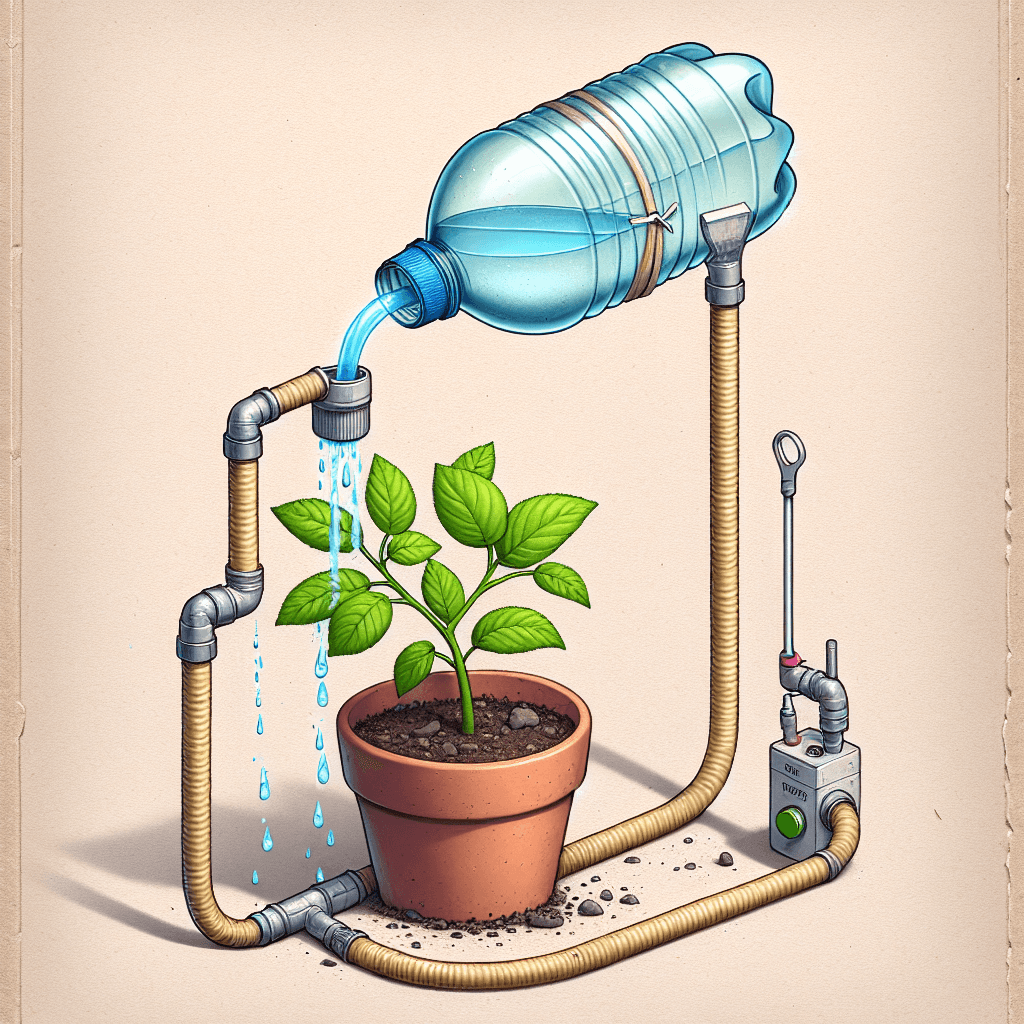
The Thirsty Plant Solution: Recycled Gravity-Fed Water Systems
Inquiry Framework
Question Framework
Driving Question
The overarching question that guides the entire project.How can we, as solution seekers, design a gravity-powered system using recycled materials to ensure our indoor plants get the water they need to thrive?Essential Questions
Supporting questions that break down major concepts.- What do plants specifically need to survive, and how can we tell if those needs are being met?
- How does gravity affect the way water moves from one place to another?
- Which properties of different recycled materials (plastic, cardboard, metal) make them good or bad for holding and moving water?
- How can we use the engineering design process to test, fail, and improve our watering systems?
- What does it mean to be a 'solution seeker' when faced with a problem like thirsty plants or plastic waste?
Standards & Learning Goals
Learning Goals
By the end of this project, students will be able to:- Students will identify the essential needs of plants (water, air, light) and explain how a lack of water affects a plant's ability to thrive.
- Students will demonstrate an understanding of gravity by designing a system that moves water from a higher reservoir to a lower plant container without mechanical pumps.
- Students will evaluate the physical properties of recycled materials (e.g., plastic, cardboard, metal) to determine their suitability for holding or transporting water.
- Students will apply the Engineering Design Process (EDP) to brainstorm, build, test, and refine a prototype of a self-watering system.
- Students will demonstrate the 'Solution Seeker' mindset by documenting their failures during the testing phase and explaining how they iterated on their design to find a solution.
Next Generation Science Standards (NGSS)
Teacher-Defined Competencies
Entry Events
Events that will be used to introduce the project to studentsThe Case of the Parched Pothos
Students enter to find a 'Crime Scene' tape around a wilted, dry plant on the teacher’s desk. They are handed a 'Detective Case File' explaining that the plant 'died' of thirst over the weekend, and their mission as Solution Seekers is to engineer a life-support system that works even when humans aren't in the building.Portfolio Activities
Portfolio Activities
These activities progressively build towards your learning goals, with each submission contributing to the student's final portfolio.The Plant Detective Case Brief
In this opening activity, students transform into 'Plant Detectives' to investigate why the Pothos plant on the teacher's desk 'died.' They will research the basic needs of plants and officially define the problem they need to solve to prevent this from happening again.Steps
Here is some basic scaffolding to help students complete the activity.Final Product
What students will submit as the final product of the activityA 'Case Brief' document that includes a list of plant needs, a drawing of the 'crime scene,' and a formal problem statement.Alignment
How this activity aligns with the learning objectives & standardsAligns with NGSS 3-LS4-3 (Environmental conditions for survival) and 3-5-ETS1-1 (Defining a simple design problem). It requires students to state exactly what the 'parched pothos' needs to survive and what constraints (recycled materials, no pumps) they must work within.The Gravity & Material Gauntlet
Before building, students must understand their 'tools.' In this lab, students test different recycled materials (plastic bottles, cardboard tubes, aluminum foil, yogurt cups) to see which hold water, which leak, and how water travels downhill.Steps
Here is some basic scaffolding to help students complete the activity.Final Product
What students will submit as the final product of the activityA 'Material Power-Up' Chart that categorizes recycled items by their waterproofness and flow-ability.Alignment
How this activity aligns with the learning objectives & standardsAligns with Learning Goals regarding the physical properties of materials and the force of gravity. It also supports 3-5-ETS1-2 by helping students understand which materials will meet the project's criteria.The Blueprint Battle
Now that students know their materials and the power of gravity, they must brainstorm two different ways to move water from a reservoir to a plant. They will sketch these ideas and compare them to see which is more likely to work.Steps
Here is some basic scaffolding to help students complete the activity.Final Product
What students will submit as the final product of the activityA 'Double-Design Blueprint' showing two labeled invention ideas with a short explanation of why one was chosen for the build phase.Alignment
How this activity aligns with the learning objectives & standardsAligns with 3-5-ETS1-2 (Generate and compare multiple possible solutions). Students must think critically about how to apply their knowledge of gravity to a physical design.The 'Leak Lab' & Iteration Log
Students build their chosen design and put it to the test! In this activity, 'failure' is expected. Students will run water through their system, find where it leaks or clogs, and document how they will fix it.Steps
Here is some basic scaffolding to help students complete the activity.Final Product
What students will submit as the final product of the activityA 'Failure & Fix-It' Log that shows a photo/drawing of a problem and the specific engineering change made to solve it.Alignment
How this activity aligns with the learning objectives & standardsAligns with 3-5-ETS1-3 (Plan and carry out fair tests and identify failure points). This is where students engage deeply with the 'Solution Seeker' mindset by embracing mistakes.The Solution Seeker’s Showcase
To conclude the project, students present their working (or improved) self-watering systems. They must explain the science of how it works and, more importantly, share the story of how they overcame a challenge during the process.Steps
Here is some basic scaffolding to help students complete the activity.Final Product
What students will submit as the final product of the activityA 'Solution Seeker' Video Pitch or Poster that showcases the final product and the journey of trial and error.Alignment
How this activity aligns with the learning objectives & standardsAligns with Teacher-Defined Competency SS-01 (I am a solution seeker) and 3-5-ETS1-3. It focuses on the resilience and communication aspect of the engineering process.Rubric & Reflection
Portfolio Rubric
Grading criteria for assessing the overall project portfolioThe Thirsty-Plant Solution: Engineering & Mindset Rubric
Scientific Investigation & Problem Setup
Focuses on the initial research, identification of biological needs, and physical science properties required for the project.Problem Definition & Constraints (3-5-ETS1-1)
Ability to define a design problem based on the needs of a plant while identifying specific constraints (gravity, recycled materials).
Exemplary
4 PointsIndependently identifies all plant needs, creates a vivid drawing of the scene, and writes a highly specific problem statement that clearly integrates all constraints.
Proficient
3 PointsIdentifies the main plant needs and writes a clear problem statement that mentions gravity and recycled materials.
Developing
2 PointsIdentifies some plant needs; problem statement is present but may miss specific constraints like gravity or the use of recycled materials.
Beginning
1 PointsProvides a vague or incomplete problem statement; requires significant teacher support to identify plant needs or constraints.
Science Foundations: Materials & Gravity
Demonstrates understanding of how physical properties of materials (waterproofness) and the force of gravity (flow-ability) affect the movement of water.
Exemplary
4 PointsProvides deep analysis of materials, predicting how properties like texture or shape affect flow, and uses gravity data to optimize the 'slide' angle perfectly.
Proficient
3 PointsCorrectly identifies which materials are waterproof and demonstrates how the angle of a slide moves water using gravity.
Developing
2 PointsAttempts to test materials but results may be inconsistent; shows basic understanding that water moves down but struggles to explain why.
Beginning
1 PointsCompletes lab stations but cannot explain the connection between material choice, gravity, and water movement.
Design & Planning
Assesses the brainstorming and planning phase of the engineering design process.Design Comparison (3-5-ETS1-2)
Generating and comparing two distinct design ideas based on their likely effectiveness within the project constraints.
Exemplary
4 PointsDevelops two distinct, highly detailed blueprints with clear labels and a sophisticated pros/cons comparison that references specific material properties.
Proficient
3 PointsCreates two different sketches with labels and provides a logical reason for choosing one design over the other.
Developing
2 PointsDrafts two designs that are very similar; the comparison of 'pros and cons' is present but lacks detail or clear reasoning.
Beginning
1 PointsDrafts only one design or two incomplete sketches; provides little to no justification for the choice of design.
Engineering & Testing
Evaluates the hands-on testing, refinement, and technical problem-solving during the building phase.Iteration & Failure Analysis (3-5-ETS1-3)
Identifying specific failure points during testing and applying engineering changes to improve the system.
Exemplary
4 PointsIdentifies multiple subtle failure points (e.g., slow leaks, evaporation) and implements innovative 'fixes' that significantly improve performance.
Proficient
3 PointsClearly identifies a failure point (e.g., a leak or clog) and documents a specific change made to the design to solve it.
Developing
2 PointsIdentifies a problem but the 'fix' is ineffective or does not address the root cause of the failure.
Beginning
1 PointsObserves that the system does not work but cannot identify a specific reason why or how to fix it without constant guidance.
Reflection & Communication
Assesses the student's ability to reflect on their learning journey and communicate their results effectively.The 'Solution Seeker' Mindset (SS-01)
Demonstrates resilience and a growth mindset by reflecting on challenges and communicating the iterative journey.
Exemplary
4 PointsArticulates a sophisticated reflection on failure as a learning tool; presentation is exceptionally clear and inspires others to seek solutions.
Proficient
3 PointsDescribes the challenges faced and how they were overcome; clearly explains how the final system uses gravity and recycled materials.
Developing
2 PointsDescribes the final product but provides limited reflection on the 'Solution Seeker' process or the challenges faced.
Beginning
1 PointsPresentation is incomplete or fails to address how challenges were handled during the project.