
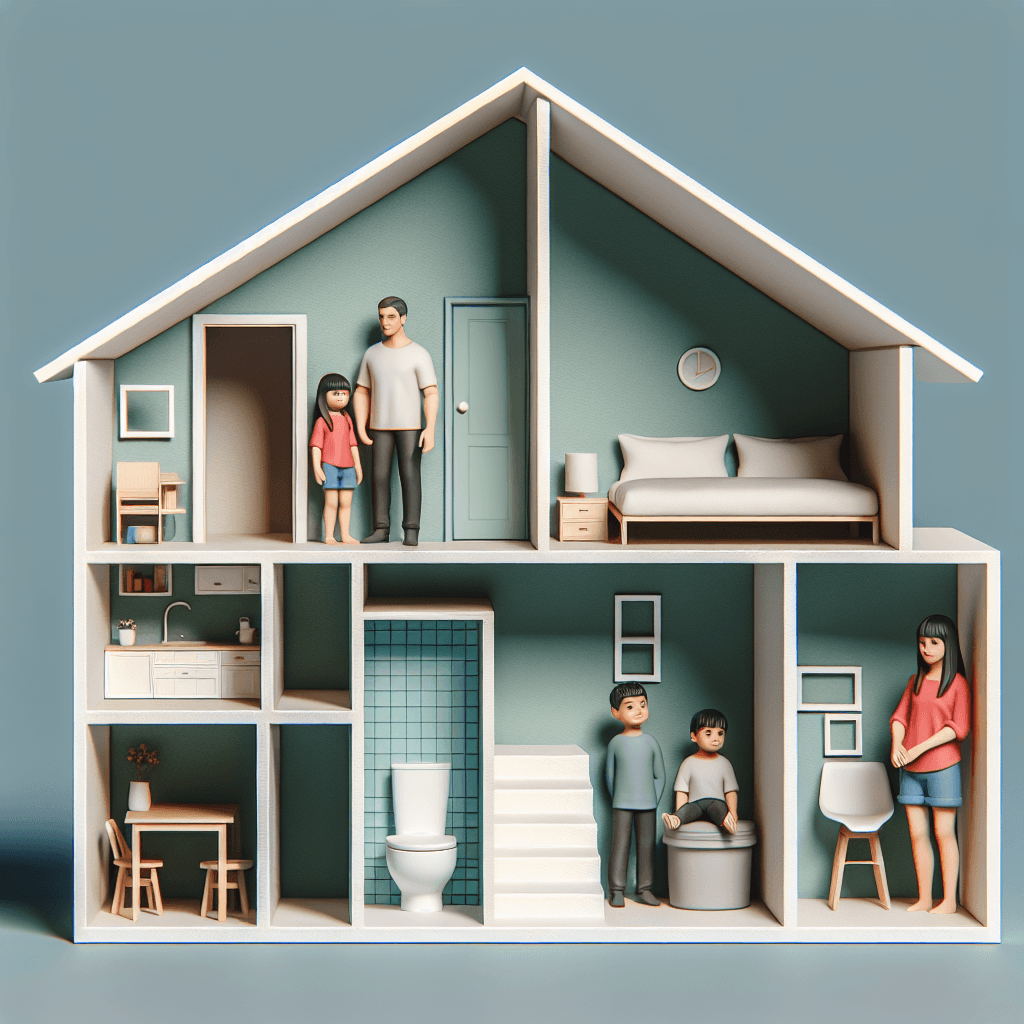
The Tiny House Pivot: Calculating Volume for Growing Families
Inquiry Framework
Question Framework
Driving Question
The overarching question that guides the entire project.How can we, as adaptable designers, use the mathematics of additive volume to create a tiny house that reconfigures and grows along with its family's needs?Essential Questions
Supporting questions that break down major concepts.- How can we use volume to determine if a living space is functional for a specific number of people?
- How does the total volume of a home change when we add or reconfigure rectangular rooms (additive volume)?
- In what ways can a designer change the dimensions (length, width, or height) of a space to solve the problem of a growing family?
- How does being an adaptable learner help us find creative solutions when our initial design no longer meets a client's needs?
- What is the relationship between the physical size of a house and the needs of the people living inside it?
Standards & Learning Goals
Learning Goals
By the end of this project, students will be able to:- Calculate the volume of right rectangular prisms using the formulas V = l x w x h and V = b x h in the context of designing tiny house rooms.
- Apply the concept of additive volume to determine the total living space of a multi-room tiny house by summing the volumes of individual rectangular sections.
- Analyze and modify architectural designs to solve spatial problems, specifically adjusting dimensions to increase volume for a growing family.
- Communicate design decisions and mathematical reasoning through a "Pivot Protocol" presentation that explains how the house reconfigures.
- Demonstrate adaptability by iterating on initial designs in response to changing project constraints and client needs.
Common Core State Standards (Math)
P21 Framework for 21st Century Learning / Teacher Specified
ISTE Standards for Students
Common Core State Standards (Math Practices)
Entry Events
Events that will be used to introduce the project to studentsThe 'Upward Bound' Floor Tape Challenge
Students enter to find a 3D floor plan taped on the ground, but half the 'furniture' is stacked in the hallway. A video message from a frantic client explains their family just doubled in size, and they need to 'build up, not out' within the same footprint. Students must use 'Volume Blocks' to prove how vertical space can save the family's home.Portfolio Activities
Portfolio Activities
These activities progressively build towards your learning goals, with each submission contributing to the student's final portfolio.Foundation First: The Core Module Design
In this introductory activity, students act as lead architects to design the 'Core Module' of their tiny house. They must decide on the initial dimensions for a single rectangular prism room that serves as the foundation of the home. Students will practice using volume formulas to ensure their base meets the minimum living requirements for a single inhabitant.Steps
Here is some basic scaffolding to help students complete the activity.Final Product
What students will submit as the final product of the activityAn 'Architect's Base Sketch' featuring a labeled diagram of the core room with length, width, and height, accompanied by a calculation sheet showing the volume in cubic units.Alignment
How this activity aligns with the learning objectives & standardsAligns with CCSS.MATH.CONTENT.5.MD.C.5.B (Apply formulas V = l x w x h and V = b x h) and ISTE 1.4.a (Deliberate design process).The Additive Addition: Expanding the Footprint
The client has requested a expansion! Students must now add a second, non-overlapping rectangular prism (e.g., a bathroom or a kitchen nook) to their core module. This activity introduces the concept of additive volume, requiring students to calculate the volume of two separate parts and combine them to find the total living space of the growing home.Steps
Here is some basic scaffolding to help students complete the activity.Final Product
What students will submit as the final product of the activityA 3D 'Composite Model' (built with blocks or digital software) and an 'Additive Volume Report' showing the sum of the two room volumes.Alignment
How this activity aligns with the learning objectives & standardsAligns with CCSS.MATH.CONTENT.5.MD.C.5.C (Recognize volume as additive) and CCSS.MATH.PRACTICE.MP1 (Make sense of problems and persevere).The Pivot Protocol: Vertical Growth Challenge
Disaster strikes! The family size has doubled, but the local zoning laws say the house cannot get any wider. Students must 'pivot' their design vertically. This activity challenges students to reconfigure their previous prisms or add a third 'loft' level to accommodate more people within the same ground footprint. They must demonstrate flexibility as they scrap parts of their old design to meet new constraints.Steps
Here is some basic scaffolding to help students complete the activity.Final Product
What students will submit as the final product of the activityThe 'Pivot Protocol Blueprint'—a before-and-after comparison showing how the house was reconfigured to increase volume vertically, including a written reflection on how they adapted to the new constraints.Alignment
How this activity aligns with the learning objectives & standardsAligns with P21.LSI.1.1.A (I am an adaptable learner) and CCSS.MATH.CONTENT.5.MD.C.5.C (Solving real-world problems with additive volume).The Adaptable Architect's Grand Opening
To conclude the project, students prepare a professional pitch for their client. They must explain not only the final volume of the home but also the 'story of the design'—how they adapted when the family grew. This activity focuses on communicating mathematical logic and the design thinking process.Steps
Here is some basic scaffolding to help students complete the activity.Final Product
What students will submit as the final product of the activityA 'Grand Opening' Presentation (Slide deck or Video) showcasing the final 3D model, the volume calculations, and the 'Adaptability Log.'Alignment
How this activity aligns with the learning objectives & standardsAligns with CCSS.MATH.PRACTICE.MP1 (Communicate mathematical reasoning) and P21.LSI.1.1.A (Incorporate feedback and negotiate solutions).Rubric & Reflection
Portfolio Rubric
Grading criteria for assessing the overall project portfolioTiny House: Pivot Protocol Volume & Adaptability Rubric
Mathematical Calculation & Geometric Modeling
This category assesses the student's ability to accurately apply 5th-grade geometric measurement standards to their architectural designs.Volume Formula Mastery (5.MD.C.5.B)
Application of the formulas V = l x w x h and V = B x h to find volumes of right rectangular prisms with whole-number edge lengths.
Exemplary
4 PointsCalculations for all prisms (Core, Addition, and Loft) are 100% accurate. Student consistently uses both V = l x w x h and V = B x h to verify results, showing a sophisticated understanding of the relationship between base area and volume.
Proficient
3 PointsCalculations for all prisms are accurate using at least one formula correctly. The volume of the core module and additions are clearly calculated with correct units.
Developing
2 PointsCalculations are mostly accurate, but may contain minor errors in multiplication or inconsistent use of units. Student may struggle to apply the V = B x h formula.
Beginning
1 PointsCalculations are incomplete or contain significant errors. There is little to no evidence of correct formula application.
Additive Volume Integration (5.MD.C.5.C)
Ability to find the volumes of solid figures composed of non-overlapping right rectangular prisms by adding the volumes of the parts.
Exemplary
4 PointsDemonstrates advanced mastery by accurately calculating total volume for three or more complex, non-overlapping prisms. Clearly labels each part and provides a seamless mathematical 'story' of the home's expansion.
Proficient
3 PointsAccurately calculates the total volume of the home by adding the core module and subsequent additions. Correctly identifies prisms as non-overlapping.
Developing
2 PointsAttempts to add volumes of different rooms but may include overlapping sections or make errors in the summation process.
Beginning
1 PointsFails to recognize volume as additive or provides a total volume that does not correspond to the sum of the individual parts.
The Adaptable Learner (Competency) Outreach
This category evaluates the student's ability to pivot their thinking and maintain a positive, flexible approach to problem-solving.Adaptability & Redesign (P21 Adaptable Learner)
The ability to modify a design in response to new constraints (the 'Pivot') and handle setbacks positively.
Exemplary
4 PointsDemonstrates exceptional flexibility. When faced with the vertical growth constraint, the student innovated beyond the basic requirement, creating a sophisticated loft or multi-level solution that maximizes space while documenting the 'pivot' with deep insight.
Proficient
3 PointsIncorporate feedback and constraints effectively. Successfully reconfigured the house design to grow vertically when the 'Pivot Protocol' was introduced, moving from a horizontal to a vertical mindset.
Developing
2 PointsShows emerging adaptability. Attempted to change the design but may have struggled to let go of the original plan or only partially met the 'build up, not out' constraint.
Beginning
1 PointsStruggles to adapt to new constraints. The design remains largely unchanged from the initial phase despite the new client requirements and zoning laws.
Metacognitive Reflection (Growth Mindset)
Reflection on the learning process, specifically how the student navigated challenges and changed their thinking.
Exemplary
4 PointsReflection provides a profound analysis of the student's growth. Identifies specific moments of frustration and the exact strategy used to overcome them, showing a high level of metacognition.
Proficient
3 PointsReflection clearly describes how the student handled the 'pivot'. Mentions specific changes made to the design and a positive approach to the design challenge.
Developing
2 PointsReflection is brief or generic. Mentions that changes were made but does not explain the student's internal process for dealing with the setback.
Beginning
1 PointsReflection is missing or does not address the concept of being an adaptable learner.
Architectural Communication & Process
This category focuses on the student's ability to communicate their mathematical and architectural findings to an audience.Communication of Design Logic (MP1)
The clarity and logic used to present the final design, calculations, and the 'story' of the pivot.
Exemplary
4 PointsThe pitch is professional and highly persuasive. Uses precise mathematical vocabulary and innovative visuals (charts/graphs) to tell the story of the home’s evolution. Data visualization is used to make the volume growth clear.
Proficient
3 PointsPresents a clear 'Grand Opening' pitch. Includes all required elements: 3D model, volume calculations, and the Adaptability Log. Explanations of design choices are logical.
Developing
2 PointsThe presentation is organized but may lack clarity in some areas. Some mathematical reasoning is missing, or the connection between the model and the volume data is weak.
Beginning
1 PointsThe presentation is disorganized or incomplete. It is difficult to understand how the house reconfigured or how the volume was calculated.
Design Process & Blueprinting (ISTE 1.4.a)
Using a deliberate process for generating ideas, prototyping, and solving authentic problems.
Exemplary
4 PointsThe 'Pivot Protocol Blueprint' shows a highly detailed before-and-after comparison. The design process is evident through multiple iterations and clear labeling of dimensions.
Proficient
3 PointsThe blueprint and model show a clear design process. The student followed the steps from core module to additive expansion to vertical pivot in a logical sequence.
Developing
2 PointsThere is some evidence of a design process, but the final product may not clearly reflect the transition from the core module to the vertical pivot.
Beginning
1 PointsMinimal evidence of a design process. The final product appears rushed or does not follow the constraints established in the project steps.