
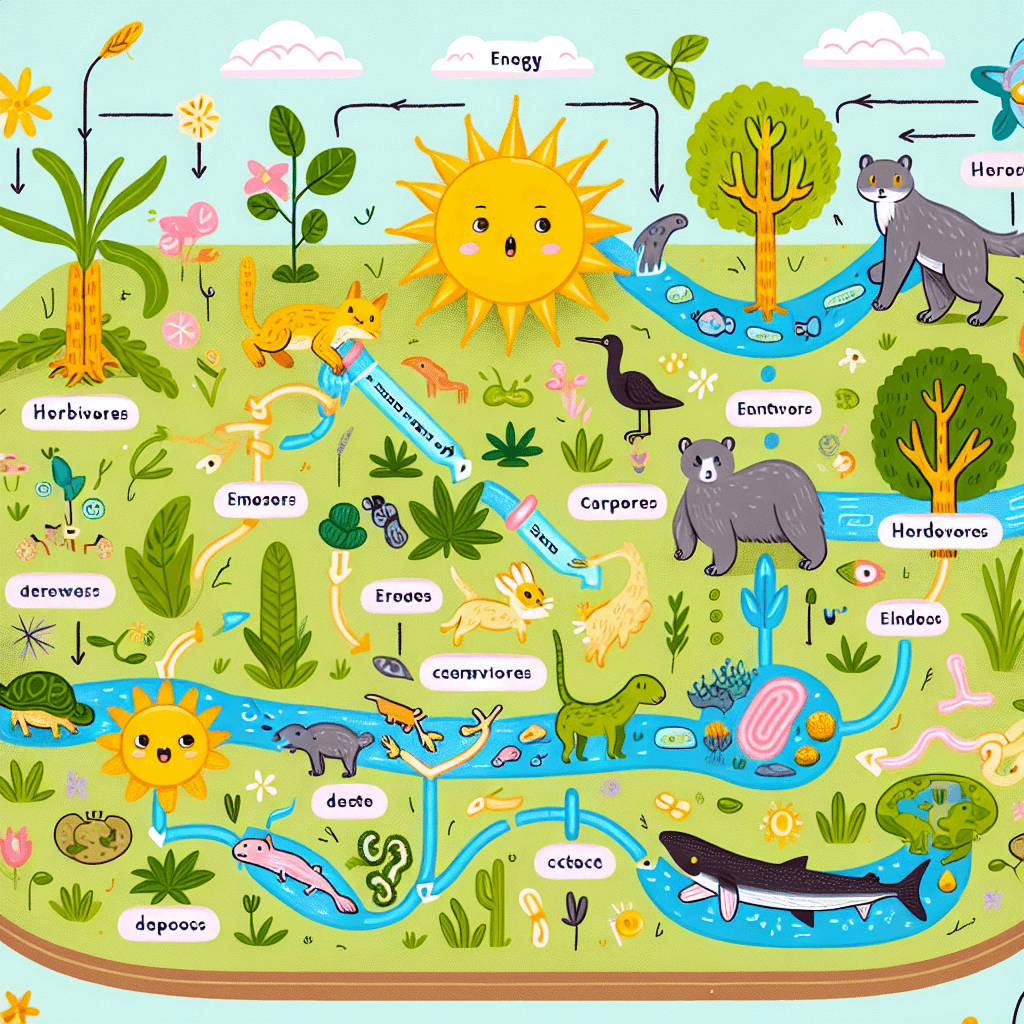
The Web of Life: Modeling Energy and Matter Flow
Inquiry Framework
Question Framework
Driving Question
The overarching question that guides the entire project.How can we, as ecological consultants, design a model of a local food web to predict how specific environmental changes will impact the delicate balance between the flow of energy and the cycling of matter?Essential Questions
Supporting questions that break down major concepts.- How does energy from the sun eventually reach an apex predator, and what is lost along the way?
- In what ways do decomposers act as the 'recyclers' of an ecosystem to ensure matter is never wasted?
- How can we use a food web model to predict the consequences of removing a single 'key' species from an environment?
- Why is the flow of energy considered a one-way street while the movement of matter is considered a cycle?
- How do non-living factors (like sunlight, water, and soil) dictate which living organisms can thrive in a specific food web?
Standards & Learning Goals
Learning Goals
By the end of this project, students will be able to:- Develop a comprehensive model of a local food web that illustrates the specific relationships between producers, consumers, and decomposers.
- Explain the fundamental difference between the one-way flow of energy and the cyclical movement of matter within an ecosystem.
- Predict the specific ecological consequences and cascading effects of environmental changes or the removal of a keystone species using a food web model.
- Analyze the role of abiotic factors (sunlight, soil, water) in dictating the structure and health of a specific food web.
- Communicate scientific findings as 'ecological consultants' by presenting evidence-based predictions of ecosystem stability.
Next Generation Science Standards
Common Core State Standards (ELA/Literacy)
Common Core State Standards (Mathematics)
Entry Events
Events that will be used to introduce the project to studentsEcosystem Forensics: The Case of the Missing Predator
Students are presented with a mock legal brief from a luxury resort suing a local conservation group because the resort's 'nuisance' wolves were removed, but now the forest is dying and the river is eroding. Students must act as forensic ecologists, tracing energy flow and matter cycling to prove how the removal of one 'scary' species triggered a cascade that is physically destroying the landscape.Portfolio Activities
Portfolio Activities
These activities progressively build towards your learning goals, with each submission contributing to the student's final portfolio.The Local Biosphere Dossier
As newly appointed 'Ecological Consultants,' students must first understand the 'players' in their local ecosystem. In this activity, students research and catalog specific organisms from a local ecosystem (e.g., a nearby forest, wetland, or park). They must identify the roles of these organisms—producer, primary consumer, secondary consumer, or decomposer—and document the non-living (abiotic) factors that support them, such as soil type, annual rainfall, and sunlight levels.Steps
Here is some basic scaffolding to help students complete the activity.Final Product
What students will submit as the final product of the activityA digital or physical 'Biosphere Dossier' featuring at least 12 organisms and 3 abiotic factors, each with a brief description of their role and energy source.Alignment
How this activity aligns with the learning objectives & standardsThis activity aligns with MS-LS2-3 by requiring students to identify the 'living parts' (producers, consumers, decomposers) and 'nonliving parts' (abiotic factors) of an ecosystem. It also meets CCSS.ELA-LITERACY.WHST.6-8.7 by engaging students in short research projects to answer questions about local species.The 10% Rule & The Recycler's Ledger
Before building a full web, students must master the 'math of the mountain.' Students will create a Trophic Energy Pyramid to visualize the 10% rule, calculating how much energy is lost as heat between levels. Simultaneously, they will map the 'Recycler’s Path,' showing how decomposers return matter (nutrients) from every level of the pyramid back to the soil for producers, illustrating the fundamental difference between energy flow and matter cycling.Steps
Here is some basic scaffolding to help students complete the activity.Final Product
What students will submit as the final product of the activityA 'Mathematical Energy & Matter Map' that includes a trophic pyramid with calculated energy values (Joules or percentages) and a circular flow diagram for matter.Alignment
How this activity aligns with the learning objectives & standardsThis activity aligns with MS-LS2-3 (flow of energy and cycling of matter) and CCSS.MATH.PRACTICE.MP4 (Model with mathematics). It specifically addresses the concept that energy is a 'one-way street' while matter is a 'cycle.'The Web of Life Master Plan
Now, students integrate their research and energy math into a comprehensive Food Web Model. This isn't just a chain; it's a complex map showing multiple feeding relationships. Students must use different colored arrows to distinguish between the 'Flow of Energy' (one-way) and the 'Cycling of Matter' (return loops). This model will serve as the master blueprint for their final forensic analysis.Steps
Here is some basic scaffolding to help students complete the activity.Final Product
What students will submit as the final product of the activityA large-scale, color-coded Food Web Poster or Interactive Digital Map (using tools like Canva or Miro) showing the interconnectedness of their researched ecosystem.Alignment
How this activity aligns with the learning objectives & standardsThis is the primary alignment for MS-LS2-3: 'Develop a model to describe the cycling of matter and flow of energy among living and nonliving parts of an ecosystem.' It synthesizes all previous research into a complex, predictive model.The Ecological Domino Effect Report
Returning to the 'Case of the Missing Predator,' students will now use their master food web to simulate a 'System Shock.' They will choose one species (the wolf or another keystone) to 'remove' from their model and then trace the cascading effects. They must explain how this removal disrupts both the energy flow and the matter cycle, leading to the environmental degradation described in the entry event (e.g., overgrazing, erosion).Steps
Here is some basic scaffolding to help students complete the activity.Final Product
What students will submit as the final product of the activityAn 'Ecological Impact Memo' addressed to the resort owners, featuring a 'Before and After' visual and a written argument predicting the ecosystem's collapse or shift.Alignment
How this activity aligns with the learning objectives & standardsThis activity aligns with MS-LS2-2 (predicting patterns of interactions) and MS-LS2-3 (using a model to describe changes). It requires students to use their model to make evidence-based scientific predictions.Rubric & Reflection
Portfolio Rubric
Grading criteria for assessing the overall project portfolioEcological Consultant: Food Web & System Dynamics Rubric
Component Identification & Classification
Focuses on the foundational research and identification of the living and non-living parts of a specific local ecosystem.Ecosystem Cataloging & Research
The ability to accurately research, identify, and categorize local biotic (producers, consumers, decomposers) and abiotic (non-living) components.
Exemplary
4 PointsIdentifies a diverse range of local organisms (exceeding 12) and abiotic factors with precise scientific names and detailed descriptions of their specific roles. Demonstrates a sophisticated understanding of how specific abiotic factors (e.g., soil pH, nitrogen levels) uniquely support the chosen producers.
Proficient
3 PointsCorrectly identifies and catalogs 12 organisms (3 producers, 6 consumers, 3 decomposers) and 3 abiotic factors. Provides accurate descriptions of their roles and identifies the primary energy source for each organism.
Developing
2 PointsIdentifies most required organisms but may have minor errors in categorization (e.g., mislabeling a primary consumer as a producer). Descriptions of roles or energy sources are basic or occasionally incomplete.
Beginning
1 PointsProvides an incomplete list of organisms or abiotic factors. Classification of trophic levels is frequently inaccurate, or descriptions are missing or largely incorrect.
System Dynamics Modeling
Assesses the student's ability to model the interaction of energy and matter as required by standard MS-LS2-3.Modeling Energy Flow & Matter Cycling
The ability to develop a model that distinguishes between the one-way flow of energy (including the 10% rule) and the cyclical movement of matter through decomposers.
Exemplary
4 PointsThe model illustrates a sophisticated understanding of thermodynamics; calculations for the 10% rule are precise across all levels, and the distinction between the 'one-way street' of energy and 'closed-loop' of matter is creatively and explicitly visualized. Decomposer 'Matter Loops' are accurately traced from every trophic level.
Proficient
3 PointsSuccessfully populates a four-tier energy pyramid with accurate 10% rule calculations. Model clearly uses different colors or line styles to distinguish between energy flow (arrows pointing to eater) and matter cycles (returning to soil/producers).
Developing
2 PointsDevelops a basic pyramid and food web, but the 10% rule math may contain minor errors. The distinction between energy flow and matter cycles is present but may be visually confusing or lack consistent arrow directionality.
Beginning
1 PointsThe model is incomplete or contains significant misconceptions. Arrows point in the wrong direction (e.g., from predator to prey), or matter cycling is omitted. 10% rule calculations are missing or incorrect.
Ecological Analysis & Prediction
Evaluates the application of the model to real-world scenarios and the ability to predict patterns of interaction (MS-LS2-2).Predictive Analysis & System Impact
The ability to use the food web model to predict the cascading ecological consequences of removing a keystone species or changing an environmental variable.
Exemplary
4 PointsProvides a highly nuanced prediction that traces 'tertiary effects' (e.g., how predator removal affects soil stability or water quality). Logic is based on complex interactions within the model, and the restoration recommendation is supported by specific evidence from the energy/matter data.
Proficient
3 PointsAccurately predicts three secondary effects of removing a keystone species (e.g., population explosions and subsequent crashes). Identifies at least one 'abiotic fallout' effect and provides a logical recommendation for restoring balance.
Developing
2 PointsPredicts immediate impacts of species removal (e.g., 'the deer will increase') but fails to trace the wider 'domino effect' through the rest of the web or the abiotic environment. Recommendation is vague.
Beginning
1 PointsFails to use the model to make predictions, or predictions contradict the established relationships in the food web. Impacts on the ecosystem are largely ignored or misunderstood.
Professional Scientific Communication
Focuses on the literacy and mathematical communication skills required to share scientific findings effectively.Evidence-Based Communication
The ability to present scientific findings and arguments clearly, using the persona of an ecological consultant and supporting claims with evidence.
Exemplary
4 PointsThe 'Ecological Impact Memo' and 'Dossier' are professional, highly organized, and persuasive. Uses precise scientific vocabulary throughout. Mathematical models are used as a primary tool to justify ecological conclusions. Final products are polished and ready for a 'client.'
Proficient
3 PointsCommunicates clearly as a consultant, using appropriate scientific terminology (trophic, abiotic, keystone). Evidence from the models is directly cited in the final report to support predictions. The work is organized and addresses all parts of the prompt.
Developing
2 PointsCommunication is mostly clear, but the 'consultant' persona is inconsistent. Scientific terms are used but sometimes incorrectly. Relies on general statements rather than specific evidence from the models developed in previous steps.
Beginning
1 PointsThe final report is disorganized or lacks scientific reasoning. Communication is informal and fails to address the requirements of the ecological consultant scenario. Evidence is not used to support claims.