
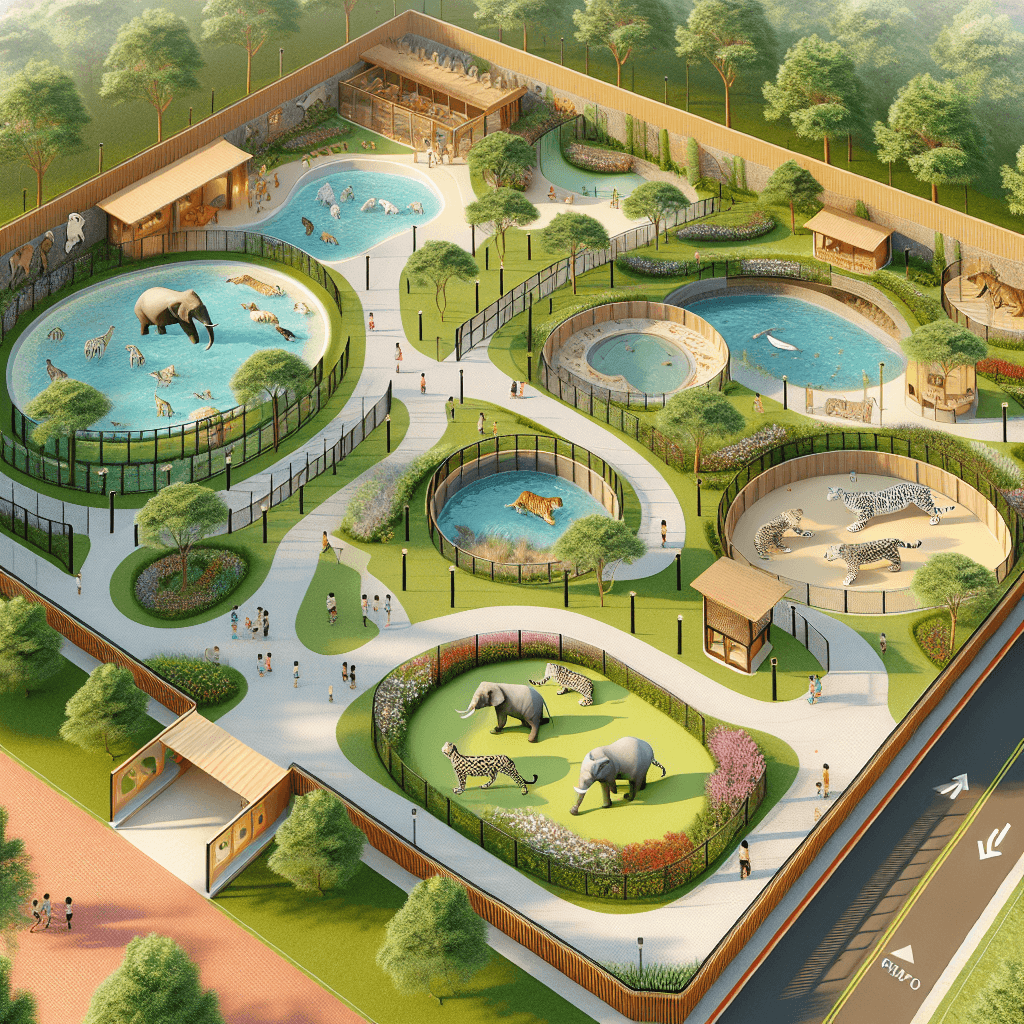
The Zoo Architect: Dividing Space for Endangered Species
Inquiry Framework
Question Framework
Driving Question
The overarching question that guides the entire project.How can we, as expert Habitat Designers, use division and area models to transform 8,000 square feet of jungle into a functional sanctuary that provides 18 endangered species the precise space they need to thrive?Essential Questions
Supporting questions that break down major concepts.- How can we use division to design a functional zoo habitat that maximizes space for 18 endangered species?
- How can we break down a large area (8,000 sq ft) into equal parts using place value and division strategies?
- How do area models and rectangular arrays help us visualize the physical space each animal species will occupy?
- When dividing space, what does the "remainder" represent, and how should a designer handle it (e.g., extra space, walking paths, or buffer zones)?
- How can we use the relationship between multiplication and division to verify that our zoo blueprints are accurate?
- Why is it important to use precise mathematical calculations when designing environments for living creatures?
Standards & Learning Goals
Learning Goals
By the end of this project, students will be able to:- Students will accurately divide a four-digit dividend (8,000 sq ft) by a two-digit divisor (18 species) to determine the base area for each habitat.
- Students will construct and explain area models or rectangular arrays to visually represent the division of the jungle terrain into specific plots.
- Students will analyze the mathematical remainder in the context of design, deciding how to allocate 'leftover' space for non-habitat needs like pathways or buffer zones.
- Students will verify their spatial calculations using the inverse relationship between multiplication and division to ensure the total area equals 8,000 square feet.
- Students will communicate their design choices by connecting their mathematical findings to the physical needs of the endangered species in a final blueprint.
Common Core State Standards for Mathematics
Common Core State Standards for Mathematical Practice
Entry Events
Events that will be used to introduce the project to studentsThe Mystery Architect's Crate
Each student group discovers a mysterious, locked crate containing a 8,000 sq. ft. topographical 'jungle grid' and 18 unidentified animal figurines. A cryptic letter from a retired zookeeper challenges them to solve the 'Spatial Puzzle'—dividing the terrain so perfectly that every species has an equitable share, using area models to prove their math is flawless.Portfolio Activities
Portfolio Activities
These activities progressively build towards your learning goals, with each submission contributing to the student's final portfolio.The Territory Estimator: Mental Mapping
Before diving into precise calculations, students must become 'spatial scouts.' In this activity, they use estimation and compatible numbers to get a sense of the scale of the 8,000 sq ft jungle. They will experiment with rounding the divisor (18) to a friendlier number (20) to predict the approximate size each species will receive, ensuring their future precise answers are reasonable.Steps
Here is some basic scaffolding to help students complete the activity.Final Product
What students will submit as the final product of the activityA 'Spatial Prediction Log' that includes estimation calculations, a written prediction of the area per species, and a brief explanation of why rounding the divisor helps prevent design errors.Alignment
How this activity aligns with the learning objectives & standardsThis activity aligns with CCSS.MATH.CONTENT.5.NBT.B.6 by focusing on strategies based on place value and the relationship between multiplication and division. It specifically addresses the 'mental math' and estimation component required to handle two-digit divisors before formalizing calculations.The Area Model Architect
Now that they have an estimate, students will use the Area Model (or Box Method) to find the exact quotient of 8,000 ÷ 18. This activity visualizes division as the process of finding a missing side length of a rectangle. Students will 'chunk' the 8,000 sq ft into manageable pieces (e.g., 18 x 400, 18 x 40) until they have accounted for as much of the 8,000 sq ft as possible.Steps
Here is some basic scaffolding to help students complete the activity.Final Product
What students will submit as the final product of the activityA large-scale 'Area Model Poster' that shows the step-by-step breakdown of 8,000 divided by 18, showing all partial quotients and the final sum.Alignment
How this activity aligns with the learning objectives & standardsThis activity directly addresses CCSS.MATH.CONTENT.5.NBT.B.6 by requiring students to 'illustrate and explain the calculation by using... area models.' It focuses on using partial quotients and properties of operations to break down a four-digit dividend.The Remainder Rescue Mission
In this activity, designers must address the 'leftover' land. Since 18 does not divide 8,000 perfectly, students will find a remainder. They must decide as a design team how to use those remaining square feet. Will it be a communal watering hole? A walking path for tourists? A buffer zone for safety? They will use mathematical reasoning to justify the use of every single square foot of the 8,000 sq ft terrain.Steps
Here is some basic scaffolding to help students complete the activity.Final Product
What students will submit as the final product of the activityA 'Land Use Manifesto' which includes the final division equation (8,000 / 18 = 444 R 8) and a creative design proposal for the remaining 8 square feet.Alignment
How this activity aligns with the learning objectives & standardsThis activity aligns with CCSS.MATH.CONTENT.5.NBT.B.6 by identifying the quotient and remainder, and supports 5.NF.B.3 by interpreting the remainder within a real-world context.The Master Sanctuary Map & Proof
In the final phase, students act as lead inspectors. They must prove their blueprints are mathematically sound before 'construction' begins. They will use the inverse relationship between multiplication and division to verify their work (Quotient x Divisor + Remainder = Dividend). Once verified, they will translate their math into a final scale drawing of the zoo.Steps
Here is some basic scaffolding to help students complete the activity.Final Product
What students will submit as the final product of the activityThe 'Master Sanctuary Blueprint': A color-coded map showing 18 equal habitats and the 'Remainder Zone,' accompanied by a 'Mathematical Proof Certificate' showing the multiplication check.Alignment
How this activity aligns with the learning objectives & standardsThis activity aligns with CCSS.MATH.CONTENT.5.NBT.B.6 by explaining the calculation using equations and reinforces 5.NBT.B.5 by using multi-digit multiplication to verify the division.Rubric & Reflection
Portfolio Rubric
Grading criteria for assessing the overall project portfolioThe Zoo Habitat Designer: Division & Spatial Modeling Rubric
Mathematical Operations & Modeling
Focuses on the core mathematical operations and the visualization of division through area models.Estimation & Prediction Strategy
Ability to use compatible numbers and place value strategies to estimate the quotient of 8,000 ÷ 18 and predict the reasonableness of the final result.
Exemplary
4 PointsEstimation is highly accurate using sophisticated compatible numbers (e.g., comparing 8000/20 with 8000/18); provides a deep, insightful explanation of how rounding the divisor affects the quotient.
Proficient
3 PointsEstimation uses appropriate compatible numbers (8,000 ÷ 20 = 400); provides a clear explanation of whether the actual area will be larger or smaller than the estimate.
Developing
2 PointsEstimation is attempted but uses less efficient numbers; explanation of the relationship between the estimate and the actual area is partial or slightly confused.
Beginning
1 PointsEstimation is missing or mathematically unsound; little to no connection made between the estimate and the final calculation.
Division Modeling & Accuracy
Accuracy and clarity in using an area model or rectangular array to divide 8,000 by 18, including the effective use of partial quotients and properties of operations.
Exemplary
4 PointsArea model is flawless and elegantly organized; uses highly efficient partial quotients (e.g., 400, 40, 4); shows a sophisticated grasp of place value in the breakdown.
Proficient
3 PointsArea model is accurate and clearly labeled; partial quotients are used correctly to reach the quotient of 444 with a remainder of 8.
Developing
2 PointsArea model is present but contains minor calculation errors or disorganized 'chunks'; shows an emerging understanding of partial quotients.
Beginning
1 PointsArea model is incomplete, incorrect, or missing; demonstrates significant difficulty in breaking down a four-digit dividend by a two-digit divisor.
Application & Critical Thinking
Evaluates how students apply mathematical results to real-world design decisions and verification processes.Contextual Interpretation of Remainders
Ability to interpret the mathematical remainder (8) within the context of the zoo design and provide a logical, equitable justification for its use.
Exemplary
4 PointsIdentifies the remainder accurately and proposes an innovative, highly detailed use that enhances the sanctuary's mission; justification shows deep critical thinking about land equity.
Proficient
3 PointsIdentifies the remainder (8 sq ft) and provides a logical design choice (e.g., a path or watering hole) with a clear written justification.
Developing
2 PointsIdentifies the remainder but the proposed use is vague or lacks a clear connection to the 8 sq ft available; justification is basic.
Beginning
1 PointsFails to identify the remainder or ignores it in the design; cannot explain the significance of the 'leftover' square footage.
Calculation Verification (The Proof)
Effectiveness in using the inverse relationship between multiplication and division (444 x 18 + 8) to verify the accuracy of the total area.
Exemplary
4 PointsVerification is perfectly executed with no errors; provides a clear, meta-cognitive reflection on why verification is essential for professional design.
Proficient
3 PointsUses the standard algorithm for multiplication correctly to check the work; proves that the quotient, divisor, and remainder sum to 8,000.
Developing
2 PointsAttempts verification but contains errors in the multiplication algorithm; sum does not match the original dividend of 8,000.
Beginning
1 PointsLittle to no evidence of verification; does not use inverse operations to check for calculation errors.
Communication & Final Product
Assesses the student's ability to communicate their findings and translate data into a visual design.Spatial Representation & Blueprinting
Quality and accuracy of the final blueprint, including the spatial representation of 18 habitats and the labeling of areas.
Exemplary
4 PointsThe blueprint is professional, perfectly scaled, and color-coded; all 18 habitats and the remainder zone are labeled with precise, verified mathematical data.
Proficient
3 PointsThe blueprint clearly shows 18 equal habitats and the remainder zone; math labels are accurate and the map is neat and legible.
Developing
2 PointsThe blueprint is present but spatial divisions are uneven or messy; some labels are missing or do not match the calculations.
Beginning
1 PointsThe map is incomplete, lacks a grid/scale, or does not represent the 18 species required by the project.
Mathematical Communication
The ability to clearly explain mathematical choices and land-use decisions through written logs, manifestos, and posters.
Exemplary
4 PointsCommunication is exceptionally clear and persuasive; uses precise mathematical vocabulary (dividend, divisor, quotient, area) fluently throughout all portfolio artifacts.
Proficient
3 PointsUses mathematical vocabulary correctly; explains design choices and calculations in a way that is easy for an outside audience to follow.
Developing
2 PointsExplanations are present but brief; uses limited mathematical vocabulary; some design choices lack clear reasoning.
Beginning
1 PointsExplanations are missing or unclear; relies on numbers alone without providing a narrative or justification for the work.