
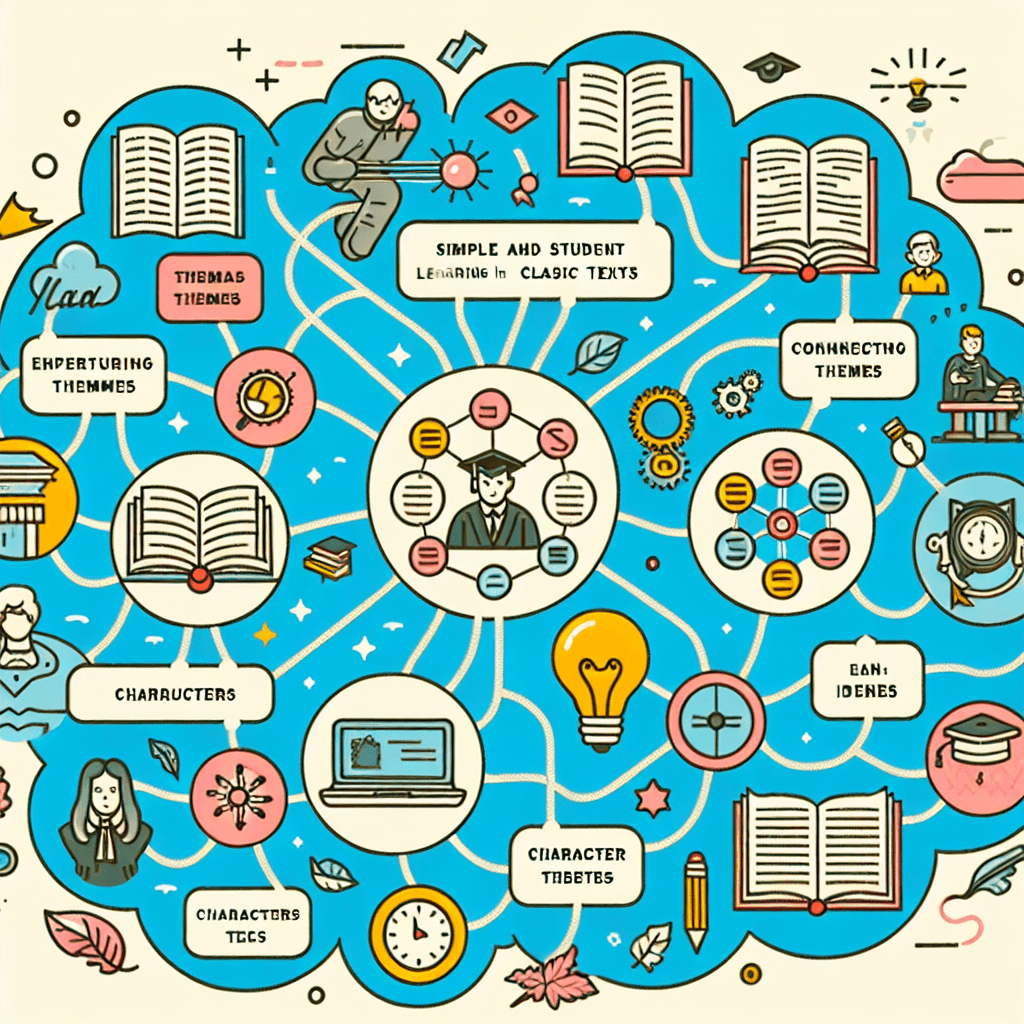
Thematic Mind Maps: Connecting Ideas in Classic Texts
Inquiry Framework
Question Framework
Driving Question
The overarching question that guides the entire project.How can we use mind maps to analyze and understand the development and interaction of central ideas in classic texts?Essential Questions
Supporting questions that break down major concepts.- How do central ideas develop and interact throughout a text?
- In what ways can a mind map help us understand complex literary texts?
- How can identifying themes enhance our understanding of a story?
- What are the benefits of connecting ideas visually when analyzing literature?
Standards & Learning Goals
Learning Goals
By the end of this project, students will be able to:- Students will create mind maps to visually represent the central ideas in classic texts and their development over the course of the text.
- Students will analyze the interaction of different central ideas within the text and how they contribute to the text's themes.
- Students will enhance their comprehension of complex literary texts through the visualization of ideas and themes.
- Students will collaborate effectively with peers to discuss and refine their understanding of the text's central ideas and themes.
English Language Arts (Grade 8)
Entry Events
Events that will be used to introduce the project to studentsEscape the Plot Room
Present students with a locked 'plot room' full of clues and puzzles related to central themes from different classic texts. The goal is to solve the puzzles to escape the room, challenging students to identify and connect core ideas creatively while relating to an intellectually stimulating escape game experience.Portfolio Activities
Portfolio Activities
These activities progressively build towards your learning goals, with each submission contributing to the student's final portfolio.Unlock the Textual Secrets
In this activity, students will engage with the classic text through a dynamic 'escape room' challenge that will set the context for understanding and identifying central ideas. Students will be presented with puzzles and clues aimed at encouraging them to think critically about the themes and key concepts in the text by working collaboratively in a stimulating and creative environment.Steps
Here is some basic scaffolding to help students complete the activity.Final Product
What students will submit as the final product of the activityCompletion of the escape room challenge with identified themes and central ideas documented.Alignment
How this activity aligns with the learning objectives & standardsSupports ELA.8.SL.1.1 by engaging students in collaborative discussions and critical thinking exercises.Thematic Quest Journals
Students will begin crafting their thematic quest journals by recording their escape room insights. This activity will focus on breaking down the central ideas they encountered in the initial exercise and diving deeper into their development. They'll be prompted to explore the themes with a focus on extracting textual evidence to support their findings.Steps
Here is some basic scaffolding to help students complete the activity.Final Product
What students will submit as the final product of the activityA detailed quest journal entry featuring central ideas, evidence, and reflections.Alignment
How this activity aligns with the learning objectives & standardsAligns with ELA.8.R.1.2 as students determine themes and analyze their development with textual evidence.Mind Map Magic
Students will transform their quest journal notes into vivid mind maps, visually connecting central ideas and their interactions within the text. This activity emphasizes the power of visual organization and helps synthesize their understanding of complex ideas.Steps
Here is some basic scaffolding to help students complete the activity.Final Product
What students will submit as the final product of the activityA comprehensive mind map illustrating the text's central ideas and themes with supporting evidence.Alignment
How this activity aligns with the learning objectives & standardsDirectly aligns with ELA.8.R.2.2 by facilitating visual analysis of central ideas and their interactions.Collaborative Connections
In this culminating activity, students will share and refine their mind maps through small group discussions. The focus will be on drawing connections between their results and preparing for a persuasive presentation on how mind mapping enriches text analysis.Steps
Here is some basic scaffolding to help students complete the activity.Final Product
What students will submit as the final product of the activityA group presentation and refined mind maps showcasing enhanced organizational strategies for literary analysis.Alignment
How this activity aligns with the learning objectives & standardsThis activity reinforces ELA.8.SL.1.1 through effective collaboration and communication, and supports ELA.8.R.2.2 by evaluating how mind maps aid in understanding texts.Rubric & Reflection
Portfolio Rubric
Grading criteria for assessing the overall project portfolioThematic Mind Maps and Literary Analysis Rubric
Understanding and Analyzing Themes
Evaluates the depth of students' understanding of central ideas and themes in classic texts.Identification of Central Ideas
Measures students' ability to accurately identify and articulate central themes in a given text.
Exemplary
4 PointsIdentifies multiple central ideas with sophistication, articulates their interactions comprehensively, and connects them creatively to the text.
Proficient
3 PointsIdentifies central ideas accurately and articulates their interactions clearly, providing relevant connections to the text.
Developing
2 PointsIdentifies some central ideas with partial accuracy, showing basic understanding but with inconsistent articulation of interactions.
Beginning
1 PointsStruggles to identify central ideas, showing limited understanding and incomplete articulation of their interactions.
Analysis of Themes
Assesses how well students analyze the development and interaction of themes using textual evidence.
Exemplary
4 PointsProvides a thorough analysis of theme development with strong textual evidence, showcasing deep insight and critical thinking.
Proficient
3 PointsOffers a clear analysis of theme development with sufficient evidence to support interpretations.
Developing
2 PointsPresents a basic analysis of theme development with some textual evidence, though interpretations may be superficial.
Beginning
1 PointsPresents an unclear analysis with limited or irrelevant evidence, demonstrating minimal comprehension.
Mind Map Creation
Assesses the creativity, organization, and comprehension demonstrated through the creation of thematic mind maps.Visual Organization
Evaluates the clarity and creativity of the mind map structure and its ability to convey relationships between themes.
Exemplary
4 PointsExhibits exceptional creativity and organization, with a clear visual structure that effectively conveys all relationships between themes.
Proficient
3 PointsDisplays clear organization and visual coherence, successfully conveying most relationships between themes.
Developing
2 PointsShows some attempt at organization, though the visual structure may be unclear or partially convey theme relationships.
Beginning
1 PointsLacks clear organization and visual coherence, failing to effectively convey relationships between themes.
Comprehension Through Mind Mapping
Assesses how well the mind map reflects students’ understanding of themes and ideas.
Exemplary
4 PointsDemonstrates deep comprehension and insight through a mind map that thoroughly represents themes and their interactions.
Proficient
3 PointsShows good comprehension with a mind map that adequately represents most themes and their interactions.
Developing
2 PointsRepresents some themes with limited accuracy, often missing comprehensive interactions.
Beginning
1 PointsReflects limited understanding with a mind map that does not accurately represent themes or their interactions.
Collaboration and Presentation
Evaluates students' ability to communicate ideas collaboratively and through presentations.Effective Collaboration
Measures engagement and contribution level during group activities and discussions.
Exemplary
4 PointsActively leads group discussions, builds on others’ ideas, and significantly contributes to collaborative task success.
Proficient
3 PointsParticipates actively, contributes useful ideas, and engages constructively with peers.
Developing
2 PointsParticipates intermittently with inconsistent contributions to group efforts.
Beginning
1 PointsRarely participates or contributes, needing significant support to engage in group activities.
Presentation Skills
Assesses the clarity, persuasiveness, and organization in presenting ideas and insights from mind mapping.
Exemplary
4 PointsPresents ideas clearly and persuasively with excellent organization, engaging the audience effectively.
Proficient
3 PointsPresents ideas clearly with logical organization, showing a fair degree of engagement with the audience.
Developing
2 PointsPresents ideas with some clarity but lacks consistent organization and audience engagement.
Beginning
1 PointsStruggles to present ideas clearly, with poor organization and minimal audience engagement.