
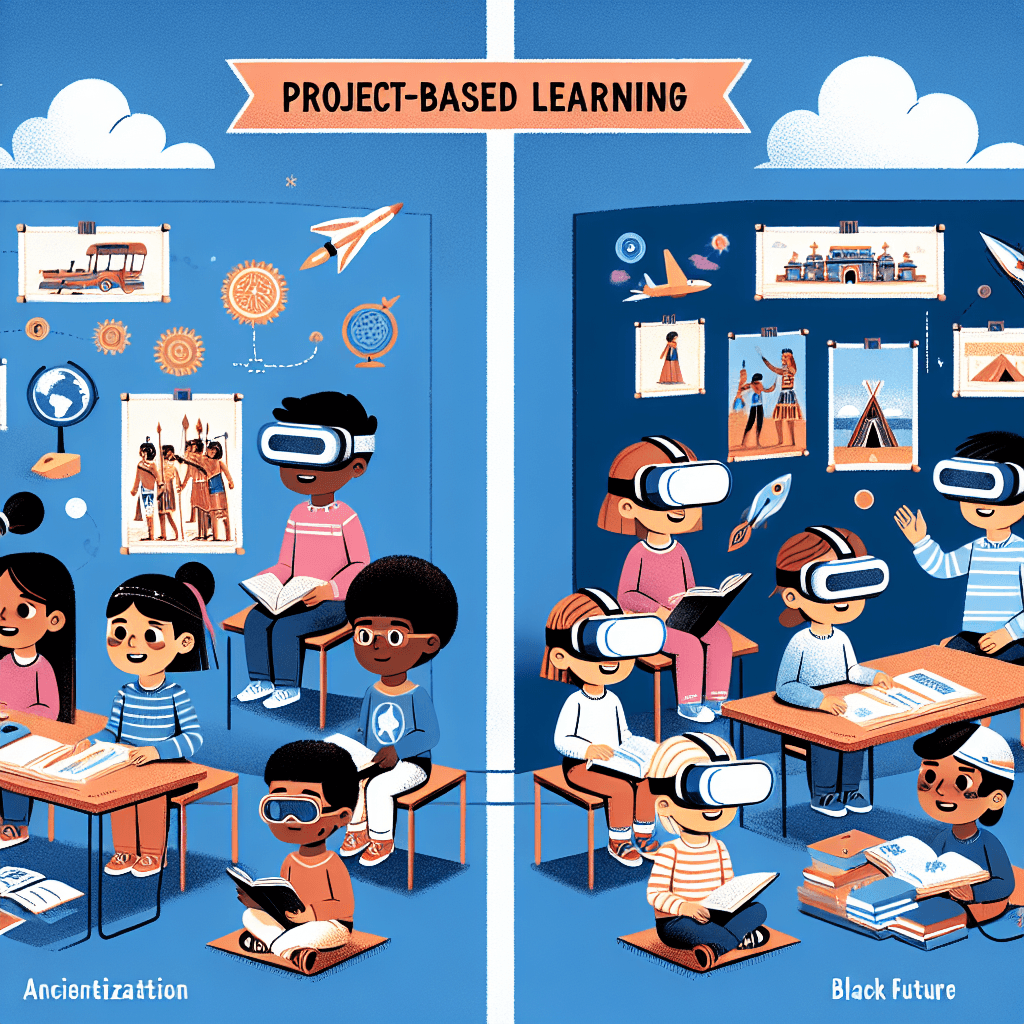
Time Traveler's Explorer: Discover Past and Present through VR
Inquiry Framework
Question Framework
Driving Question
The overarching question that guides the entire project.How can we use virtual reality to understand the human and physical characteristics of a region across different time periods, and what can this tell us about the impact of historical events on the present and future?Essential Questions
Supporting questions that break down major concepts.- What are the human and physical characteristics that define a region?
- How have these characteristics evolved over time in response to historical events?
- In what ways do historical events shape the present-day conditions of a region?
- How can exploring the past and present of a region foster a deeper understanding of its current state?
- What role does technology, like VR, play in enhancing our understanding of historical and geographical changes?
Standards & Learning Goals
Learning Goals
By the end of this project, students will be able to:- Analyze the human and physical characteristics of a selected region using VR technology.
- Examine how historical events have shaped the present-day conditions of the region.
- Utilize virtual reality tools to create presentations that effectively communicate changes in the region over time.
- Investigate how technological advancements, such as VR, can deepen understanding of geographical and historical content.
- Develop skills in comparing and contrasting information from multiple sources to understand a region's evolution.
Teacher specified
Common Core Standards for Literacy in History/Social Studies
Next Generation Science Standards
Common Core Standards for Speaking and Listening
Entry Events
Events that will be used to introduce the project to studentsImmersive Regional Storytelling
Using VR tools, students reconstruct and narrate historic events of a region from different time periods, integrating cultural narratives and geographical changes. Their challenge is to present these stories innovatively, highlighting how the past informs the present.VR Scavenger Hunt in Time
A scavenger hunt through VR takes students across different time periods of a region, collecting artifacts and insights that reveal historical and geographical shifts. The adventure helps them piece together how past human and physical characteristics have evolved into the present landscape.Portfolio Activities
Portfolio Activities
These activities progressively build towards your learning goals, with each submission contributing to the student's final portfolio.VR Research Expedition
Students will embark on a virtual reality research expedition to gather insights about a region's historical and present state. This activity involves immersive exploration and detailed examination of changes in the region over time, aided by VR tools.Steps
Here is some basic scaffolding to help students complete the activity.Final Product
What students will submit as the final product of the activityA comprehensive report analyzing the evolution of human and physical characteristics of the region.Alignment
How this activity aligns with the learning objectives & standardsAligns with standards 2A, NGSS.HS-ESS3-1 by allowing students to explore and analyze geographic changes and their impacts over time.Digital Storytellers
In this activity, students become digital storytellers by using VR to create interactive narratives that connect historical events to present-day conditions in a chosen region. They will focus on how past events have shaped current human and geographical characteristics.Steps
Here is some basic scaffolding to help students complete the activity.Final Product
What students will submit as the final product of the activityAn interactive VR narrative showcasing historical influences on present-day regional characteristics.Alignment
How this activity aligns with the learning objectives & standardsAligns with standards 2A, ELA-LITERACY.SL.9-10.5 by employing digital media to demonstrate understanding and convey information.Rubric & Reflection
Portfolio Rubric
Grading criteria for assessing the overall project portfolioVR Time Travel Exploration & Presentation Rubric
Historical Analysis
Assessment of students' understanding of historical events and their impact on a region's development over time.Understanding of Historical Events
Evaluates students' ability to accurately describe historical events and their significance in shaping a region.
Exemplary
4 PointsProvides a sophisticated understanding and interpretation of key historical events, with detailed insights into their regional impact.
Proficient
3 PointsAccurately explains key historical events with clear links to their significance for regional development.
Developing
2 PointsIdentifies key historical events with limited analysis of their significance or regional impact.
Beginning
1 PointsShows initial recognition of historical events with minimal understanding of their relevance.
Connection Between Past and Present
Measures how well students can relate historical events to current regional characteristics.
Exemplary
4 PointsSeamlessly connects past events with present conditions, providing comprehensive evidence for all claims.
Proficient
3 PointsClearly relates past events to present conditions with substantial evidence for most claims.
Developing
2 PointsAttempts to relate past events to present conditions with inconsistent evidence and analysis.
Beginning
1 PointsStruggles to link past events with present conditions, lacking supporting evidence.
Digital Media Integration
Evaluation of students' use and integration of VR and other digital media tools in their presentations.Use of Virtual Reality Tools
Assess students' ability to strategically use VR tools to enhance understanding and engagement with regional characteristics.
Exemplary
4 PointsInnovative and strategic use of VR tools, greatly enhancing understanding and engagement.
Proficient
3 PointsEffective use of VR tools that appropriately enhances understanding and engagement.
Developing
2 PointsBasic use of VR tools, with limited enhancement to understanding and engagement.
Beginning
1 PointsMinimal use of VR tools, with negligible enhancement to understanding.
Interactive Digital Storytelling
Evaluates the creativity and effectiveness of interactive digital stories created to connect past events with present conditions.
Exemplary
4 PointsCreatively and effectively crafts a compelling digital story that deeply connects historical events with present conditions.
Proficient
3 PointsCrafts an engaging digital story that effectively connects historical events to present conditions.
Developing
2 PointsCreates a basic digital story with a partial connection between historical events and present conditions.
Beginning
1 PointsAttempts to create a digital story with unclear or minimal connections to historical events and present conditions.
Critical Thinking and Analysis
Assessment of students' abilities to critically analyze information from multiple sources.Comparative Analysis of Sources
Evaluates students' skills in comparing and contrasting information from multiple sources regarding the region's evolution.
Exemplary
4 PointsDemonstrates superior analytical skills in comparing and contrasting multiple sources, providing rich insights into regional evolution.
Proficient
3 PointsShows effective analytical skills in comparing and contrasting multiple sources with clear insights.
Developing
2 PointsAttempts to compare and contrast sources with emerging analytical skills.
Beginning
1 PointsMinimal attempt to analyze and compare sources, with limited insights.