
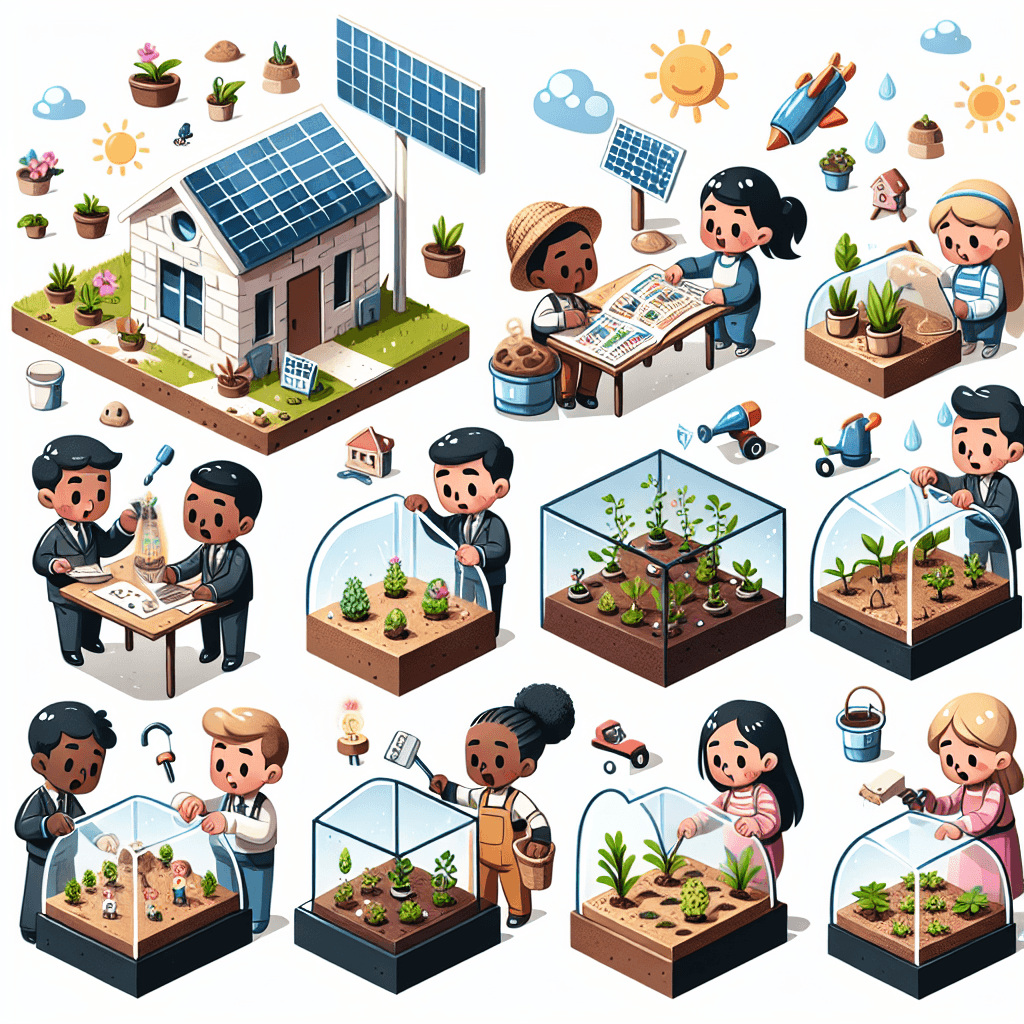
Tiny Plant Architects: Mini Habitats for Essential Growth
Inquiry Framework
Question Framework
Driving Question
The overarching question that guides the entire project.How can we design and build a mini habitat that meets all the essential needs of a plant and helps it grow and thrive?Essential Questions
Supporting questions that break down major concepts.- What are the basic needs of a plant to grow and stay healthy?
- How can we create a mini habitat that provides all necessary resources for a plant?
- In what ways do plants interact with their environment to meet their needs?
- Why is each of the needs (water, air, light, space, and nutrients) important for a plant's growth and survival?
- How does a plant obtain water, air, light, space, and nutrients in a natural habitat?
Standards & Learning Goals
Learning Goals
By the end of this project, students will be able to:- Students will understand the essential needs of plants, including water, air, light, space, and nutrients.
- Students will be able to design and build a model of a mini plant habitat that provides for all essential plant needs.
- Students will collaborate effectively in groups to explore how plants interact with their environments.
- Students will be able to explain the importance of each plant need and how it is provided in their mini habitat.
- Students will develop skills in using models to represent real-world plant habitats.
NGSS
Common Core Standards
Entry Events
Events that will be used to introduce the project to studentsPlant Detective Day
Students arrive to find the classroom transformed into a 'Plant Detective Agency', where they are tasked as detectives to solve the mystery of plant survival. They will wear detective hats and use clues around the room to learn the essential elements plants need to thrive.Portfolio Activities
Portfolio Activities
These activities progressively build towards your learning goals, with each submission contributing to the student's final portfolio.Plant Needs Exploration Stations
Students will explore various stations that demonstrate the essential needs of plants. This hands-on activity helps students to identify and differentiate between key resources plants need to survive.Steps
Here is some basic scaffolding to help students complete the activity.Final Product
What students will submit as the final product of the activityA class chart with observations and learned concepts about plant needs from each station.Alignment
How this activity aligns with the learning objectives & standardsAligns with 1-LS1-1 by demonstrating how plants meet their needs and K-2-ETS1-2 as students engage with models of real-life plant environments.Mini Habitat Blueprint Creations
In this activity, students will design blueprints for their mini plant habitats. They will include all essential plant needs in their designs, using their observations from previous activities as a guide.Steps
Here is some basic scaffolding to help students complete the activity.Final Product
What students will submit as the final product of the activityBlueprints of mini plant habitats detailing each plant’s needs.Alignment
How this activity aligns with the learning objectives & standardsSupports NGSS standards 1-LS1-1 and K-2-ETS1-2 by requiring students to model real-world plant habitats while planning habitat structures.Collaborative Habitat Construction
Students will collaborate in groups to build their mini plant habitats using simple materials. They will use their blueprints as a guide to create their models, ensuring all plant needs are met.Steps
Here is some basic scaffolding to help students complete the activity.Final Product
What students will submit as the final product of the activityA collaborative, constructed model of a mini plant habitat ensuring all plant needs are met.Alignment
How this activity aligns with the learning objectives & standardsAligns with 1-LS1-1 as students employ their knowledge of plant needs, and CCSS.ELA-LITERACY.SL.1.1 through group collaboration and presentations.Plant Habitat Reflection Journals
Students will reflect on their learning journey through this project by maintaining a Plant Habitat Reflection Journal. This activity encourages students to articulate their understanding of plant needs, their role in the group, and the insights gained during the project.Steps
Here is some basic scaffolding to help students complete the activity.Final Product
What students will submit as the final product of the activityA personal Plant Habitat Reflection Journal documenting their project journey and understanding.Alignment
How this activity aligns with the learning objectives & standardsSupports CCSS.ELA-LITERACY.SL.1.1 by encouraging discussion and K-2-ETS1-2 as students reflect on their models and learning.Plant Detective Hat Designs
Students will create their detective hats to wear during the plant detective agency entry event. This activity will serve to build excitement and engagement for the upcoming PBL activities.Steps
Here is some basic scaffolding to help students complete the activity.Final Product
What students will submit as the final product of the activityDecorative detective hats personalized with plant-themed designs.Alignment
How this activity aligns with the learning objectives & standardsEngages students with the project topic and builds excitement for participation in plant detective activities.Rubric & Reflection
Portfolio Rubric
Grading criteria for assessing the overall project portfolioTiny Plant Architects Assessment Rubric
Understanding of Plant Needs
Evaluates students' comprehension of water, air, light, space, and nutrients as essential for plant growth.Identification of Plant Needs
Assessment of the student's ability to accurately identify and explain the needs of plants based on their observations and activities.
Exemplary
4 PointsStudent consistently and accurately identifies all plant needs, provides thorough explanations, and uses specific examples from activities to support understanding.
Proficient
3 PointsStudent accurately identifies all plant needs and explains them with some examples from activities.
Developing
2 PointsStudent identifies some plant needs but provides limited explanations and examples.
Beginning
1 PointsStudent struggles to identify plant needs accurately and offers minimal explanations or examples.
Explanation of Importance
Assessment of the student's ability to articulate why each plant need is vital for plant growth and survival.
Exemplary
4 PointsStudent provides detailed and insightful explanations on the importance of each plant need, linking them to plant growth and survival eloquently.
Proficient
3 PointsStudent explains the importance of each plant need clearly, connecting them to plant growth and survival.
Developing
2 PointsStudent provides basic explanations on the importance of some plant needs, showing limited connection to plant growth.
Beginning
1 PointsStudent gives unclear or incomplete explanations about plant needs.
Blueprint Design and Execution
Measures the student’s ability to design and create blueprints for a mini plant habitat that meets all plant needs.Blueprint Completeness
Assessment of the detail and organization of the student's blueprint, ensuring all plant needs are represented.
Exemplary
4 PointsBlueprint is detailed, well-organized, includes all plant needs, and uses innovative solutions.
Proficient
3 PointsBlueprint is organized, includes all plant needs, and follows logical planning.
Developing
2 PointsBlueprint includes most plant needs but lacks organization and detail.
Beginning
1 PointsBlueprint is incomplete and poorly organized, missing several plant needs.
Application of Blueprint in Construction
Evaluation of how effectively the student used their blueprint to guide the construction of a mini habitat.
Exemplary
4 PointsConstruction closely follows the blueprint, effectively representing all plant needs with creative solutions.
Proficient
3 PointsConstruction follows the blueprint adequately, representing all plant needs well.
Developing
2 PointsConstruction follows the blueprint partially, capturing some plant needs.
Beginning
1 PointsConstruction poorly follows the blueprint, missing many plant needs.
Collaboration and Presentation
Assesses the student's ability to collaborate with peers and present their work effectively.Collaboration Contribution
Assessment of the student's contribution to group efforts and collaborative problem-solving.
Exemplary
4 PointsStudent shows leadership in collaboration, encouraging teamwork and providing valuable input consistently.
Proficient
3 PointsStudent contributes actively, participates in teamwork effectively, and shares ideas willingly.
Developing
2 PointsStudent participates in collaboration but contributes minimally and requires prompting.
Beginning
1 PointsStudent rarely participates in group activities and struggles to contribute.
Presentation Clarity and Engagement
Evaluation of how clearly and engagingly the student presents their mini habitat and learning outcomes.
Exemplary
4 PointsPresentation is clear, confident, and engaging, effectively communicating ideas and showcasing learning.
Proficient
3 PointsPresentation is clear and communicates ideas well, demonstrating understanding.
Developing
2 PointsPresentation communicates basic ideas but lacks clarity and engagement.
Beginning
1 PointsPresentation is unclear and struggles to convey ideas well.
Reflection and Metacognition
Evaluates the student's ability to reflect on their learning process, recognizing growth and areas for improvement.Reflection Quality
Assessment of the depth and insight of the student's reflections in their journals.
Exemplary
4 PointsReflections are insightful, detailed, showcasing deep learning, growth, and clear future learning goals.
Proficient
3 PointsReflections are thorough, showing clear learning outcomes and some growth recognition.
Developing
2 PointsReflections are basic, showing limited insight into personal learning and development.
Beginning
1 PointsReflections are vague, lacking depth and personal learning insights.