
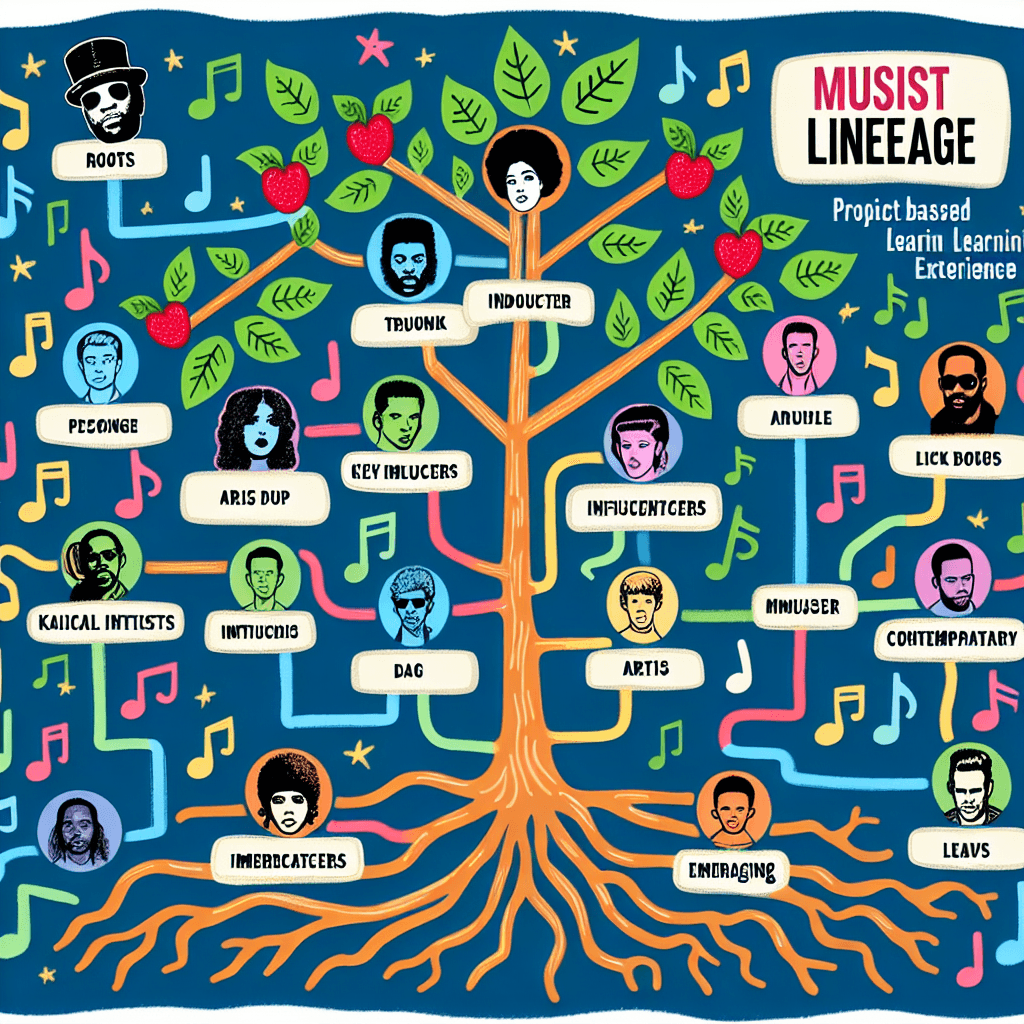
Tracing the Musical Lineage: Artist Influence Tree
Inquiry Framework
Question Framework
Driving Question
The overarching question that guides the entire project.How can we create a musical family tree that traces the influence of past artists on a contemporary musician, considering cultural, historical, and personal impacts?Essential Questions
Supporting questions that break down major concepts.- What elements and techniques are passed down from one artist to their musical 'descendants' or influenced artists?
- How do cultural and historical contexts shape the music of both 'ancestor' and contemporary artists?
- In what ways can music serve as a historical document, reflecting social and cultural change over time?
- How do personal experiences and identities of artists impact their music and the artists they influence?
- What is the role of collaboration and mentorship in the evolution of musical styles?
- How can we trace the evolution of a specific music genre through artist influences and contributions?
Standards & Learning Goals
Learning Goals
By the end of this project, students will be able to:- Students will analyze how cultural, historical, and personal contexts influence the music of various artists.
- Students will identify and trace the influence of past artists on contemporary musicians.
- Students will critically evaluate music from different periods to determine elements of musical heritage and innovation.
- Students will create a 'musical family tree' that visually and textually represents the lineage of influence between artists.
- Students will explore the roles of collaboration and mentorship in shaping musical styles and careers.
National Core Arts Standards (NCAS)
Entry Events
Events that will be used to introduce the project to studentsMusical DNA: Unraveling the Artist
Invite students to a surprise live video call with a music producer who discusses how they discover and work with artists influenced by past legends. As the producer shares sound clips hinting at these influences, students begin to connect the dots between contemporary and classic sounds, sparking their curiosity about musical lineages.Backstage Pass: Time Travel Edition
Create a time travel-themed virtual reality experience where students 'visit' different musical eras backstage, meeting legendary artists who share stories of their influence on modern-day musicians. This immersive journey encourages students to ask questions about musical evolution and personal discovery.Portfolio Activities
Portfolio Activities
These activities progressively build towards your learning goals, with each submission contributing to the student's final portfolio.Artist Ancestry Explorer
Students will research and select a contemporary artist of interest. They will investigate the artist’s musical style, influences and identify an 'ancestor' artist who significantly influenced them.Steps
Here is some basic scaffolding to help students complete the activity.Final Product
What students will submit as the final product of the activityA research paper outlining the chosen contemporary artist, their musical style, and the influence of a selected ancestor artist.Alignment
How this activity aligns with the learning objectives & standardsAligns with MU:Re7.2.IIa by analyzing the structure and context of musical works.Sound Detective: Tracing Musical Influence
Students will delve into the music of both the contemporary and ancestor artists. They need to analyze various tracks to identify techniques, themes, and elements that show clear influences from the ancestor artist to the contemporary artist.Steps
Here is some basic scaffolding to help students complete the activity.Final Product
What students will submit as the final product of the activityA comparative analysis document in the form of a graphic organizer illustrating the influences found between both artists.Alignment
How this activity aligns with the learning objectives & standardsSupports MU:Re7.2.IIa and MU:Re9.1.IIa by evaluating technical and expressive aspects considering their contexts.Cultural Context Analyst
Students investigate how cultural and historical contexts influenced both the contemporary and ancestor artists. They will explore how these contexts shaped their music and impacted their evolution over time.Steps
Here is some basic scaffolding to help students complete the activity.Final Product
What students will submit as the final product of the activityA detailed timeline illustrating the influence of cultural and historical contexts on both artists.Alignment
How this activity aligns with the learning objectives & standardsRelates to MU:Re9.1.IIa and MU:Cn11.1.IIa by connecting musical works with their varied contexts.Musical Heritage Family Tree
Students synthesize their collected research and analyses to create a visual and textual 'musical family tree'. This tree will represent the lineage and influence between the artists studied, incorporating cultural, historical, and personal narratives discovered.Steps
Here is some basic scaffolding to help students complete the activity.Final Product
What students will submit as the final product of the activityA comprehensive musical family tree with visual and textual elements detailing the lineage between studied artists.Alignment
How this activity aligns with the learning objectives & standardsAligns with MU:Cn11.1.IIa by relating musical works with their varied context.Mentorship and Collaboration Reflection
Students will reflect on the role of mentorship and collaboration in the evolution of their selected artists. They will explore instances where mentorship influenced the artists and analyze how this has supported their musical development.Steps
Here is some basic scaffolding to help students complete the activity.Final Product
What students will submit as the final product of the activityA reflective essay that outlines the impact of mentorship on the development of the studied artists’ music.Alignment
How this activity aligns with the learning objectives & standardsSupports MU:Pr4.3.IIa by demonstrating how understanding musical style and context informs performances.Rubric & Reflection
Portfolio Rubric
Grading criteria for assessing the overall project portfolioMusical Ancestry and Influence Rubric
Research and Analytical Skills
This category evaluates the student's ability to conduct thorough research and analyze the musical influences between contemporary and ancestor artists.Depth of Content Research
Evaluates the comprehensiveness of the research on both contemporary and ancestor artists, and the ability to identify influences.
Exemplary
4 PointsConducts comprehensive research with diverse sources, clearly identifies nuanced influences between artists.
Proficient
3 PointsConducts thorough research with varied sources, identifies clear influences between artists.
Developing
2 PointsConducts basic research with limited sources, identifies some influences but lacks depth.
Beginning
1 PointsConducts minimal research with few sources, struggles to identify influences.
Critical Analysis
Measures the student's ability to critically evaluate and compare musical works in terms of style, technique, and influence.
Exemplary
4 PointsProvides insightful analysis and clear comparison of technique and style, supported by strong evidence.
Proficient
3 PointsProvides clear analysis and comparison, supported by relevant evidence.
Developing
2 PointsProvides basic analysis and limited comparison, with some supporting evidence.
Beginning
1 PointsStruggles to analyze and compare works, with minimal supporting evidence.
Historical and Cultural Context Understanding
Assesses the student's understanding of the cultural and historical contexts influencing the artists.Contextual Insight
Evaluates the ability to connect musical works to their historical and cultural contexts.
Exemplary
4 PointsDeeply understands and connects works to rich, varied historical and cultural contexts.
Proficient
3 PointsClearly connects musical works to their historical and cultural contexts.
Developing
2 PointsMakes basic contextual connections, lacking depth in understanding.
Beginning
1 PointsStruggles to connect works to their contexts, showing limited understanding.
Creative Synthesis and Presentation
This category evaluates how well students synthesize information to create a visual 'musical family tree' and present their analyses.Visual Creativity and Clarity
Measures the creativity and clarity of the visual representation of the musical family tree.
Exemplary
4 PointsCreates an exceptionally creative and clear visual representation that effectively communicates musical lineage and influences.
Proficient
3 PointsCreates a clear and creative visual representation that communicates main influences.
Developing
2 PointsCreates a basic visual representation with some clarity, but limited creativity.
Beginning
1 PointsStruggles to create a clear visual representation, showing minimal creativity or clarity.