
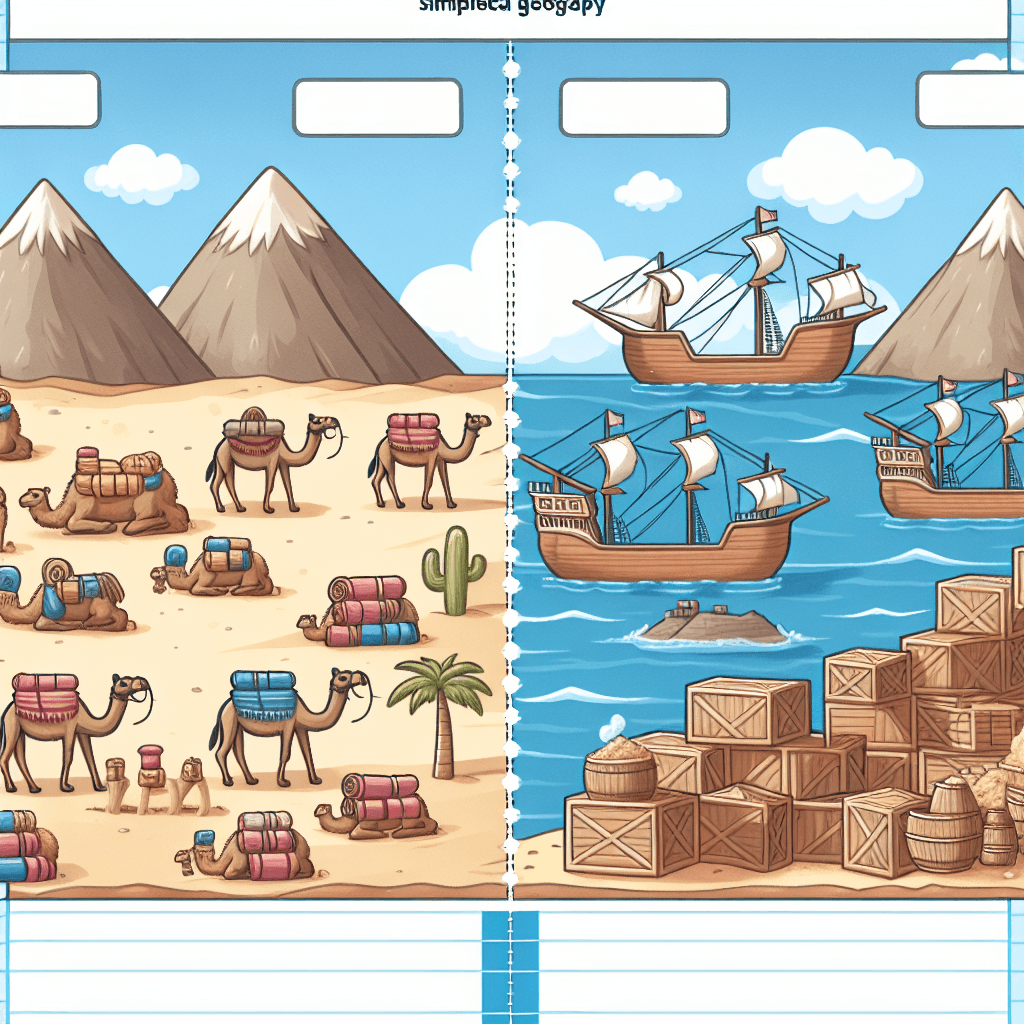
Trading Across Deserts and Oceans: Geography's Impact on Trade
Inquiry Framework
Question Framework
Driving Question
The overarching question that guides the entire project.How did geographic features influence trade patterns and the development of civilizations in the post-classical period, particularly regarding the roles of the Mongol Empire and Islamic merchant activity?Essential Questions
Supporting questions that break down major concepts.- How did geographic features shape trade patterns in the post-classical period?
- In what ways did trade influence the development of civilizations, particularly in relation to the Islamic world?
- What role did merchant activity and pilgrimage play in advancing geographical knowledge during the medieval era?
- How did the rise of the Mongol Empire transform connections between civilizations?
- What similarities and differences can be observed between the development of civilizations in the Americas and those in Eurasia?
- How do historians' interpretations of the post-classical period challenge or reinforce the notion of the 'Dark Ages' in Europe?
Standards & Learning Goals
Learning Goals
By the end of this project, students will be able to:- Analyze the influence of geographic features on historic trade patterns during the post-classical period.
- Evaluate the significance of the Mongol Empire and Islamic merchant activity in shaping trade and cultural interactions.
- Compare and contrast the development of civilizations in the Americas and Eurasia, focusing on trade and geographic influence.
World History Standards
Entry Events
Events that will be used to introduce the project to studentsDesert Expedition Simulation
Students receive a distress call from a fictional ancient caravan lost in the Saharan Desert. They must work together to create a plausible survival strategy, focusing on geographical features that impact trade and survival. In doing so, they explore the dynamics of trade in arid environments.Portfolio Activities
Portfolio Activities
These activities progressively build towards your learning goals, with each submission contributing to the student's final portfolio.Geographic Trade Map Explorers
Students will create a detailed trade map that highlights key trade routes and geographic features from the post-classical period. This activity will encourage students to visualize how geographic factors influenced trade patterns and settlement locations across different civilizations.Steps
Here is some basic scaffolding to help students complete the activity.Final Product
What students will submit as the final product of the activityA comprehensive trade map showcasing geographic features and trade routes from the post-classical period, accompanied by a presentation.Alignment
How this activity aligns with the learning objectives & standardsAligns with WH Standard 3.1 by having students explain the impact of geography on trade patterns.Civilization Development Debate
Engage students in a structured debate comparing the development of civilizations in the Americas to those in regions like Europe and Asia. They will evaluate historians' interpretations and use evidence to support their arguments.Steps
Here is some basic scaffolding to help students complete the activity.Final Product
What students will submit as the final product of the activityA recorded debate showcasing each group's arguments regarding civilization development, along with a reflection on the validity of their positions based on researched evidence.Alignment
How this activity aligns with the learning objectives & standardsAligns with WH Standard 3.2, evaluating historians' interpretations on civilization development.Mongol Empire Role-Play
In this role-play activity, students will take on the personas of key figures from the Mongol Empire and discuss the long-term effects of their conquests. This will promote understanding of the diffusion of ideas, technologies, and diseases.Steps
Here is some basic scaffolding to help students complete the activity.Final Product
What students will submit as the final product of the activityA collaborative role-play session followed by a reflective essay analyzing the impacts of the Mongol conquests.Alignment
How this activity aligns with the learning objectives & standardsAligns with WH Standard 3.3 by evaluating the long-term effects of the Mongol conquests.Colonization Context Presentation
Students will research the social, political, religious, technological, and economic changes in medieval Europe that set the stage for later European colonization efforts. They will compile findings in a multimedia presentation.Steps
Here is some basic scaffolding to help students complete the activity.Final Product
What students will submit as the final product of the activityA multimedia presentation detailing the changes in medieval Europe that facilitated later colonization.Alignment
How this activity aligns with the learning objectives & standardsAligns with WH Standard 3.4, explaining the context for European colonization.Cultural Diffusion Case Study Reports
Students will explore different case studies of cultural diffusion and prepare reports that identify patterns in the spread of technology, writing, and political systems. Each report will showcase a different cultural exchange event, such as the impact of Chinese culture on Japan.Steps
Here is some basic scaffolding to help students complete the activity.Final Product
What students will submit as the final product of the activityA written report on a chosen case study of cultural diffusion, presented verbally to the classroom.Alignment
How this activity aligns with the learning objectives & standardsAligns with WH Standard 3.5 by identifying patterns in the diffusion of civilization elements.Rubric & Reflection
Portfolio Rubric
Grading criteria for assessing the overall project portfolioPost-Classical Trade and Civilization Influence Rubric
Understanding of Geographic and Trade Influences
Evaluates the student's ability to analyze how geographic features affected historic trade routes and patterns during the post-classical period.Analysis of Trade Routes
Effectiveness in analyzing historical trade routes impacted by geographic features.
Exemplary
4 PointsDemonstrates a sophisticated understanding of complex trade routes and the precise geographic features that influenced them, using detailed examples.
Proficient
3 PointsPresents a thorough analysis of key trade routes, showing clear understanding of geographic influences with relevant examples.
Developing
2 PointsProvides a basic analysis of trade routes with limited examples of geographic influences. Shows emerging understanding.
Beginning
1 PointsStruggles to identify how geographic features influenced trade routes. Limited descriptions and examples.
Impact of Trade on Civilization Development
Assesses the student's understanding of how trade influenced the development of civilizations in various regions.
Exemplary
4 PointsProvides an exceptional evaluation of trade's impact on civilizations, with a nuanced comparison between different regions.
Proficient
3 PointsEffectively evaluates trade's influence on civilizations, providing clear comparisons across regions.
Developing
2 PointsOffers a limited evaluation of trade's influence, with superficial comparisons between regions.
Beginning
1 PointsShows minimal understanding of how trade impacted civilizations, with little comparative analysis.
Critical Thinking and Historical Perspective
Focuses on the student's ability to critically assess historical narratives and contribute thoughtful perspectives to discussions.Critique of Historical Sources
Ability to critically evaluate historical interpretations related to the post-classical period.
Exemplary
4 PointsDemonstrates exceptional critique of historical sources, offering insightful perspectives supported by comprehensive evidence.
Proficient
3 PointsOffers well-supported critiques of historical sources with appropriate evidence and understanding.
Developing
2 PointsProvides limited critiques of historical sources with basic evidence, reflecting emerging critical decision-making.
Beginning
1 PointsShows initial understanding with minimal critique of sources and limited evidence.
Interpretation of Historical Developments
Evaluates the student's ability to interpret significant historical developments and their implications.
Exemplary
4 PointsInterprets complex historical developments with exceptional clarity and insight, providing supported conclusions.
Proficient
3 PointsInterprets key historical developments effectively with clear conclusions and supportive details.
Developing
2 PointsOffers basic interpretation of historical developments, needing more context and depth in conclusions.
Beginning
1 PointsStruggles to interpret historical developments with minimal support or clarity.
Collaboration and Communication
Assesses students' skills in contributing to group activities, communicating ideas clearly, and fostering constructive dialogue.Effectiveness in Group Collaboration
Evaluates how well the student works with others in project-based group tasks or debates.
Exemplary
4 PointsDemonstrates leadership and fosters inclusive, effective collaboration with peers. Contributions enhance group outcomes.
Proficient
3 PointsContributes effectively to group tasks, supporting a cooperative and productive team environment.
Developing
2 PointsShows basic involvement in group activities with inconsistent contribution levels.
Beginning
1 PointsParticipates minimally, often needing prompting to contribute to group tasks.
Clarity and Effectiveness of Communication
Assesses the student's ability to clearly communicate ideas and findings in both written and oral formats.
Exemplary
4 PointsCommunicates ideas with exceptional clarity and persuasiveness, using varied formats effectively.
Proficient
3 PointsCommunicates clearly and effectively, using appropriate formats to convey ideas.
Developing
2 PointsCommunicates with basic clarity, often hesitant or unclear in conveying ideas.
Beginning
1 PointsStruggles to communicate ideas clearly, often unorganized or vague.