
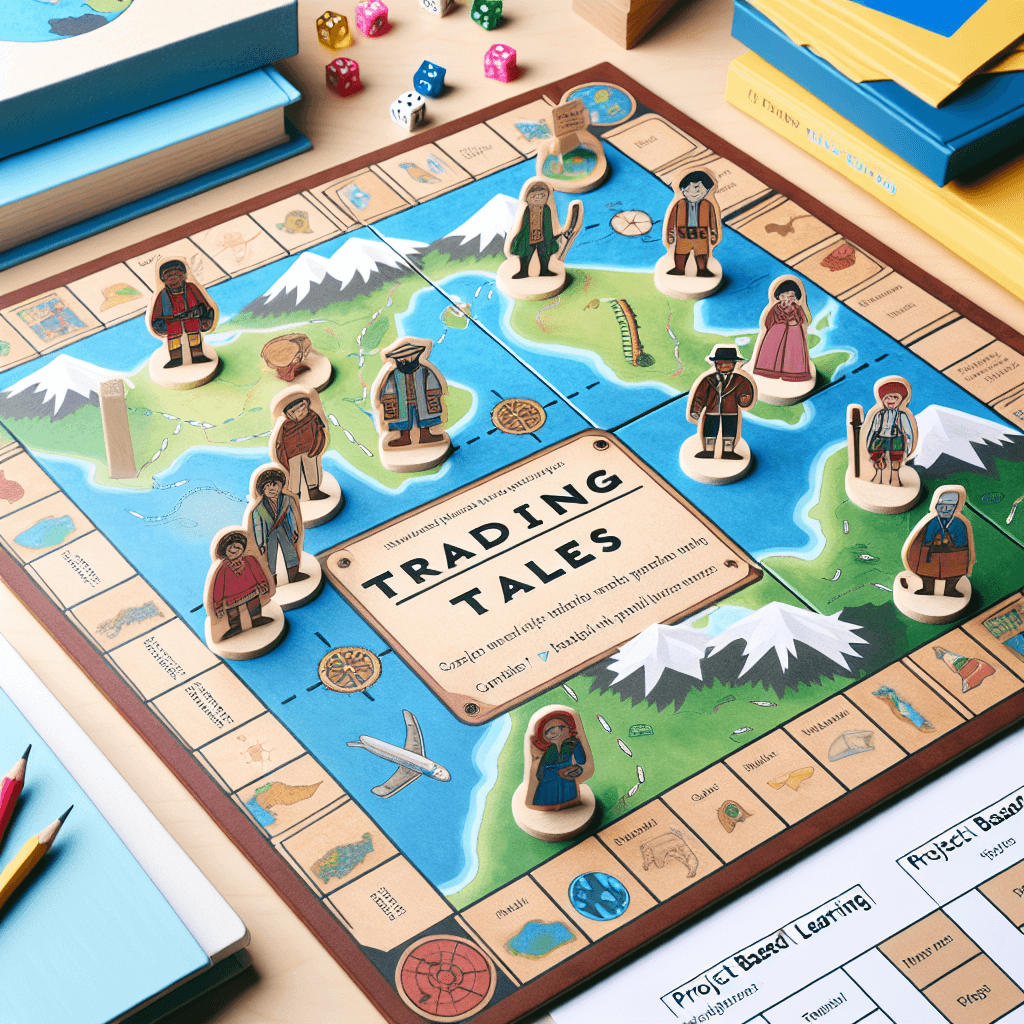
Trading Tales: A Board Game of Explorers
Inquiry Framework
Question Framework
Driving Question
The overarching question that guides the entire project.How did the interactions between explorers and American Indians, shaped by the goals and obstacles of exploration, lead to cooperation, conflict, and cultural exchange, and how can we design a trading game with clear grammar and rules to reflect these complex relationships?Essential Questions
Supporting questions that break down major concepts.- How did explorers' interactions with American Indians lead to both cooperation and conflict?
- In what ways did the goals and obstacles of European explorers shape their journeys and impact North America?
- How can we use correct grammar and sentence structure to clearly explain the rules and historical context of our trading game?
- How does trade affect the cultures of different groups who are trading?
Standards & Learning Goals
Learning Goals
By the end of this project, students will be able to:- Understand the causes, obstacles, and consequences of North American exploration.
- Identify key explorers and their accomplishments.
- Analyze the interactions between explorers and American Indians, including cooperation and conflict.
- Apply grammar rules for apostrophes and sentence structure.
- Design a board game that simulates trade and cultural exchange.
Georgia Standards of Excellence
Entry Events
Events that will be used to introduce the project to studentsLost Explorer's Journal
A weathered journal, supposedly belonging to a long-lost explorer, is 'discovered.' The journal contains cryptic entries, maps with missing locations, and sketches of unknown plants and animals. Students work in teams to decipher the journal's clues, piecing together the explorer's journey and the cultures they encountered.Mystery Artifact Auction
A mysterious collection of 'artifacts' (ranging from convincingly aged documents to unusual trinkets) is presented. Students participate in a silent auction, using play money. The catch? The origins and purpose of the artifacts are unknown, sparking curiosity about exploration and trade.'Unboxing' the New World
Each group receives a sealed crate filled with everyday items from different continents/cultures (e.g., spices, textiles, tools, toys). Without knowing the origins, students must examine, categorize, and hypothesize about each item's purpose, its potential value in trade, and the culture that produced it.Portfolio Activities
Portfolio Activities
These activities progressively build towards your learning goals, with each submission contributing to the student's final portfolio.Explorer's Journal: Apostrophe Adventure
Students will analyze journal entries from the 'Lost Explorer's Journal' entry event, focusing on identifying and correcting the use of apostrophes in contractions and possessive nouns. This activity reinforces grammar skills while contextualizing historical narratives.Steps
Here is some basic scaffolding to help students complete the activity.Final Product
What students will submit as the final product of the activityA corrected version of the journal excerpts with explanations of apostrophe usage.Alignment
How this activity aligns with the learning objectives & standardsAligns with 3.L.GC.1.18 (Use apostrophes to form contractions and singular possessive nouns) and provides context for SS3H2 (Exploration of North America).Sentence Structure Scavengers
Using the 'Mystery Artifact Auction' event, students will create sentences to describe each artifact using simple, compound, and complex sentences. This will help them practice sentence structure while imagining the artifacts' historical context.Steps
Here is some basic scaffolding to help students complete the activity.Final Product
What students will submit as the final product of the activityA collection of sentences describing artifacts, correctly labeled by sentence type (simple, compound, complex) with explanations.Alignment
How this activity aligns with the learning objectives & standardsAligns with 3.L.GC.2.a (Distinguish between correctly structured simple, compound, and complex sentences) and builds background knowledge for SS3H2 (Exploration of North America).Explorer Fact File
Following the 'Unboxing the New World' activity and classroom discussions, students will research one of the explorers listed in standard SS3H2.b and create a fact file detailing their accomplishments, motivations, and obstacles faced.Steps
Here is some basic scaffolding to help students complete the activity.Final Product
What students will submit as the final product of the activityA fact file on the chosen explorer, including their name, dates of exploration, accomplishments, reasons for exploration, and obstacles faced.Alignment
How this activity aligns with the learning objectives & standardsDirectly aligns with SS3H2.b (Describe the accomplishments of key explorers) and SS3H2.a (Reasons for and obstacles to exploration).Cooperation & Conflict Comic Strip
Students will create a comic strip depicting an example of cooperation or conflict between European explorers and American Indians. This activity will require them to analyze historical interactions and represent them visually.Steps
Here is some basic scaffolding to help students complete the activity.Final Product
What students will submit as the final product of the activityA comic strip illustrating an instance of cooperation or conflict between European explorers and American Indians, with clear visual and textual explanations.Alignment
How this activity aligns with the learning objectives & standardsDirectly aligns with SS3H2.c (Describe examples of cooperation and conflict between European explorers and American Indians).Trading Game Rulebook: Grammar & Gameplay
Students will draft the rulebook for their trading game, ensuring that the rules are clearly written using correct grammar (apostrophes, sentence structure) and that the gameplay reflects the historical context of exploration and cultural exchange.Steps
Here is some basic scaffolding to help students complete the activity.Final Product
What students will submit as the final product of the activityA complete and well-written rulebook for the trading game, demonstrating correct grammar and reflecting historical accuracy.Alignment
How this activity aligns with the learning objectives & standardsIntegrates 3.L.GC.1.18 (Apostrophes), 3.L.GC.2.a (Sentence Structure), SS3H2.a (Reasons/Obstacles), SS3H2.b (Explorer Accomplishments), and SS3H2.c (Cooperation/Conflict).Rubric & Reflection
Portfolio Rubric
Grading criteria for assessing the overall project portfolioTrading Tales Portfolio Rubric: Grade 3
Grammar & Mechanics
Focuses on the correct use of apostrophes, sentence structure, and overall clarity in written work.Apostrophe Usage
Accuracy and consistency in using apostrophes to form contractions and possessive nouns.
Exemplary
4 PointsDemonstrates mastery of apostrophe usage with no errors. Explanations are thorough and insightful.
Proficient
3 PointsUses apostrophes correctly in most instances, with only minor errors. Explanations are clear and accurate.
Developing
2 PointsShows some understanding of apostrophe usage, but makes frequent errors. Explanations are attempted but may be unclear or incomplete.
Beginning
1 PointsStruggles to use apostrophes correctly, with numerous errors. Unable to provide clear explanations.
Sentence Structure
Ability to construct grammatically correct and varied sentences (simple, compound, complex).
Exemplary
4 PointsConsistently constructs grammatically correct and sophisticated sentences. Demonstrates a strong understanding of sentence variety.
Proficient
3 PointsConstructs grammatically correct sentences in most instances. Demonstrates an understanding of sentence variety.
Developing
2 PointsShows an emerging understanding of sentence structure, but makes some grammatical errors. Limited sentence variety.
Beginning
1 PointsStruggles to construct grammatically correct sentences. Demonstrates little understanding of sentence structure.
Historical Understanding
Demonstrates knowledge of explorers, their accomplishments, and the interactions between explorers and American Indians.Explorer Knowledge
Accurately identifies and describes the accomplishments, motivations, and obstacles faced by key explorers.
Exemplary
4 PointsDemonstrates a deep and nuanced understanding of the explorer's accomplishments, motivations, and obstacles. Provides insightful details and connections.
Proficient
3 PointsAccurately describes the explorer's accomplishments, motivations, and obstacles. Provides sufficient details.
Developing
2 PointsShows some understanding of the explorer's accomplishments, motivations, and obstacles, but may include inaccuracies or omissions.
Beginning
1 PointsStruggles to identify and describe the explorer's accomplishments, motivations, and obstacles. Contains significant inaccuracies.
Cultural Interactions
Analyzes and represents the cooperation and conflict between European explorers and American Indians.
Exemplary
4 PointsProvides a sophisticated analysis of the complexities of cooperation and conflict, demonstrating a nuanced understanding of the perspectives of both explorers and American Indians.
Proficient
3 PointsClearly illustrates an example of cooperation or conflict and accurately represents the perspectives involved.
Developing
2 PointsPresents an example of cooperation or conflict, but the representation may be simplistic or lack nuance.
Beginning
1 PointsStruggles to represent cooperation or conflict accurately. Demonstrates a limited understanding of the historical context.
Game Design & Rulebook
Focuses on the clarity, accuracy, and historical relevance of the trading game rulebook.Rulebook Clarity
The rulebook is easy to understand and follow.
Exemplary
4 PointsThe rulebook is exceptionally clear, concise, and well-organized. Instructions are easy to follow and leave no room for ambiguity.
Proficient
3 PointsThe rulebook is clear and easy to understand. Instructions are generally well-organized and complete.
Developing
2 PointsThe rulebook is understandable, but some instructions may be unclear or incomplete. Organization could be improved.
Beginning
1 PointsThe rulebook is difficult to understand. Instructions are confusing and poorly organized.
Historical Accuracy & Relevance
The game mechanics and rules accurately reflect the historical context of exploration, trade, and cultural exchange.
Exemplary
4 PointsThe game mechanics and rules demonstrate a deep understanding of the historical context, accurately simulating trade, cultural exchange, and potential conflicts. The game promotes critical thinking about historical events.
Proficient
3 PointsThe game mechanics and rules generally reflect the historical context of exploration, trade, and cultural exchange. The game simulates key aspects of these interactions.
Developing
2 PointsThe game mechanics and rules touch upon the historical context, but may contain inaccuracies or oversimplifications. The connection to historical events is not always clear.
Beginning
1 PointsThe game mechanics and rules show little connection to the historical context of exploration, trade, and cultural exchange.