
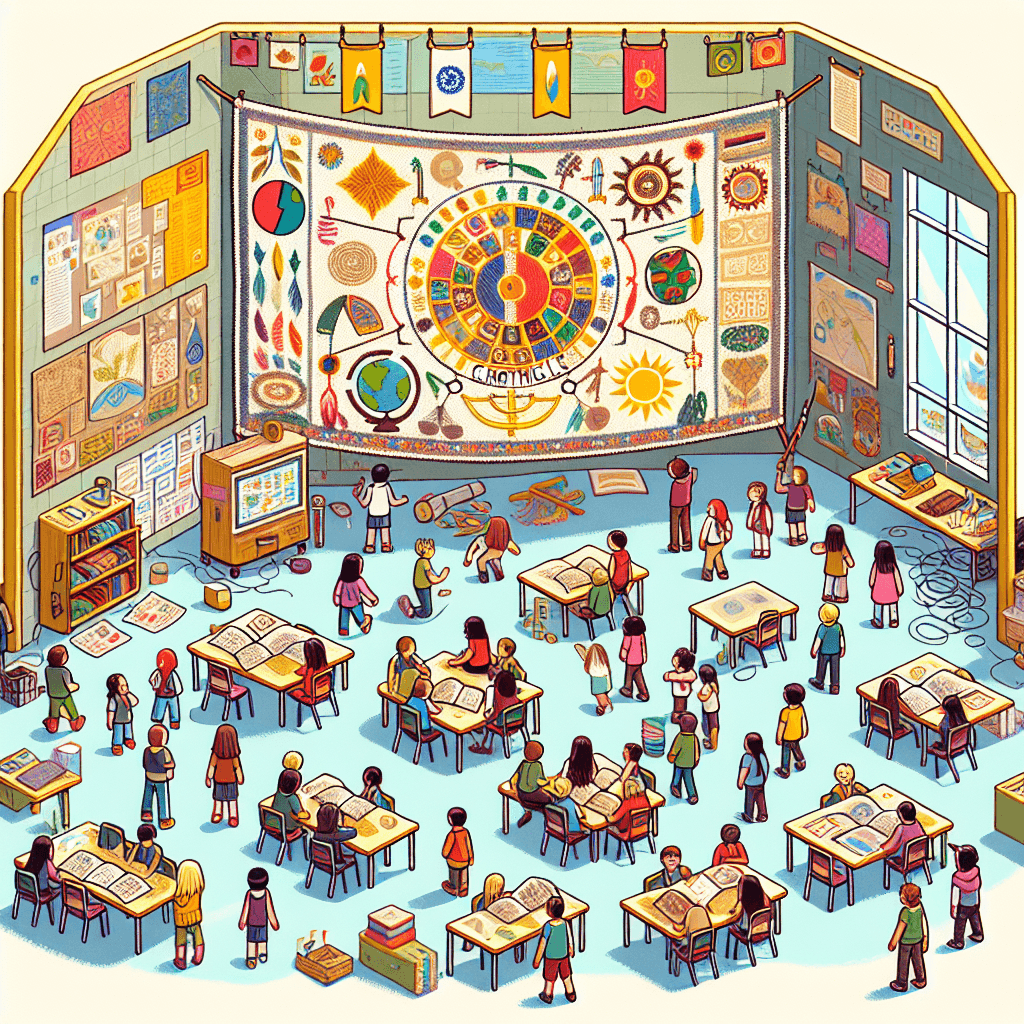
Treaty Tapestry Chronicles
Inquiry Framework
Question Framework
Driving Question
The overarching question that guides the entire project.How can we visually represent the key events and their impacts that led to the signing of the treaty ending the French and Indian War through tapestry creation?Essential Questions
Supporting questions that break down major concepts.- What were the major causes and outcomes of the French and Indian War?
- How did the French and Indian War impact the relationships between European powers?
- What role did treaties play in concluding the French and Indian War?
- How were the lives of people in North America affected by the end of the French and Indian War?
- What were the key events that led to the signing of the treaty ending the French and Indian War?
Standards & Learning Goals
Learning Goals
By the end of this project, students will be able to:- Understand and explain the major causes and outcomes of the French and Indian War.
- Create visual representations (tapestries) that depict key events leading to the signing of the treaty ending the French and Indian War.
- Analyze how the French and Indian War impacted relationships between European powers in North America.
- Explain the role of treaties in concluding the French and Indian War.
- Describe the effects of the war’s end on various peoples’ lives in North America.
Social Studies Standards
Common Core Standards
Entry Events
Events that will be used to introduce the project to studentsLetters from the Past
Students receive surprise 'letters' from historical figures living during the French and Indian War, presenting a variety of perspectives and challenging them to explore differing viewpoints on the war's end. The diverse range of voices includes soldiers, Native American leaders, and European monarchs which allows students to critically analyze the events surrounding the peace treaties while expressing these narratives on tapestry.Portfolio Activities
Portfolio Activities
These activities progressively build towards your learning goals, with each submission contributing to the student's final portfolio.Tapestry Storyboarding
Students begin by sketching the main events and ideas they intend to depict in their tapestries, focusing on the key moments leading to the end of the French and Indian War. This helps them organize their thoughts and ensures they cover important historical details.Steps
Here is some basic scaffolding to help students complete the activity.Final Product
What students will submit as the final product of the activityA series of preliminary sketches with annotations highlighting key events.Alignment
How this activity aligns with the learning objectives & standardsStandards 5.3a and CCSS.ELA-LITERACY.RI.5.3 - Students will organize and visually plan the depiction of historical events.Historical Perspective Panels
Students craft panels that present perspectives of different historical figures involved in the French and Indian War. These panels involve writing short narratives or reflections from the point of view of figures such as soldiers, Native American leaders, or European monarchs.Steps
Here is some basic scaffolding to help students complete the activity.Final Product
What students will submit as the final product of the activityA set of illustrated panels with accompanying narratives that express varying historical perspectives.Alignment
How this activity aligns with the learning objectives & standardsStandards 5.3a and CCSS.ELA-LITERACY.W.5.1 - Encourages analysis of historical events and writing supported opinion pieces.Treaty Tapestry Design Workshop
Based on their storyboards and perspective panels, students collaboratively design sections of a large tapestry that encompasses all key events and perspectives studied.Steps
Here is some basic scaffolding to help students complete the activity.Final Product
What students will submit as the final product of the activityDetailed design sections for a cohesive class tapestry representing the end of the French and Indian War.Alignment
How this activity aligns with the learning objectives & standardsStandards 5.3a, 5.3b - Integrates analysis of historical events and relations into a collective visual project.Rubric & Reflection
Portfolio Rubric
Grading criteria for assessing the overall project portfolioChronicles of Peace: Treaty Tapestry Rubric
Historical Understanding
Measures the student's comprehension and analysis of historical events and their ability to reflect this understanding in their tapestry project.Analysis of Key Events
Assesses how well students identify and explain the causes and effects of the French and Indian War in their tapestry work.
Exemplary
4 PointsInsightfully analyzes major causes and effects with sophisticated understanding.
Proficient
3 PointsIdentifies and explains major causes and effects thoroughly.
Developing
2 PointsPartially explains causes and effects with some inaccuracies.
Beginning
1 PointsStruggles to identify and explain key causes and effects.
Perspective Integration
Evaluates the student’s ability to incorporate diverse historical perspectives in their project.
Exemplary
4 PointsSeamlessly integrates multiple perspectives with depth and empathy.
Proficient
3 PointsEffectively includes multiple perspectives in a coherent manner.
Developing
2 PointsIncorporates some perspectives, though not fully developed or interconnected.
Beginning
1 PointsLimited integration of perspectives, largely unconnected.
Creative Expression and Visual Storytelling
Assesses students' ability to creatively represent historical events and narratives through detailed and coherent visual storytelling.Visual Representation Quality
Evaluates the creativity and clarity of visual elements in representing the historical narrative.
Exemplary
4 PointsCreatively and clearly depicts historical narratives with exceptional detail.
Proficient
3 PointsAccurately and creatively represents narratives with clear detail.
Developing
2 PointsRepresents narratives with basic clarity, lacking detail.
Beginning
1 PointsStruggles with clear and creative visual representation.
Narrative Coherence
Assesses the clarity and logical flow of narratives produced to accompany visual elements.
Exemplary
4 PointsNarratives are coherent, logically structured, and richly detailed.
Proficient
3 PointsNarratives are coherent and adequately detailed.
Developing
2 PointsNarratives have lapses in logic or detail.
Beginning
1 PointsNarratives lack coherence and detailed description.
Collaboration and Reflection
Focuses on teamwork and the ability to engage in reflective thinking about the tapestry project process.Collaborative Contribution
Measures active participation and leadership in group activities and design workshops.
Exemplary
4 PointsShows exceptional leadership and teamwork.
Proficient
3 PointsActively participates and contributes to the group.
Developing
2 PointsParticipates with encouragement, but has inconsistent engagement.
Beginning
1 PointsLimited participation in group activities.
Reflective Thinking
Assesses the ability to reflect on learning and process within the tapestry project.
Exemplary
4 PointsProvides insightful reflections that demonstrate deep learning.
Proficient
3 PointsOffers meaningful reflections with clear learning insights.
Developing
2 PointsProvides basic reflections, limited in depth.
Beginning
1 PointsStruggles to articulate reflections on the project.