
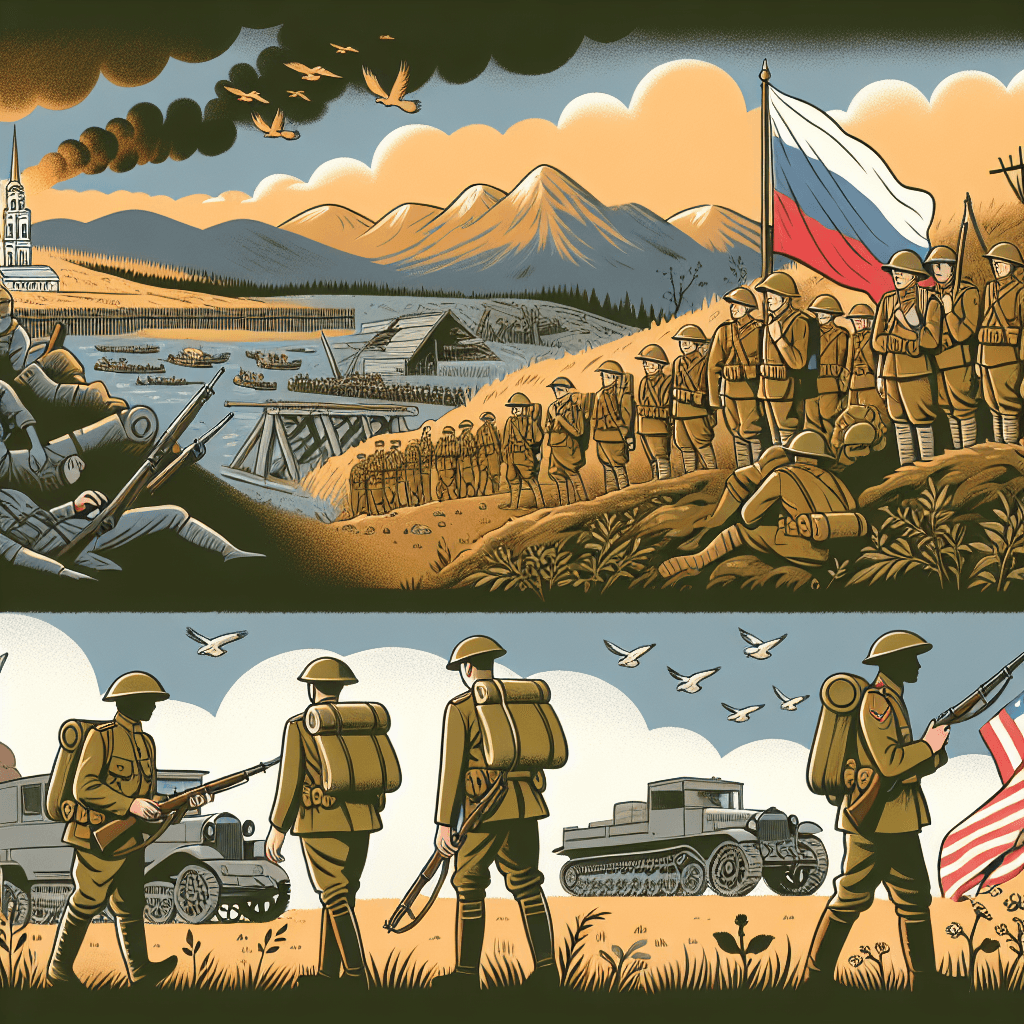
Turning Points of WWI: Russia, US, and the Outcome
Inquiry Framework
Question Framework
Driving Question
The overarching question that guides the entire project.How did the chaos of revolution in Russia and the arrival of the Americans dramatically shift the tides of World War I, and what lasting impact did these events have on the world stage?Essential Questions
Supporting questions that break down major concepts.- What were the major causes of the Russian Revolution?
- How did the Russian Revolution impact Russia's involvement in World War I?
- What were the reasons for the United States' entry into World War I?
- How did the entry of the United States into World War I affect the balance of power?
- In what ways did the Russian Revolution and the entry of the United States shape the outcome of World War I?
Standards & Learning Goals
Learning Goals
By the end of this project, students will be able to:- Analyze the causes and consequences of the Russian Revolution.
- Evaluate the impact of the Russian Revolution on Russia's participation in World War I.
- Determine the reasons for the United States' entry into World War I.
- Assess the effects of the United States' entry into World War I on the balance of power.
- Explain how the Russian Revolution and the entry of the United States shaped the outcome of World War I.
Entry Events
Events that will be used to introduce the project to studentsThe Telegram Intercept
Students receive a 'leaked' telegram that mirrors the Zimmerman Telegram but implicates a modern-day country in a similar plot. They must analyze the telegram, research the implicated country's current geopolitical situation, and debate whether this act warrants intervention, mirroring the US decision to enter WWI.Portfolio Activities
Portfolio Activities
These activities progressively build towards your learning goals, with each submission contributing to the student's final portfolio.Revolution's Roots Research
Students will delve into the historical context of the Russian Revolution, identifying key factors that led to the downfall of the Tsarist regime. This activity sets the stage for understanding the revolution's impact on World War I.Steps
Here is some basic scaffolding to help students complete the activity.Final Product
What students will submit as the final product of the activityA well-researched report outlining the causes of the Russian Revolution, accompanied by a timeline of key events.Alignment
How this activity aligns with the learning objectives & standardsAddresses the learning goal: Analyze the causes and consequences of the Russian Revolution.The Eastern Front Impact Analysis
Students will explore how the Russian Revolution directly affected Russia's involvement in World War I, including the Treaty of Brest-Litovsk and its consequences for the Allied forces.Steps
Here is some basic scaffolding to help students complete the activity.Final Product
What students will submit as the final product of the activityAn analytical essay explaining how the Russian Revolution influenced Russia's role in WWI, including the effects of the Treaty of Brest-Litovsk.Alignment
How this activity aligns with the learning objectives & standardsAddresses the learning goal: Evaluate the impact of the Russian Revolution on Russia's participation in World War I.America's War Rationale
Students will investigate the reasons behind the United States' decision to enter World War I, considering factors such as unrestricted submarine warfare, the Zimmerman Telegram, and economic interests.Steps
Here is some basic scaffolding to help students complete the activity.Final Product
What students will submit as the final product of the activityA persuasive speech arguing for or against the United States' entry into World War I, based on historical evidence.Alignment
How this activity aligns with the learning objectives & standardsAddresses the learning goal: Determine the reasons for the United States' entry into World War I.Turning Points: Revolution & Intervention
Students will synthesize their knowledge to explain how the Russian Revolution and the entry of the United States shaped the final outcome of World War I, considering both immediate and long-term consequences.Steps
Here is some basic scaffolding to help students complete the activity.Final Product
What students will submit as the final product of the activityA comprehensive essay explaining how the Russian Revolution and the entry of the United States shaped the outcome of World War I, including long-term consequences.Alignment
How this activity aligns with the learning objectives & standardsAddresses the learning goal: Explain how the Russian Revolution and the entry of the United States shaped the outcome of World War I.Shifting Sands: The American Influence
Students will examine how the entry of the United States into World War I shifted the balance of power, focusing on military, economic, and psychological impacts on the Allied and Central Powers.Steps
Here is some basic scaffolding to help students complete the activity.Final Product
What students will submit as the final product of the activityA comparative analysis chart illustrating the shifts in military, economic, and psychological advantages after the US entry into the war.Alignment
How this activity aligns with the learning objectives & standardsAddresses the learning goal: Assess the effects of the United States' entry into World War I on the balance of power.Rubric & Reflection
Portfolio Rubric
Grading criteria for assessing the overall project portfolioWorld War I Turning Points Assessment Rubric
Research and Analysis
Evaluation of students' ability to conduct thorough research and analyze historical events accurately.Depth of Research
Assesses the extent and depth of research conducted, focusing on the relevance and variety of sources.
Exemplary
4 PointsConducts extensive research using a wide range of credible sources, demonstrating a comprehensive understanding.
Proficient
3 PointsConducts thorough research using multiple credible sources, demonstrating a strong understanding.
Developing
2 PointsConducts adequate research using some credible sources, demonstrating a basic understanding.
Beginning
1 PointsConducts limited research with minimal credible sources, demonstrating incomplete understanding.
Historical Analysis
Evaluates the ability to analyze and interpret historical events and their impacts.
Exemplary
4 PointsAnalyzes historical events with exceptional insight, making innovative connections and interpretations.
Proficient
3 PointsAnalyzes historical events effectively, making clear and logical interpretations.
Developing
2 PointsAnalyzes historical events with some insight, but interpretations are basic and lack depth.
Beginning
1 PointsStruggles to analyze historical events, with minimal insight and weak interpretations.
Synthesis and Communication
Assessment of students' ability to synthesize information and communicate findings effectively.Synthesis of Information
Measures the ability to combine insights from various sources into a coherent narrative.
Exemplary
4 PointsSynthesizes information into a highly coherent and insightful narrative that is exceptionally well-structured.
Proficient
3 PointsSynthesizes information into a clear and logical narrative that is well-structured.
Developing
2 PointsAttempts to synthesize information, but narrative is somewhat disorganized and lacks coherence.
Beginning
1 PointsStruggles to synthesize information into a coherent narrative, with significant disorganization.
Effective Communication
Evaluates clarity, style, and persuasiveness in written and spoken communication.
Exemplary
4 PointsCommunicates with exceptional clarity and style, using language effectively to persuade and inform.
Proficient
3 PointsCommunicates clearly and effectively, with adequate style and persuasiveness.
Developing
2 PointsCommunicates ideas with some clarity, but with shortcomings in style and persuasive impact.
Beginning
1 PointsStruggles with clarity and style in communication, lacking persuasive impact.
Critical Thinking and Reflection
Evaluation of students' critical thinking and ability to reflect on historical implications.Critical Evaluation
Measures the ability to critically evaluate historical events and ideas.
Exemplary
4 PointsEvaluates historical events with a high degree of complexity, critically questioning underlying assumptions.
Proficient
3 PointsCritically evaluates historical events with clear reasoning and evidence-based assessment.
Developing
2 PointsEvaluates historical events in a basic manner, with limited critical questioning.
Beginning
1 PointsStruggles to critically evaluate historical events, with minimal depth or questioning.