
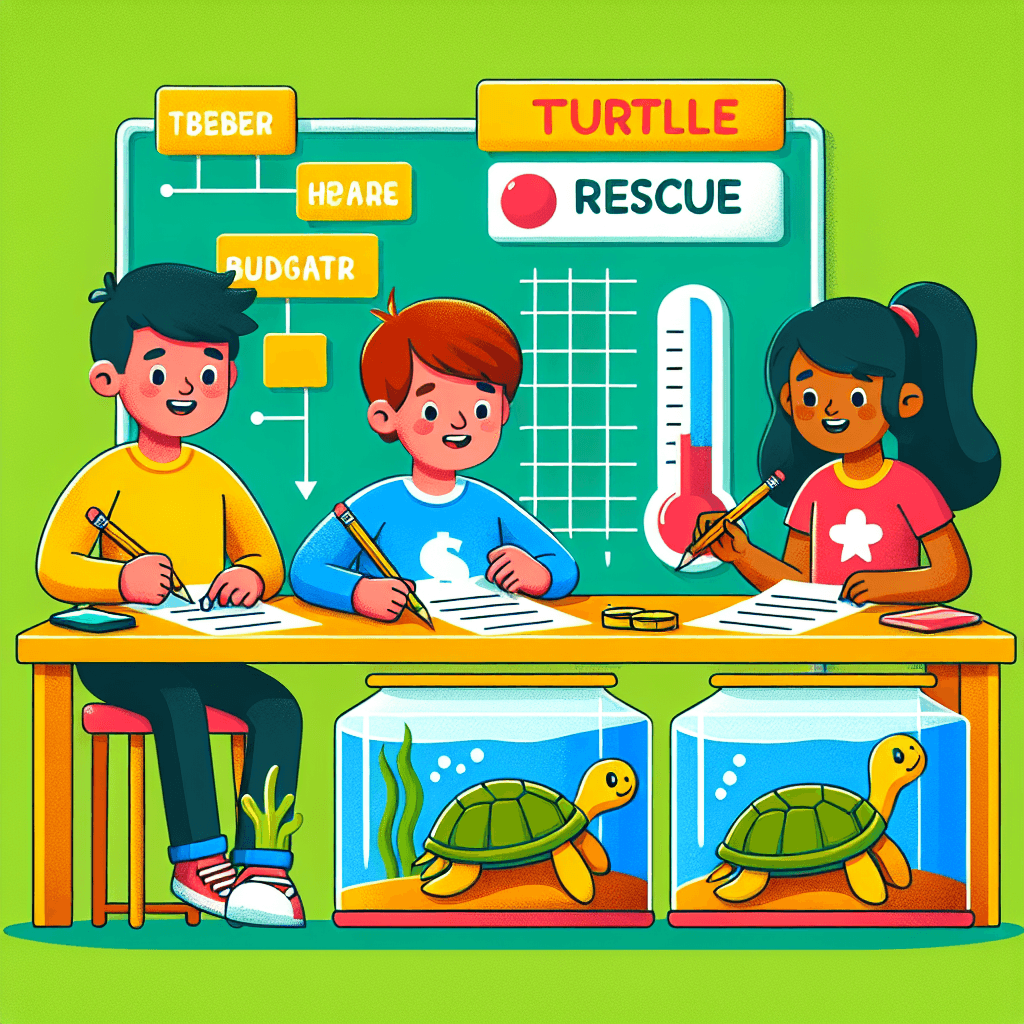
Turtle Rescue: Budgeting and Temperature Math Project
Inquiry Framework
Question Framework
Driving Question
The overarching question that guides the entire project.How can we, as turtle rescuers, use math to provide the best possible care for rescued turtles, managing our budget, monitoring their health, building their habitats, and scheduling their care?Essential Questions
Supporting questions that break down major concepts.- How can we use addition and subtraction to manage our turtle rescue budget effectively?
- How does temperature affect the turtles' health, and how can we use math to monitor and regulate it?
- How can we use measurement to ensure the turtles have appropriate living spaces?
- How can we collect and represent data about the turtles to help them?
- How can we use our understanding of time to create a feeding and care schedule for the turtles?
Standards & Learning Goals
Learning Goals
By the end of this project, students will be able to:- Students will be able to add and subtract to manage a turtle rescue budget effectively.
- Students will be able to use measurement to ensure the turtles have appropriate living spaces.
- Students will be able to collect and represent data about the turtles to help them.
- Students will be able to use their understanding of time to create a feeding and care schedule for the turtles.
Entry Events
Events that will be used to introduce the project to studentsTurtle Temperature Challenge
Students receive a mysterious package containing temperature data from rescued turtles, some of which are dangerously low. Can they use addition and subtraction to determine how much each turtle's temperature needs to increase to reach a safe level, sparking immediate empathy and a concrete math challenge?The Great Turtle Bake Sale
The school decides to host a bake sale to raise money for the turtle rescue. Students use multiplication and division to determine ingredient quantities, calculate profits per item, and track overall earnings, turning a classroom event into a real-world math exercise.Portfolio Activities
Portfolio Activities
These activities progressively build towards your learning goals, with each submission contributing to the student's final portfolio.Turtle Budget Builders
Students will learn to add and subtract costs associated with turtle care to stay within a set budget. This activity introduces basic financial management skills in the context of caring for turtles.Steps
Here is some basic scaffolding to help students complete the activity.Final Product
What students will submit as the final product of the activityA detailed budget worksheet showing how to allocate funds for turtle care within a $50 limit, including itemized costs and remaining balance.Alignment
How this activity aligns with the learning objectives & standardsAddresses the learning goal: Students will be able to add and subtract to manage a turtle rescue budget effectively.Rubric & Reflection
Portfolio Rubric
Grading criteria for assessing the overall project portfolioTurtle Budget Builders Rubric
Budget Accuracy
Focuses on the accuracy of calculations and adherence to the budget limit.Addition and Subtraction
Accuracy of adding and subtracting costs to calculate the remaining budget.
Exemplary
4 PointsAll addition and subtraction calculations are accurate and precise, with a clear understanding of how each transaction affects the total budget.
Proficient
3 PointsMost addition and subtraction calculations are accurate, with only minor errors that do not significantly impact the budget's integrity.
Developing
2 PointsSome addition and subtraction calculations contain errors, leading to inaccuracies in the budget's remaining balance.
Beginning
1 PointsAddition and subtraction calculations are frequently inaccurate, resulting in a significantly flawed budget.
Budget Adherence
Ability to stay within the $50 budget limit while purchasing necessary items.
Exemplary
4 PointsThe budget meticulously stays within the $50 limit, with thoughtful allocation of funds to maximize turtle care without overspending.
Proficient
3 PointsThe budget remains within the $50 limit, with only slight instances of miscalculation or near-exceedance.
Developing
2 PointsThe budget occasionally exceeds the $50 limit, requiring some adjustments or a limited understanding of budget constraints.
Beginning
1 PointsThe budget significantly exceeds the $50 limit, indicating a lack of understanding of budget constraints and financial planning.
Financial Literacy
Focuses on the understanding and application of financial concepts within the rescue context.Needs vs. Wants
Distinguishes between essential needs (e.g., food, medical care) and optional wants (e.g., luxury items) for turtle care.
Exemplary
4 PointsClearly differentiates between essential needs and optional wants for turtle care, prioritizing needs effectively within the budget.
Proficient
3 PointsMostly differentiates between needs and wants, with some minor instances of confusing priorities within the budget.
Developing
2 PointsStruggles to differentiate between needs and wants, leading to some misallocation of funds and potential neglect of essential items.
Beginning
1 PointsFails to differentiate between needs and wants, resulting in a budget that does not adequately address the turtles' essential requirements.
Cost Prioritization
Ability to prioritize essential expenses and make informed decisions about which items to purchase first.
Exemplary
4 PointsDemonstrates excellent prioritization skills, allocating funds strategically to ensure the turtles' most critical needs are met before considering less essential items.
Proficient
3 PointsPrioritizes expenses effectively, with a clear rationale for the order in which items are purchased and a focus on meeting essential needs.
Developing
2 PointsShows some understanding of cost prioritization but may occasionally overlook essential items or allocate funds inefficiently.
Beginning
1 PointsStruggles to prioritize expenses, often purchasing less essential items before addressing the turtles' critical needs, indicating a lack of financial planning skills.
Presentation and Clarity
Focuses on the clarity and organization of the budget worksheet, making it easy to understand and follow.Organization
The budget worksheet is well-organized, with clear headings, itemized lists, and a logical flow of information.
Exemplary
4 PointsThe budget worksheet is exceptionally well-organized, using clear headings, itemized lists, and a logical flow of information to enhance readability and understanding.
Proficient
3 PointsThe budget worksheet is generally well-organized, with clear headings and itemized lists that facilitate understanding.
Developing
2 PointsThe budget worksheet lacks organization, with unclear headings, incomplete itemized lists, and a confusing flow of information.
Beginning
1 PointsThe budget worksheet is disorganized and difficult to follow, with missing headings, jumbled lists, and no logical flow of information.
Clarity of Explanation
Provides clear and concise explanations for each budget decision, justifying the allocation of funds.
Exemplary
4 PointsProvides exceptionally clear and concise explanations for each budget decision, thoroughly justifying the allocation of funds and demonstrating a deep understanding of financial planning principles.
Proficient
3 PointsProvides clear explanations for most budget decisions, justifying the allocation of funds with sufficient detail.
Developing
2 PointsProvides incomplete or unclear explanations for some budget decisions, lacking sufficient justification for the allocation of funds.
Beginning
1 PointsFails to provide clear explanations for budget decisions, offering little to no justification for the allocation of funds and demonstrating a lack of understanding of financial planning principles.