
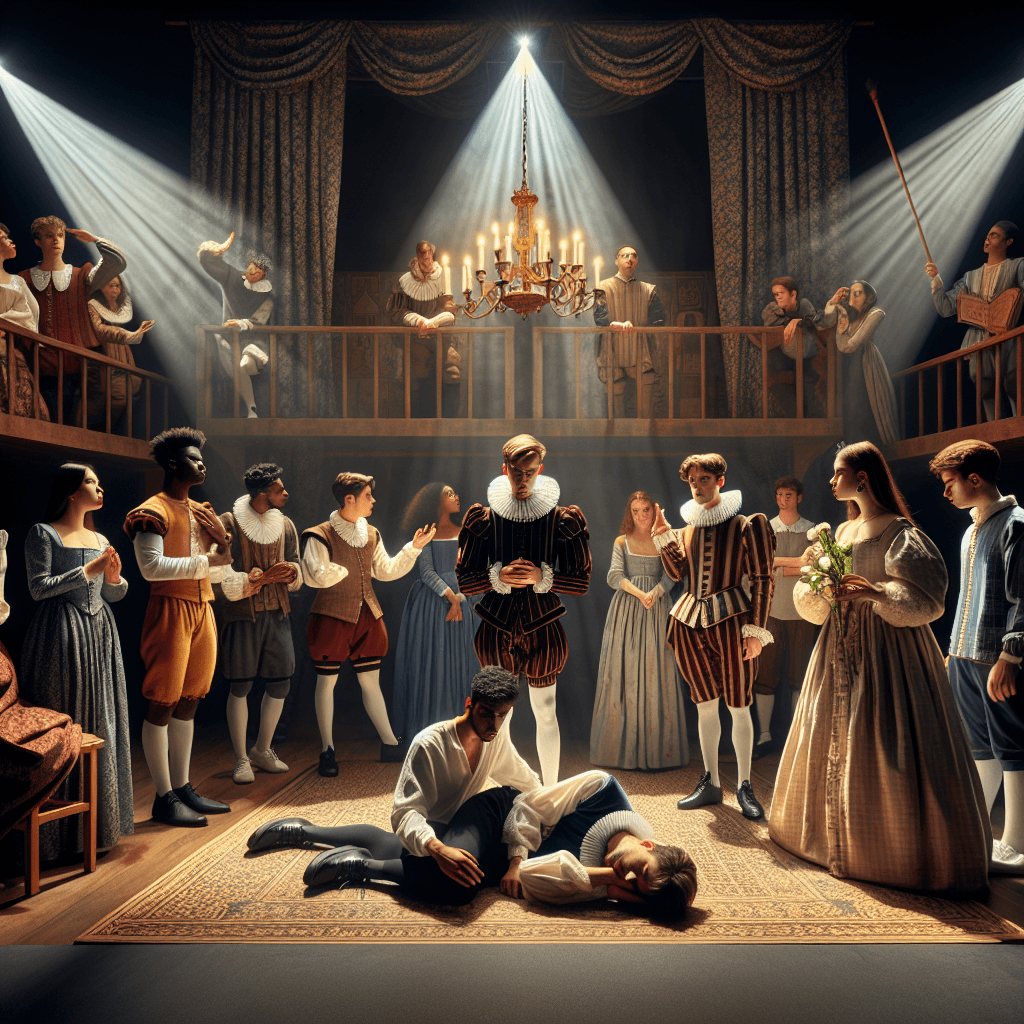
Twelfth Night on Stage: Shakespearean Acting Project
Inquiry Framework
Question Framework
Driving Question
The overarching question that guides the entire project.How can we, as Shakespearean actors, effectively interpret and perform scenes from Twelfth Night to communicate its key themes and motifs to a modern audience while reflecting on its societal norms and enhancing audience engagement?Essential Questions
Supporting questions that break down major concepts.- What are the key themes and motifs in Twelfth Night, and how do they resonate with modern audiences?
- How do characters in Twelfth Night reflect the societal norms of Elizabethan society, and are there parallels with today’s society?
- How can the use of language in Twelfth Night enhance a performer’s communication and audience engagement?
- In what ways can analyzing the characters' motivations in Twelfth Night help develop a deeper understanding of the text?
- What techniques can actors use to effectively convey the emotions and intentions of their characters in a Shakespearean play?
Standards & Learning Goals
Learning Goals
By the end of this project, students will be able to:- Students will effectively interpret and perform scenes from Shakespeare's Twelfth Night to communicate its themes and motifs.
- Students will analyze the key themes and motifs of Twelfth Night and how they resonate with modern audiences.
- Students will assess the sociohistorical context of Twelfth Night and draw parallels with contemporary society.
- Students will enhance their speaking and listening skills through performance and peer feedback.
- Students will use language analysis to inform their acting decisions and enhance audience engagement.
Common Core State Standards
Entry Events
Events that will be used to introduce the project to studentsVirtual Shakespearean Mystery
Leveraging technology, students embark on a virtual tour of the Globe Theatre. Along the way, they uncover clues left by an anonymous 'Shakespearean ghost' demanding the restoration of a lost scene from Twelfth Night. This sparks collaboration and inquiry into the text of the play.Shakespeare's Talent Show
Students enter a transformed classroom set up as a 17th-century theater. A 'casting director' challenges them to audition for a role by interpreting a modern song or dialogue as if it were written by Shakespeare. This prompts curiosity about language use and performance styles in Shakespeare's time.Portfolio Activities
Portfolio Activities
These activities progressively build towards your learning goals, with each submission contributing to the student's final portfolio.Shakespearean Sleuths
In this activity, students will become detectives, delving into Twelfth Night's language and themes. They'll explore key passages to uncover the play's underlying meanings and nuances, connecting them to modern themes.Steps
Here is some basic scaffolding to help students complete the activity.Final Product
What students will submit as the final product of the activityTheme and language maps connecting Twelfth Night to modern themes.Alignment
How this activity aligns with the learning objectives & standardsAligns with CCSS.ELA-LITERACY.RL.8.4; focuses on analyzing language and themes.Character Chronicles
Students will create detailed dossiers on the characters of Twelfth Night. These character studies will explore the societal norms and motivations within the play and draw modern parallels.Steps
Here is some basic scaffolding to help students complete the activity.Final Product
What students will submit as the final product of the activityDetailed character dossiers illustrating motivations and societal norms.Alignment
How this activity aligns with the learning objectives & standardsAligns with CCSS.ELA-LITERACY.RL.8.7 and CCSS.ELA-LITERACY.W.8.9; focuses on character analysis and research.The Performance Pitch
Transform literary analysis into action by pitching a creative performance interpretation of a selected scene. Students will integrate their research on themes and character motivations into their pitch to make the text resonate with modern audiences.Steps
Here is some basic scaffolding to help students complete the activity.Final Product
What students will submit as the final product of the activityA storyboard and pitch for a scene interpretation integrating modern themes and character studies.Alignment
How this activity aligns with the learning objectives & standardsAligns with CCSS.ELA-LITERACY.SL.8.4; focuses on presentation and coherent interpretation of scenes.Rehearsal Retreat
In this activity, students will engage in collaborative rehearsals, applying interpretive insights and feedback to refine their performances. The emphasis will be on enhancing communication and engagement.Steps
Here is some basic scaffolding to help students complete the activity.Final Product
What students will submit as the final product of the activityRefined performance pieces ready for class presentation.Alignment
How this activity aligns with the learning objectives & standardsAligns with CCSS.ELA-LITERACY.SL.8.1 and CCSS.ELA-LITERACY.RL.8.4; focuses on collaborative discussion and language analysis in performance.Showcase Spectacle
The final activity culminates with a performance showcase for an audience. Students perform their scenes, demonstrating their understanding of the play's language, themes, and character motivations.Steps
Here is some basic scaffolding to help students complete the activity.Final Product
What students will submit as the final product of the activityA full class performance of Twelfth Night scenes, showcasing interpretation and language use.Alignment
How this activity aligns with the learning objectives & standardsAligns with CCSS.ELA-LITERACY.SL.8.4 and CCSS.ELA-LITERACY.RL.8.7; focuses on performing and reflecting on interpretations.Rubric & Reflection
Portfolio Rubric
Grading criteria for assessing the overall project portfolioTwelfth Night Performance and Analysis Rubric
Thematic and Language Analysis
Assessment of students' ability to analyze and interpret themes and language within Twelfth Night, connecting to modern contexts.Theme Connection
Evaluation of how well students connect Twelfth Night's themes to modern issues or contexts.
Exemplary
4 PointsStudent provides an insightful and sophisticated analysis, drawing clear and relevant connections between Twelfth Night's themes and contemporary issues.
Proficient
3 PointsStudent provides a thorough analysis, making logical connections between the play's themes and modern contexts.
Developing
2 PointsStudent attempts to connect themes to modern contexts but lacks depth or clarity in analysis.
Beginning
1 PointsStudent shows limited ability to connect themes, demonstrating minimal analysis.
Language Analysis
Evaluation of students’ understanding and interpretation of Shakespearean language in their scenes.
Exemplary
4 PointsStudent demonstrates a nuanced understanding of the language, analyzing the implications of specific word choices and their effects on tone and meaning.
Proficient
3 PointsStudent shows a clear understanding of the language, effectively analyzing essential word choices and their impact on meaning.
Developing
2 PointsStudent shows a basic understanding of the language but struggles with analyzing word choice impact.
Beginning
1 PointsStudent demonstrates minimal understanding of Shakespearean language and its use in conveying themes.
Character Analysis and Interpretation
Assessment of students' ability to analyze character motivations and interpret their roles creatively.Character Understanding
Evaluation of students’ depth of understanding regarding character motivations and societal influences.
Exemplary
4 PointsStudent demonstrates profound understanding of character motivations and effectively links these to societal norms in both Elizabethan and modern contexts.
Proficient
3 PointsStudent shows thorough understanding of character motivations and makes clear connections to societal norms.
Developing
2 PointsStudent shows emerging understanding of character motivations with limited connections to societal contexts.
Beginning
1 PointsStudent struggles to understand character motivations and societal influences.
Interpretive Creativity
Evaluation of students’ creativity in conveying their characters through performance.
Exemplary
4 PointsStudent uses innovative performance techniques, effectively conveying character emotions and intentions with originality and authenticity.
Proficient
3 PointsStudent uses effective performance techniques to convey character emotions and intentions with clarity.
Developing
2 PointsStudent uses basic performance techniques with some difficulty in conveying emotions and intentions clearly.
Beginning
1 PointsStudent shows minimal use of performance techniques, struggling to convey character emotions and intentions effectively.
Performance and Collaboration Skills
Assessment of students' presentation skills, teamwork, and ability to engage an audience effectively.Speech Delivery
Evaluation of oral communication skills during performances, focusing on clarity, expression, and audience engagement.
Exemplary
4 PointsStudent delivers speech with excellent clarity, expression, and audience engagement, showing exceptional command over language.
Proficient
3 PointsStudent delivers speech clearly with good expression and engagement levels, effectively communicating ideas.
Developing
2 PointsStudent delivers speech with partial clarity and engagement, attempting to express ideas clearly.
Beginning
1 PointsStudent struggles with speech delivery, showing limited clarity and audience engagement.
Collaboration and Reflection
Evaluation of students' collaborative work in performance preparation and reflection on feedback.
Exemplary
4 PointsStudent shows leadership in collaboration, actively contributes to discussions, and integrates feedback into performance with insightful reflection.
Proficient
3 PointsStudent participates effectively in collaborative work, contributes to discussions, and integrates feedback into performance.
Developing
2 PointsStudent participates in collaborative work but with limited contribution to discussions or integration of feedback.
Beginning
1 PointsStudent requires significant support in collaborative settings and struggles to integrate feedback.