
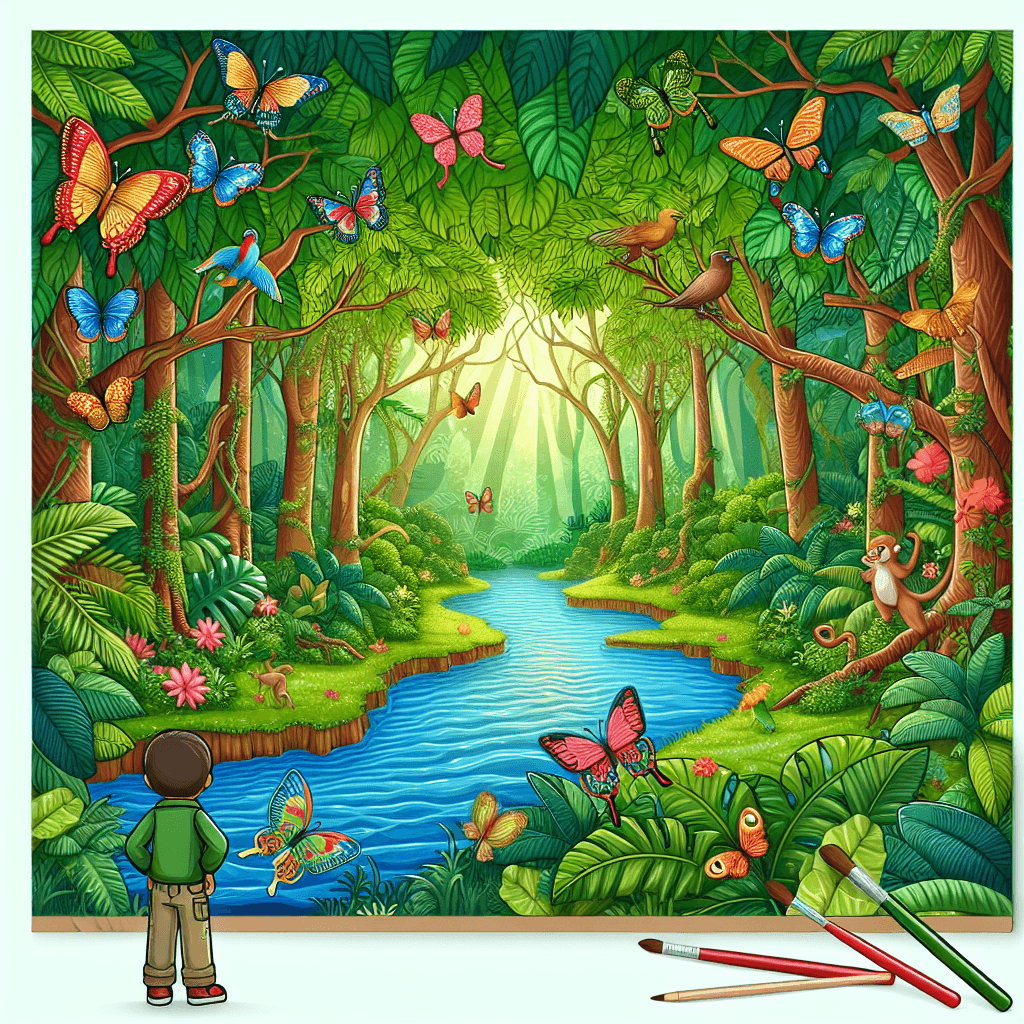
Under the Canopy: A Rainforest Narrative Adventure
Inquiry Framework
Question Framework
Driving Question
The overarching question that guides the entire project.How can we, as authors, use sensory details and real-world facts to craft a suspenseful narrative that transports our readers into the heart of the rainforest?Essential Questions
Supporting questions that break down major concepts.- How can sensory details and descriptive language bring the rainforest setting to life for a reader?
- How does the sequence of events in a story impact the reader's understanding of a character's journey through the rainforest?
- What techniques can writers use to deepen a plot and create a sense of tension or excitement in a longer narrative?
- How can real-world facts about the rainforest ecosystem be transformed into an engaging and believable fictional experience?
- How do a character's reactions to the rainforest environment reveal their personality and drive the story forward?
Standards & Learning Goals
Learning Goals
By the end of this project, students will be able to:- Students will compose a narrative that includes a clear sequence of events, a well-developed plot, and a specific focus on creating suspense or tension within the rainforest setting.
- Students will integrate at least three specific, factual details about the rainforest ecosystem (e.g., layers of the forest, specific animal behaviors, or climate) into their fictional story to enhance realism and depth.
- Students will utilize sensory language (sight, sound, smell, touch) and descriptive techniques to establish a vivid setting that 'transports' the reader.
- Students will demonstrate character development by showing how their protagonist reacts to and interacts with the unique challenges of the rainforest environment.
Common Core State Standards (ELA)
Next Generation Science Standards (NGSS)
Entry Events
Events that will be used to introduce the project to studentsThe Vanished Researcher’s Archive
Students arrive to find a "lost" field researcher's backpack containing a mud-stained journal, a cracked digital recorder, and a blurry photo of a never-before-seen animal. After listening to a 30-second audio clip of the researcher describing a sudden, mysterious change in the forest canopy, students must decide: what happened next to the researcher?The Canopy Glitch Mystery
The teacher displays a "live" satellite feed of the Amazon that suddenly glitches, revealing a group of different animal species working together to hide a hidden temple or landmark. Students are tasked with writing the "unauthorized history" of why these animals are protecting that secret, using their knowledge of rainforest layers and biodiversity.The 24-Hour Bio-Dome Crisis
The classroom is transformed into a sensory "bio-dome" with tropical soundscapes and the scent of damp earth, but a simulated emergency alert warns that the biodiversity of their sector is rapidly shifting. Students must choose a specific rainforest inhabitant (animal or human) and write a narrative detailing how they survive the next 24 hours of environmental upheaval.The Kapok Tree’s Memories
A visiting "scientist" reveals a prototype "Bio-Translator" device that has captured cryptic memories stored in the roots of an ancient Kapok tree. Students receive fragmented phrases like "the jaguar stopped hunting" or "the river began to glow" and must weave these clues into a narrative that explains the untold history of that specific patch of forest.Portfolio Activities
Portfolio Activities
These activities progressively build towards your learning goals, with each submission contributing to the student's final portfolio.The Explorer’s Fact-File
Before diving into the fiction, students must act as 'fact-checkers' for their own stories. In this activity, students select one of the project's entry events (like the Vanished Researcher’s Archive) and build a 'Fact-File' that will serve as the scientific foundation for their narrative. They will identify specific rainforest layers, animal behaviors, and environmental challenges they plan to include.Steps
Here is some basic scaffolding to help students complete the activity.Final Product
What students will submit as the final product of the activityA 'Rainforest Fact-File' graphic organizer containing at least five researched facts and three specific ecological interactions (e.g., predator-prey or symbiotic relationships) that will appear in their story.Alignment
How this activity aligns with the learning objectives & standardsThis activity aligns with CCSS.ELA-LITERACY.W.5.8 by requiring students to recall and gather relevant information about the rainforest ecosystem. It also touches upon 5-LS2-1 as students must select factual interactions within the ecosystem to ground their story in reality.Jungle Jitters: Sensory Mapping
To 'transport' the reader, students need to move beyond simple descriptions. In this activity, students will create a 'Sensory Palette' for their chosen rainforest setting. They will write descriptive 'vignettes' for each of the five senses, focusing on how the rainforest feels, smells, and sounds during the specific time of day their story takes place.Steps
Here is some basic scaffolding to help students complete the activity.Final Product
What students will submit as the final product of the activityA 'Sensory Map' of their story's setting, featuring descriptive paragraphs or bulleted lists for sight, sound, smell, touch, and taste (e.g., the taste of humidity or a tropical fruit).Alignment
How this activity aligns with the learning objectives & standardsThis activity aligns with CCSS.ELA-LITERACY.W.5.3.D, which focuses on using concrete words and phrases and sensory details to convey experiences and events precisely.The Suspense Blueprint
Now that students have the facts and the atmosphere, they must build the 'skeleton' of their narrative. Students will create a storyboard that outlines the sequence of events, focusing on how to build suspense. They will plan their introduction (the hook), the rising action (the mystery or crisis), the climax, and the resolution.Steps
Here is some basic scaffolding to help students complete the activity.Final Product
What students will submit as the final product of the activityA 6-panel Storyboard Blueprint that includes sketches of the action and 'Transition Tags' (words like 'Suddenly,' 'Beyond the clearing,' or 'As the sun dipped below the canopy') to show the passage of time and movement.Alignment
How this activity aligns with the learning objectives & standardsThis activity aligns with CCSS.ELA-LITERACY.W.5.3.A (orienting the reader and establishing a situation) and CCSS.ELA-LITERACY.W.5.3.C (using transitional words and phrases to manage the sequence of events).Into the Canopy: The First Draft
Students will now transform their storyboard into a full narrative draft. The focus here is 'Deepening the Plot.' Students will use dialogue to reveal character traits and vary their sentence structure to control the pacing—short, punchy sentences for high-action moments and longer, flowing sentences for descriptive, calm moments.Steps
Here is some basic scaffolding to help students complete the activity.Final Product
What students will submit as the final product of the activityA first draft of the 'Rainforest Narrative' (2–3 pages) that successfully integrates the sensory details, facts, and sequenced events from the previous activities.Alignment
How this activity aligns with the learning objectives & standardsThis activity aligns with CCSS.ELA-LITERACY.W.5.3.B (using narrative techniques like dialogue and pacing) and CCSS.ELA-LITERACY.L.5.3.A (expanding and combining sentences for meaning and style).Rubric & Reflection
Portfolio Rubric
Grading criteria for assessing the overall project portfolioThe Rainforest Chronicles: Integrated Narrative & Science Rubric
Narrative Architecture
Evaluates the student's ability to craft a well-structured narrative with a clear beginning, middle, and end, while effectively managing the passage of time.Plot Structure & Sequencing
The ability to organize a clear, logical sequence of events that builds suspense and resolves a conflict within the rainforest setting.
Exemplary
4 PointsThe narrative features a sophisticated, logical sequence of events with a compelling inciting incident, masterful rising action that builds intense suspense, and a resolution that thoughtfully reflects an ecological truth. The plot is deeply developed and innovative.
Proficient
3 PointsThe narrative follows a clear and logical sequence of events. It establishes a distinct conflict, uses effective rising action to create tension, and concludes with a resolution that ties the story together and relates to the rainforest.
Developing
2 PointsThe narrative has an emerging sequence of events, but the pacing may feel rushed or disjointed. The conflict is present but could be more clearly developed, and the resolution may feel abrupt or incomplete.
Beginning
1 PointsThe story lacks a clear sequence of events or a defined conflict. The plot is difficult to follow, and the resolution is missing or does not align with the events of the story.
Transitions & Pacing
The use of transitional words, phrases, and sentence variety to manage the flow of the story and create a specific atmosphere or pace.
Exemplary
4 PointsSkillfully uses a wide variety of 'Transition Tags' and varied sentence structures to masterfully control pacing (e.g., short sentences for high-tension moments). Transitions between scenes are seamless and enhance the reader's experience.
Proficient
3 PointsUses appropriate transitional words and phrases to manage the sequence of events. Includes a mix of sentence lengths to create reader interest and maintain a steady narrative flow.
Developing
2 PointsUses basic transitional words (e.g., 'then,' 'next') but they may feel repetitive. Sentence structure is mostly uniform, providing limited variation in pacing or style.
Beginning
1 PointsLacks transitional phrases, making the story feel like a list of disconnected events. Sentence structure is simple and repetitive, offering little to no control over pacing.
Descriptive Craft & Atmosphere
Focuses on the student's ability to 'transport' the reader using descriptive techniques and sensory language.Sensory Imagery
The use of sight, sound, smell, touch, and taste to create a vivid, immersive rainforest environment.
Exemplary
4 PointsUses exceptional sensory language that 'transports' the reader. Descriptions are highly specific (e.g., 'cacophony of cicadas') and avoid clichés. Every sense is intentionally used to deepen the atmosphere of the specific rainforest layer.
Proficient
3 PointsConsistently uses sensory details to describe the rainforest setting. Includes most of the five senses to help the reader visualize the environment and understand the character's experience.
Developing
2 PointsIncludes some sensory details, but they are often generic (e.g., 'it was hot,' 'the trees were green'). Descriptions are present but do not yet fully immerse the reader in the setting.
Beginning
1 PointsProvides minimal description of the setting. Relies on 'telling' rather than 'showing,' and sensory details are largely absent or ineffective.
Word Choice & Style
The intentional choice of powerful verbs and adjectives to bring the rainforest and its inhabitants to life.
Exemplary
4 PointsDemonstrates an advanced vocabulary with precise, 'strong' verbs and vivid adjectives that capture the unique essence of rainforest life. Language is evocative and shows a high level of word craft.
Proficient
3 PointsUses descriptive language and precise vocabulary to establish the setting and describe character actions. Words are chosen effectively to avoid overused or simple language.
Developing
2 PointsUses some descriptive words, but relies heavily on common adjectives and verbs. The language is functional but lacks the precision needed to create a unique rainforest atmosphere.
Beginning
1 PointsUses very limited or repetitive vocabulary. Word choices are basic and do not contribute to the reader's understanding of the specific rainforest environment.
Scientific Grounding & Realism
Evaluates the student's ability to ground their creative writing in scientific reality and demonstrate understanding of ecosystems.Fact Integration
The seamless blending of researched rainforest facts and ecological interactions into the fictional narrative.
Exemplary
4 PointsSeamlessly weaves 4+ specific, factual details and complex ecological interactions (e.g., symbiosis) into the story. The facts enhance the plot and feel like a natural part of the characters' world. Evidence of deep research is clear.
Proficient
3 PointsSuccessfully integrates at least 3 specific facts about the rainforest ecosystem. Facts are accurate and used to support the realism of the story's setting and events.
Developing
2 PointsIncludes 1-2 facts, but they may feel 'tacked on' or slightly disconnected from the narrative action. There may be minor inaccuracies in how the facts are applied to the story.
Beginning
1 PointsThe story contains few or no scientific facts. Information provided about the rainforest is vague, generic, or contains significant scientific inaccuracies.
Character-Environment Interaction
How characters react to and interact with the specific challenges and biodiversity of the rainforest environment.
Exemplary
4 PointsCharacter reactions reveal deep personality traits and drive the plot forward through sophisticated interactions with the environment (e.g., utilizing a specific plant's properties for survival). Character growth is evident.
Proficient
3 PointsCharacters show clear reactions to the rainforest environment that are consistent with the setting. The environment plays a role in the character's journey and decision-making.
Developing
2 PointsCharacters interact with the setting in basic ways, but their reactions are often predictable or don't fully reveal their personality. The rainforest feels more like a backdrop than an active part of the story.
Beginning
1 PointsCharacter interactions with the environment are minimal or unrealistic. The character's personality is not developed through their experiences in the rainforest.
Narrative Technique & Process
Assesses the student's application of specific narrative techniques and their engagement with the writing process.Dialogue & Character Voice
The use of spoken words between characters to reveal character traits, move the plot, and add realism.
Exemplary
4 PointsDialogue is used masterfully to reveal distinct character voices and advance the plot. It feels natural and is punctuated correctly, adding significant depth to the story's tension or mystery.
Proficient
3 PointsIncludes effective dialogue that helps the reader understand the characters and their situation. Dialogue sequences are clear and contribute to the overall narrative.
Developing
2 PointsIncludes some dialogue, but it may be repetitive or fail to reveal much about the characters. Punctuation of dialogue may be inconsistent.
Beginning
1 PointsThe story contains little to no dialogue, or the dialogue is confusing and does not serve a purpose in the narrative.
Planning & Evidence of Process
The quality and completion of the preparatory tools used to build the final narrative.
Exemplary
4 PointsThe Fact-File and Sensory Map are exceptionally detailed and serve as a comprehensive foundation. Every element in the final draft can be traced back to sophisticated planning in these documents.
Proficient
3 PointsThe Fact-File and Sensory Map are complete and clearly inform the final draft. The student has identified and used the required number of facts and sensory vignettes.
Developing
2 PointsThe planning documents are partially complete. Some elements from the Fact-File or Sensory Map appear in the draft, but the connection between planning and writing is inconsistent.
Beginning
1 PointsPlanning documents are incomplete or were not used to inform the final draft. The narrative lacks the foundational details required in the preparatory steps.