
Inquiry Framework
Question Framework
Driving Question
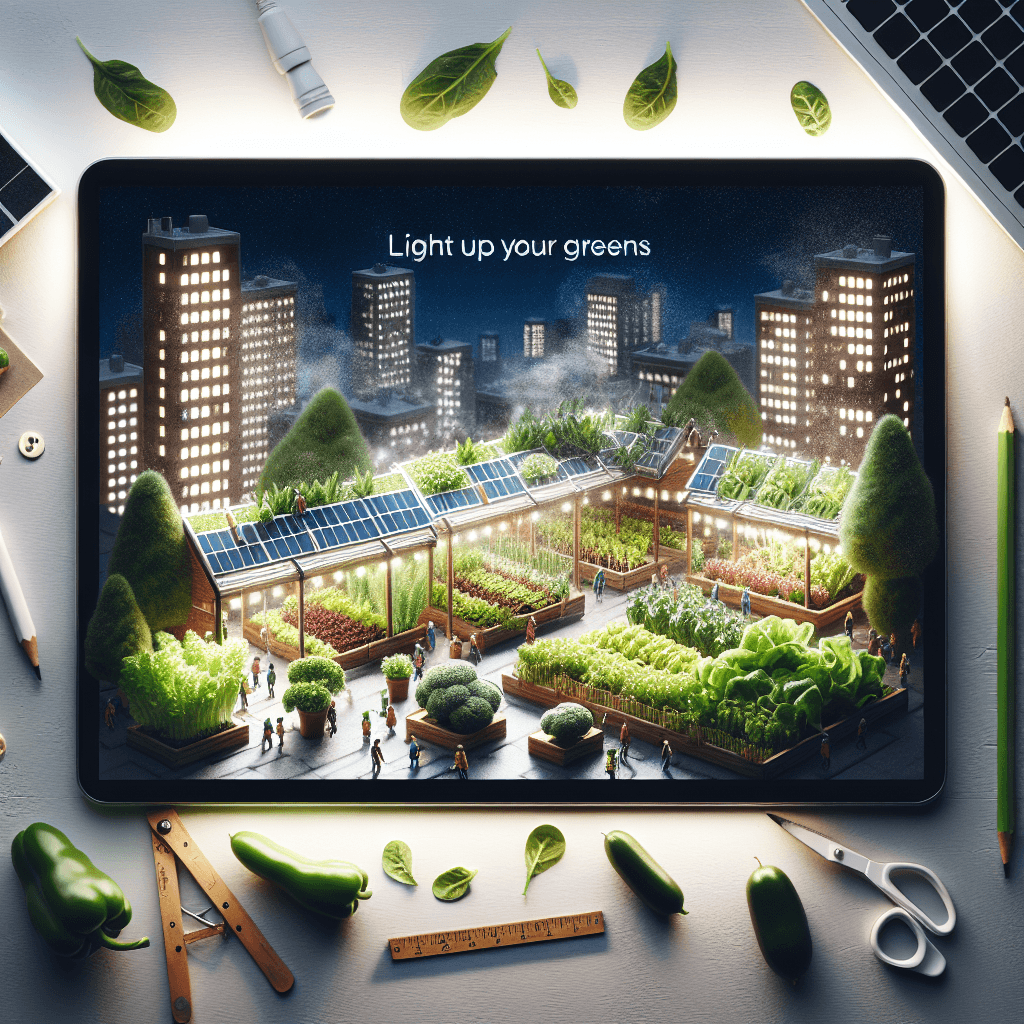
The overarching question that guides the entire project.How can we manipulate light to maximize the growth of different plant species in an urban farm, and what are the potential benefits and challenges of this approach for sustainable resource management?Essential Questions
Supporting questions that break down major concepts.- How does light intensity affect plant growth?
- What are the optimal light conditions for different plant species in an urban setting?
- How can we manipulate light to maximize plant growth in urban environments?
- What are the challenges and benefits of urban farming in terms of resource management?
- How can data analysis inform sustainable practices in urban farming?
Standards & Learning Goals
Learning Goals
By the end of this project, students will be able to:- Students will be able to design and conduct an experiment to test the effects of different light levels on plant growth.
- Students will be able to analyze and interpret data to draw conclusions about the relationship between light intensity and plant growth.
- Students will be able to apply their understanding of light and plant growth to propose solutions for optimizing plant growth in urban farming scenarios.
- Students will be able to evaluate the potential benefits and challenges of urban farming practices for sustainable resource management.
NGSS
Entry Events
Events that will be used to introduce the project to studentsThe Alien Seeds
A mysterious package arrives containing seeds from a newly discovered plant species that thrives in low-light conditions. Students investigate the plant's unique photosynthetic properties and apply their findings to improve light efficiency in urban farms.Portfolio Activities
Portfolio Activities
These activities progressively build towards your learning goals, with each submission contributing to the student's final portfolio.Mung Bean Sprout Chronicles
Students will document the growth of their mung bean under specific light conditions, focusing on observable changes like sprout length, root length, and color. They will use both qualitative and quantitative data in their observations to develop a baseline understanding of mung bean growth in different light environments.Steps
Here is some basic scaffolding to help students complete the activity.Final Product
What students will submit as the final product of the activityA detailed observation journal with daily entries, including written descriptions, sketches, and measurements of mung bean growth. This journal will serve as the initial data set for the project.Alignment
How this activity aligns with the learning objectives & standardsMS-LS2-1: Analyze and interpret data to provide evidence for the effects of resource availability... This activity focuses on observing and recording the growth of mung beans, providing initial data for later analysis.Data Detectives: Unveiling Plant Growth Patterns
Students will visually represent and analyze their collected data to identify patterns and trends in plant growth under different light conditions. They will use graphs and charts to compare the growth rates and overall health of plants in various light environments.Steps
Here is some basic scaffolding to help students complete the activity.Final Product
What students will submit as the final product of the activityGraphs and charts visualizing the collected data, demonstrating the impact of different light levels on plant growth. Students will also write a summary of their findings, explaining the observed patterns and making initial conclusions.Alignment
How this activity aligns with the learning objectives & standardsMS-LS2-1: Analyze and interpret data... This activity reinforces the standard by having students represent and analyze collected data to understand the effect of light on plant growth.Urban Farm Architects: Designing for Optimal Plant Growth
Students will apply their findings to real-world urban farming scenarios. They will design a theoretical urban farm layout that optimizes light for plant growth, considering factors like building placement, window orientation, and supplementary lighting systems.Steps
Here is some basic scaffolding to help students complete the activity.Final Product
What students will submit as the final product of the activityA detailed blueprint or model of an urban farm, demonstrating the strategic use of natural and artificial light to maximize plant growth. Accompanying this will be a written proposal explaining the design choices and their justifications based on the experimental findings.Alignment
How this activity aligns with the learning objectives & standardsMS-LS2-1: Analyze and interpret data... and apply their findings to urban farming scenarios. This activity asks students to draw conclusions about optimal light conditions and relate them to urban farming.Rubric & Reflection
Portfolio Rubric
Grading criteria for assessing the overall project portfolioUrban Farming: Light Optimization Assessment Rubric
Experimental Design and Execution
Assessment of student's ability to design, conduct, and document an experiment that tests the effects of light on plant growth.Experiment Design
Quality and clarity of the experimental setup, including control of variables and hypothesis formulation.
Exemplary
4 PointsDesigns a detailed and clear experiment with well-defined variables and hypotheses, demonstrating a deep understanding of scientific inquiry principles.
Proficient
3 PointsDesigns a comprehensive experiment with clear variables and hypotheses, showing a solid grasp of scientific inquiry principles.
Developing
2 PointsDesigns a basic experiment with some variables and hypotheses identified, indicating an emerging understanding of scientific inquiry principles.
Beginning
1 PointsStruggles to design an experiment, with poorly defined variables and hypotheses, showing an initial understanding of scientific inquiry principles.
Data Collection
Precision and regularity in collecting, documenting, and observing measurable data throughout the experiment.
Exemplary
4 PointsCollects precise and detailed data regularly, using appropriate tools and methods. Documentation is thorough and well-organized.
Proficient
3 PointsCollects clear and consistent data, using suitable tools and methods. Documentation is organized and complete.
Developing
2 PointsCollects basic data with some inconsistencies. Documentation is partly organized and occasionally incomplete.
Beginning
1 PointsCollects minimal data with significant inconsistencies. Documentation is disorganized and largely incomplete.
Data Analysis and Interpretation
Evaluates the student's ability to analyze collected data and draw meaningful conclusions about plant growth under different light conditions.Data Representation
Effectiveness in visualizing data using graphs, charts, and other tools to communicate findings.
Exemplary
4 PointsCreates insightful and precise data visualizations, effectively using graphs and charts to highlight key findings and patterns.
Proficient
3 PointsDevelops clear data visualizations, using graphs and charts to convey findings and patterns effectively.
Developing
2 PointsProduces basic data visualizations that communicate some patterns and findings.
Beginning
1 PointsProduces insufficient or unclear data visualizations that fail to communicate findings effectively.
Conclusions and Justifications
Logical conclusions and justification based on analysis of the data collected.
Exemplary
4 PointsDraws insightful conclusions, supported by robust evidence and logical reasoning, clearly justified with reference to data.
Proficient
3 PointsDraws sound conclusions, supported by appropriate evidence and reasoning, mostly justified by data.
Developing
2 PointsDraws basic conclusions with some supporting evidence and reasoning, partially justified by data.
Beginning
1 PointsStruggles to draw conclusions, with minimal evidence and reasoning, insufficiently justified by data.
Application to Urban Farming
Assessment of student's ability to apply experimental findings to design a sustainable urban farming scenario.Urban Farm Design
Creativity and feasibility of urban farm design, incorporating findings from the experiment and research into urban farming systems.
Exemplary
4 PointsDesigns an innovative and practical urban farm, effectively integrating experimental findings and comprehensive research into the layout.
Proficient
3 PointsDevelops a creative and feasible urban farm design, integrating most experimental findings and relevant research.
Developing
2 PointsCreates a basic urban farm design, incorporating some experimental findings and research.
Beginning
1 PointsStruggles to design a feasible urban farm, with minimal integration of experimental findings and research.
Proposal and Justification
Coherence and depth of explanation in the written proposal of the urban farm design.
Exemplary
4 PointsCrafts a comprehensive proposal that clearly and persuasively explains the urban farm design, fully justified with evidence and research.
Proficient
3 PointsWrites a clear proposal that explains the urban farm design, mostly justified with evidence and research.
Developing
2 PointsProduces a proposal that explains parts of the urban farm design, with limited justification from evidence and research.
Beginning
1 PointsWrites an incomplete proposal with weak explanation and justification of the urban farm design.