
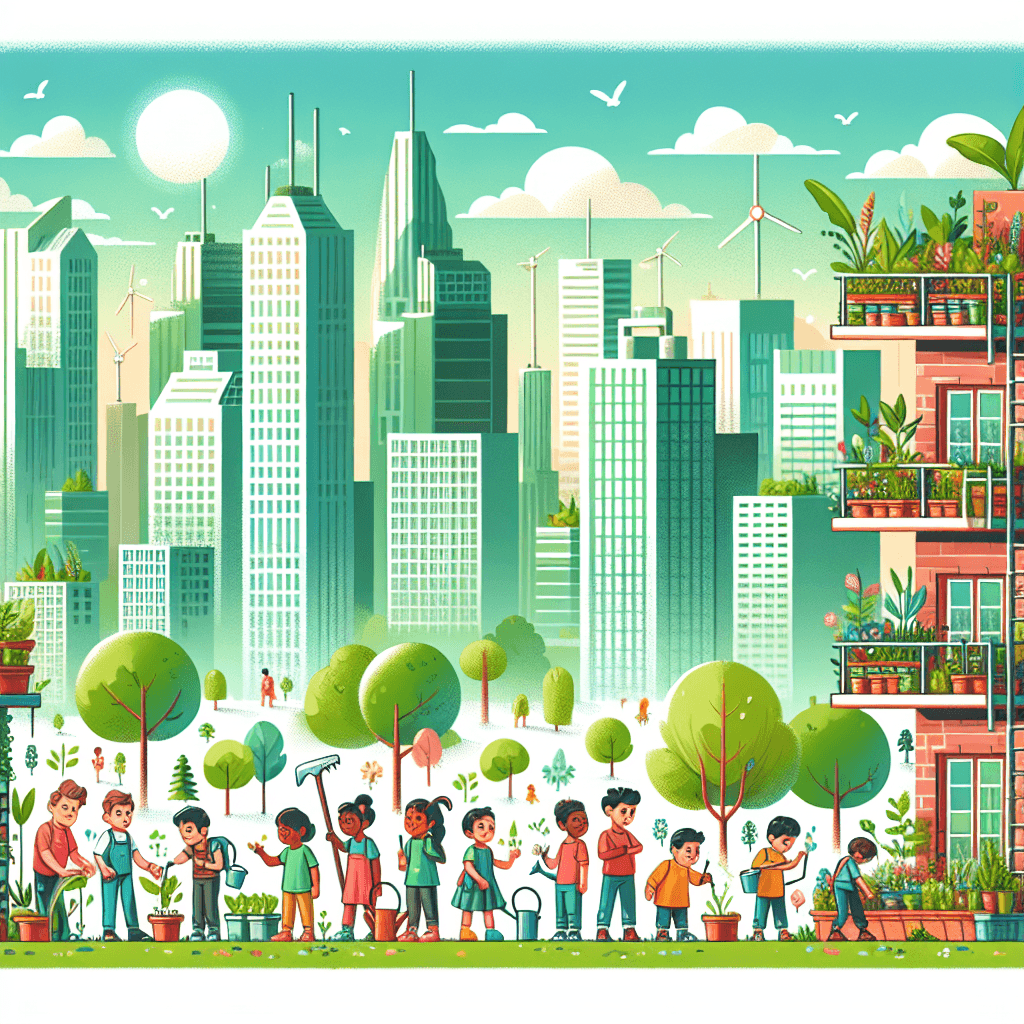
Urban Photosynthesis: Greening Our City
Inquiry Framework
Question Framework
Driving Question
The overarching question that guides the entire project.How can we design and implement a green infrastructure plan using photosynthetic organisms to improve air quality and address the specific environmental needs of our city?Essential Questions
Supporting questions that break down major concepts.- How can green infrastructure improve urban air quality?
- What types of photosynthetic organisms are most effective for improving air quality in an urban environment?
- What factors affect the rate of photosynthesis in urban environments?
- How does photosynthesis help to mitigate climate change?
- What are the benefits and drawbacks of different green infrastructure technologies?
- How can we design a green infrastructure plan that meets the specific needs of our city?
Standards & Learning Goals
Learning Goals
By the end of this project, students will be able to:- Understand the process of photosynthesis and its role in air quality improvement.
- Identify effective photosynthetic organisms for urban environments.
- Design a green infrastructure plan to address urban environmental needs.
NGSS
Entry Events
Events that will be used to introduce the project to studentsMystery Air Sample Analysis
Students receive sealed vials of 'air samples' from different city locations, some healthy, some not. They must use their existing knowledge and initial research to hypothesize about the samples' contents and connect air quality to plant health, sparking initial questions about urban air pollution and the role of photosynthesis.Portfolio Activities
Portfolio Activities
These activities progressively build towards your learning goals, with each submission contributing to the student's final portfolio.Photosynthesis Unlocked: The Carbon Cycle Connection
Students will begin by reviewing the basics of photosynthesis and then explore its connection to the carbon cycle, emphasizing how plants capture carbon dioxide from the atmosphere. This activity sets the stage for understanding the broader impact of photosynthesis on air quality and climate change.Steps
Here is some basic scaffolding to help students complete the activity.Final Product
What students will submit as the final product of the activityA detailed diagram of the carbon cycle with annotations explaining the role of photosynthesis, accompanied by a paragraph summarizing its impact on atmospheric carbon dioxide levels.Alignment
How this activity aligns with the learning objectives & standardsDirectly aligns with MS-LS1-6 by establishing a foundational understanding of photosynthesis and its role in the cycling of carbon among the biosphere, atmosphere, hydrosphere, and geosphere.Green Infrastructure Investigators: Plant Profiling
Students research various photosynthetic organisms (trees, shrubs, grasses, mosses, algae, etc.) suitable for urban environments. They will evaluate each organism's ability to absorb pollutants, its adaptability to urban conditions, and other relevant factors. This activity builds knowledge of different plant species and their potential for improving air quality.Steps
Here is some basic scaffolding to help students complete the activity.Final Product
What students will submit as the final product of the activityA portfolio of plant profiles, each detailing the characteristics, benefits, and limitations of selected photosynthetic organisms for urban green infrastructure.Alignment
How this activity aligns with the learning objectives & standardsSupports the understanding of photosynthesis in various organisms, linking directly to MS-LS1-6 by exploring different organisms' roles in carbon cycling within specific environmental contexts.Urban Ecosystem Architects: Designing Green Spaces
Students will apply their knowledge of photosynthesis and plant characteristics to design a green infrastructure plan for a specific area of their city. This plan should include the selection of appropriate photosynthetic organisms and the strategic placement of green spaces to maximize air quality benefits. They will also need to consider factors such as sunlight availability, water resources, and community needs.Steps
Here is some basic scaffolding to help students complete the activity.Final Product
What students will submit as the final product of the activityA comprehensive green infrastructure plan for a specific urban area, including a detailed map or model, a list of selected photosynthetic organisms with justifications, and an explanation of how the plan will improve air quality and address environmental needs.Alignment
How this activity aligns with the learning objectives & standardsIntegrates the understanding of photosynthesis (MS-LS1-6) into a practical application, requiring students to consider the cycling of carbon in a real-world scenario and design a solution that directly impacts the environment.Rubric & Reflection
Portfolio Rubric
Grading criteria for assessing the overall project portfolioUrban Green Infrastructure Design Rubric
Understanding Photosynthesis and the Carbon Cycle
Demonstrates understanding of the process of photosynthesis and its role in the carbon cycle and air quality.Accuracy of Carbon Cycle Diagram
Illustrates the carbon cycle accurately, highlighting the role of photosynthesis in carbon sequestration.
Exemplary
4 PointsDiagram is detailed, accurate, and clearly illustrates the flow of carbon, with a sophisticated understanding of photosynthesis's role. Annotations are insightful and comprehensive.
Proficient
3 PointsDiagram is accurate and illustrates the main components of the carbon cycle, with a clear explanation of photosynthesis's role. Annotations are clear and relevant.
Developing
2 PointsDiagram contains some inaccuracies or omissions in the carbon cycle. Explanation of photosynthesis's role is basic but present. Annotations are limited.
Beginning
1 PointsDiagram is incomplete or contains significant inaccuracies. Explanation of photosynthesis's role is minimal or missing.
Explanation of Photosynthesis's Impact
Explains how photosynthesis regulates carbon dioxide levels in the atmosphere.
Exemplary
4 PointsExplanation is thorough, insightful, and demonstrates a deep understanding of the impact of photosynthesis on atmospheric carbon dioxide levels and climate change. Connects photosynthesis to broader environmental impacts.
Proficient
3 PointsExplanation is clear, accurate, and explains how photosynthesis helps to regulate atmospheric carbon dioxide levels.
Developing
2 PointsExplanation is basic and partially accurate, but lacks depth or detail. Shows a limited understanding of the impact of photosynthesis.
Beginning
1 PointsExplanation is minimal, inaccurate, or missing. Demonstrates little to no understanding of the impact of photosynthesis.
Plant Profiling and Research
Demonstrates research skills in identifying and profiling appropriate photosynthetic organisms for urban environments.Organism Selection and Research
Selects and researches photosynthetic organisms suitable for urban environments.
Exemplary
4 PointsSelects a diverse range of highly suitable organisms. Research is thorough, detailed, and demonstrates an understanding of each organism's characteristics and benefits in an urban setting. Profiles are comprehensive and insightful.
Proficient
3 PointsSelects appropriate organisms. Research is thorough and summarizes the key characteristics and benefits of each organism. Profiles are clear and informative.
Developing
2 PointsSelects organisms that are somewhat suitable. Research is basic and lacks detail. Profiles are incomplete or contain some inaccuracies.
Beginning
1 PointsSelects organisms that are not well-suited for urban environments. Research is minimal or missing. Profiles are incomplete and lack relevant information.
Suitability and Justification
Justifies the selection of organisms based on their pollution absorption capabilities, growth requirements, and suitability for urban environments.
Exemplary
4 PointsProvides a compelling and well-supported justification for the selection of each organism, demonstrating a deep understanding of their pollution absorption capabilities, growth requirements, and suitability for the specific urban environment. Considers a wide range of environmental factors.
Proficient
3 PointsProvides a clear and logical justification for the selection of each organism, based on their pollution absorption capabilities, growth requirements, and suitability for urban environments.
Developing
2 PointsProvides a basic justification for the selection of some organisms, but lacks detail or supporting evidence. Shows a limited understanding of their suitability for urban environments.
Beginning
1 PointsProvides a minimal or inaccurate justification for the selection of organisms. Demonstrates little to no understanding of their suitability for urban environments.
Green Infrastructure Plan Design
Applies knowledge of photosynthesis and plant characteristics to design an effective green infrastructure plan.Site Analysis and Organism Placement
Conducts a thorough site analysis and selects appropriate photosynthetic organisms for the green infrastructure plan based on the analysis.
Exemplary
4 PointsSite analysis is comprehensive and detailed, demonstrating a strong understanding of the location's environmental conditions and challenges. Organism placement is strategic and optimized to maximize air quality benefits and address specific environmental needs. Demonstrates innovative and creative solutions.
Proficient
3 PointsSite analysis is thorough and identifies key environmental factors. Organism placement is logical and appropriate for the chosen location.
Developing
2 PointsSite analysis is basic and lacks detail. Organism placement is somewhat appropriate, but not fully optimized for the site conditions.
Beginning
1 PointsSite analysis is minimal or missing. Organism placement is inappropriate or illogical.
Plan Detail and Justification
Develops a detailed plan showing the placement of green spaces and justifies the choices based on their ability to improve air quality and address environmental needs.
Exemplary
4 PointsPlan is highly detailed and comprehensive, including specific information on the types of organisms to be planted, their placement, and the rationale behind each choice. Justification is compelling and demonstrates a deep understanding of the plan's impact on air quality and environmental needs. Addresses potential challenges and proposes mitigation strategies.
Proficient
3 PointsPlan is detailed and includes specific information on the types of organisms to be planted and their placement. Justification is clear and explains how the plan will improve air quality and address environmental needs.
Developing
2 PointsPlan is somewhat detailed but lacks specific information on organism types or placement. Justification is basic and lacks depth.
Beginning
1 PointsPlan is minimal or incomplete. Justification is minimal or missing.
Visual Representation
Effectively communicates the green infrastructure plan through a map or model.
Exemplary
4 PointsThe visual representation (map or 3D model) is exceptionally clear, detailed, and accurately portrays the green infrastructure plan. It effectively communicates the placement of green spaces and types of organisms, enhancing understanding of the plan's design and impact. Demonstrates creativity and attention to detail.
Proficient
3 PointsThe visual representation (map or 3D model) is clear, detailed, and accurately portrays the green infrastructure plan, including the placement of green spaces and types of organisms.
Developing
2 PointsThe visual representation (map or 3D model) is basic and lacks detail. It partially portrays the green infrastructure plan, but may have some inaccuracies or omissions.
Beginning
1 PointsThe visual representation (map or 3D model) is minimal, incomplete, or inaccurate. It does not effectively communicate the green infrastructure plan.