
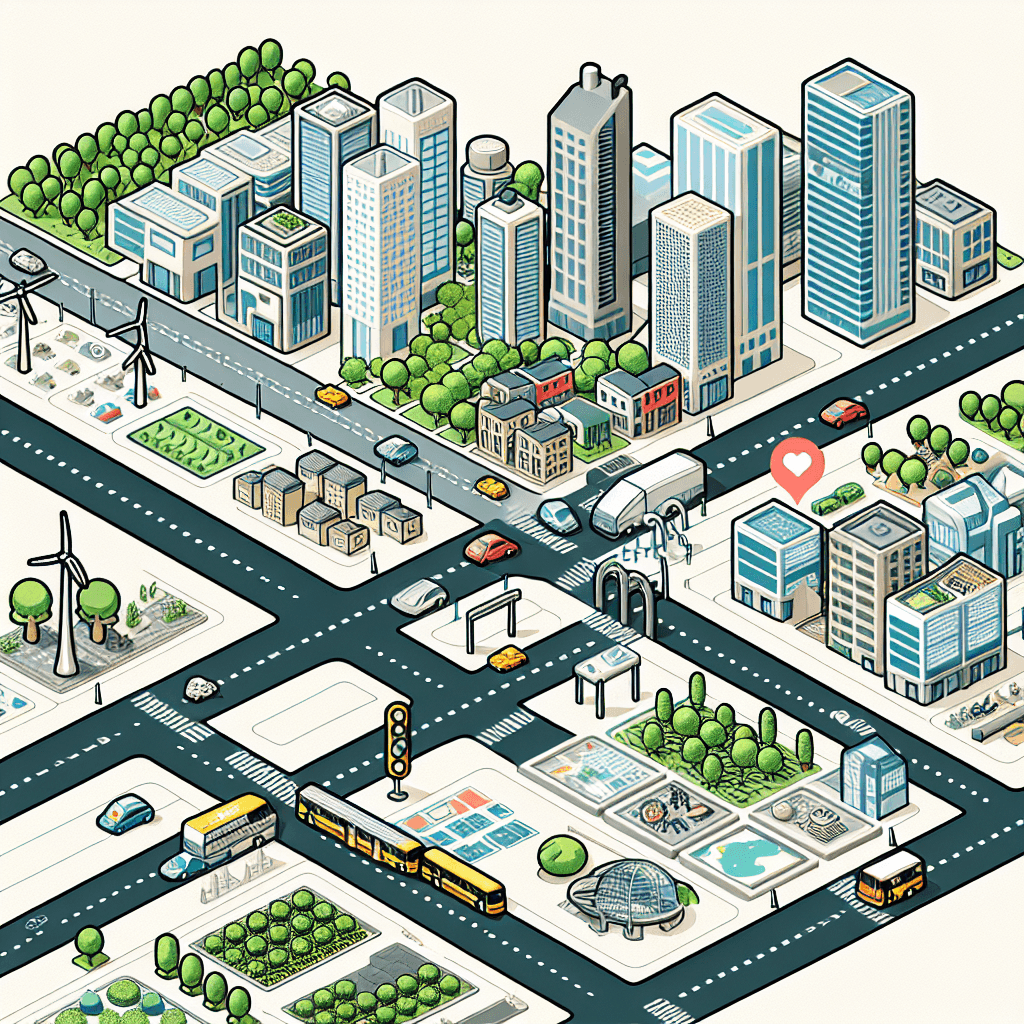
Urban Planning Simulation: City Development Challenges
Inquiry Framework
Question Framework
Driving Question
The overarching question that guides the entire project.How can we, as urban planners, design a city that balances the needs of a growing population while considering resources, geography, and culture?Essential Questions
Supporting questions that break down major concepts.- What are the key factors that influence population distribution in urban areas?
- How does urban planning address the challenges of population growth and distribution?
- What roles do resources, geography, and culture play in shaping cities?
- How can maps help us understand and solve urban challenges?
Standards & Learning Goals
Learning Goals
By the end of this project, students will be able to:- Students will be able to create and interpret maps that depict population distribution in urban regions.
- Students will develop an understanding of factors such as resources, geography, and culture that influence city planning and population distribution.
- Students will analyze urban planning challenges related to population growth and propose solutions that balance the needs of the population.
- Students will improve their research and communication skills by exploring urban planning topics and discussing them in groups.
Geography Learning Standards
Entry Events
Events that will be used to introduce the project to studentsCity Planner Invitational: Meet the Experts
Invite real urban planners to speak with students about current city challenges. Students will prepare questions and participate in a roundtable discussion about balancing population needs with environmental and economic constraints. This interaction allows students to see the relevance of their learning to actual career paths and community issues.Portfolio Activities
Portfolio Activities
These activities progressively build towards your learning goals, with each submission contributing to the student's final portfolio.Map Masterpiece: Urban Sprawl
Students will create a detailed map of a fictional city, highlighting population distribution and the geographical factors influencing it. Through this activity, students will gain a better understanding of how cities grow and change over time due to various factors.Steps
Here is some basic scaffolding to help students complete the activity.Final Product
What students will submit as the final product of the activityA detailed map of a fictional city illustrating population distribution and geographical influences.Alignment
How this activity aligns with the learning objectives & standardsG1.2.6 Create a map of the population distribution of a region and generalize about the factors influencing the distribution.Research Report: Factors of Influence
In this activity, students will delve into the factors that influence population distribution in cities by conducting research and preparing a written report. They will focus on how resources, geography, and cultural aspects shape urban areas.Steps
Here is some basic scaffolding to help students complete the activity.Final Product
What students will submit as the final product of the activityA written research report on a specific factor influencing population distribution, with evidence from credible sources.Alignment
How this activity aligns with the learning objectives & standardsFocuses on understanding factors such as resources, geography, and culture that influence city planning and population distribution.Roundtable Debate: The Future City
Students will participate in a lively debate to propose solutions for urban planning challenges related to population growth. They will advocate for a balanced city design that considers sustainable growth, resources allocation, and quality of life.Steps
Here is some basic scaffolding to help students complete the activity.Final Product
What students will submit as the final product of the activityA class debate performance advocating for well-planned urban growth solutions, with reflection on the effectiveness of different proposals.Alignment
How this activity aligns with the learning objectives & standardsEncourages students to analyze urban planning challenges related to population growth and propose balanced solutions.Mapping Solutions Poster Project
For this activity, students will combine their mapping and research skills to design a poster that presents a practical urban planning solution for a growing city, considering geographical, cultural, and resource factors.Steps
Here is some basic scaffolding to help students complete the activity.Final Product
What students will submit as the final product of the activityA visually engaging poster that showcases a city-wide solution to urban population challenges, integrating map interpretation and strategic proposals.Alignment
How this activity aligns with the learning objectives & standardsCovers the use of maps to understand and solve urban challenges, aligning with interpreting maps and understanding population influencing factors.Rubric & Reflection
Portfolio Rubric
Grading criteria for assessing the overall project portfolioUrban Planning and Population Assessment Rubric
Map Creation and Interpretation
Evaluation of students' ability to create a detailed map representing population distribution and interpret geographical factors influencing it.Detail and Accuracy
Measures the accuracy and completeness of maps, including correct use of symbols and geographical data.
Exemplary
4 PointsMap is exceptionally detailed and accurate, with precise use of symbols and clear representation of geographical data.
Proficient
3 PointsMap is detailed and mostly accurate, with correct symbols and an adequate representation of geographical factors.
Developing
2 PointsMap shows some details, but has inaccuracies and inconsistent use of symbols and geographical factors.
Beginning
1 PointsMap is incomplete, with many inaccuracies and poor representation of geographical factors and symbols.
Creativity and Innovation
Assesses students' ability to creatively apply urban planning concepts in map design, including integration of creative elements such as public spaces.
Exemplary
4 PointsDemonstrates high creativity by integrating diverse planning concepts innovatively and enhancing map design with unique elements.
Proficient
3 PointsShows creativity by integrating some planning concepts effectively and incorporating creative elements.
Developing
2 PointsDisplays limited creativity in map design, with occasional integration of planning concepts.
Beginning
1 PointsLacks creativity, with minimal integration of planning concepts and absence of innovative elements.
Research and Analysis
Evaluates students' research skills and analysis of factors influencing population distribution.Depth of Research
Evaluates the extent and quality of research conducted on factors influencing urban population distribution.
Exemplary
4 PointsConducts comprehensive research using diverse, credible sources; makes insightful connections to urban planning.
Proficient
3 PointsPerforms thorough research using credible sources; makes logical connections to urban planning.
Developing
2 PointsConducts basic research with limited source credibility; makes some connections to urban planning.
Beginning
1 PointsConducts minimal research with poor source credibility; struggles to connect to urban planning.
Clarity of Analysis
Assesses the clarity and coherence of presenting research findings and their implications on urban planning.
Exemplary
4 PointsPresents a clear and coherent analysis with strong supporting evidence and logical implications for urban planning.
Proficient
3 PointsProvides coherent analysis with supportive evidence and logical implications for urban planning.
Developing
2 PointsPresents analysis that lacks coherence with limited evidence and unclear implications.
Beginning
1 PointsAnalysis is unclear and lacks evidence or logical implications for planning.
Debate Participation and Presentation
Looks at the effectiveness of students' participation and communication during the debate on urban planning solutions.Argument Development
Evaluates the ability to develop and communicate strong arguments during debates.
Exemplary
4 PointsDevelops strong, convincing arguments supported by comprehensive research and clear reasoning.
Proficient
3 PointsFormulates solid arguments with good evidence and coherent reasoning.
Developing
2 PointsPresents basic arguments with some supporting evidence, but lacks convincing reasoning.
Beginning
1 PointsStruggles to formulate coherent arguments; lacks supporting evidence.
Engagement and Interaction
Assesses students' engagement and ability to interact effectively in group debates.
Exemplary
4 PointsEngages actively and listens well, responding thoughtfully to others' points.
Proficient
3 PointsEngages adequately and listens, occasionally providing thoughtful responses.
Developing
2 PointsShows basic engagement with limited responses to others' points.
Beginning
1 PointsMinimal engagement or interaction with peers during debate.
Poster Design and Presentation
Evaluates students' effectiveness in designing visually compelling posters and presenting urban planning solutions.Visual Design
Measures the visual appeal and effectiveness of the poster design in conveying urban planning solutions.
Exemplary
4 PointsPoster is visually striking with clear, effective design elements that enhance solution presentation.
Proficient
3 PointsPoster is visually appealing with effective design elements that convey the solution.
Developing
2 PointsPoster has some visual appeal but lacks coherence and effectiveness in design elements.
Beginning
1 PointsPoster lacks visual appeal and effective design; fails to convey solutions clearly.
Presentation Clarity
Assesses clarity and effectiveness in presenting the poster and explaining proposed solutions.
Exemplary
4 PointsPresents the poster clearly with excellent explanation of solutions; effectively engages the audience.
Proficient
3 PointsPresents the poster with clear explanation and engages the audience effectively.
Developing
2 PointsPresentation of the poster lacks clarity, and explanation of solutions is limited.
Beginning
1 PointsStruggles to present the poster clearly; fails to explain solutions effectively.