
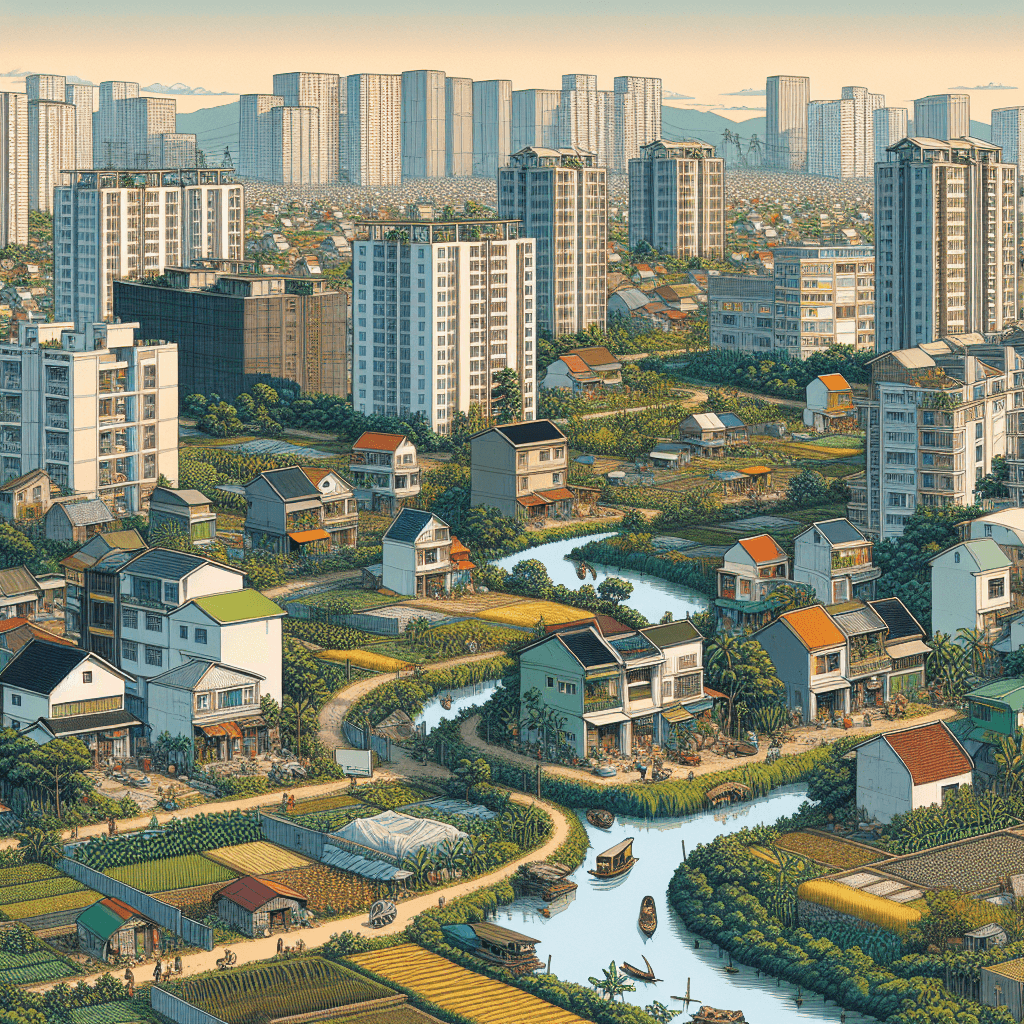
Urbanization and Housing in Vietnam: A Changing Landscape
Inquiry Framework
Question Framework
Driving Question
The overarching question that guides the entire project.How can we balance preserving Vietnamese cultural identity in housing with the demands of rapid urbanization, while also addressing environmental and social impacts in Vietnam's cities?Essential Questions
Supporting questions that break down major concepts.- How has urbanization influenced traditional Vietnamese housing styles?
- What are the key factors driving the demand for housing in urban areas of Vietnam?
- What are the environmental and social impacts of rapid urbanization on housing in Vietnam?
- How do cultural values and traditions affect housing preferences in Vietnam's cities?
- What are the challenges and opportunities for sustainable housing development in urban Vietnam?
Standards & Learning Goals
Learning Goals
By the end of this project, students will be able to:- Understand the impact of urbanization on traditional Vietnamese housing.
- Identify factors driving housing demand in Vietnam's urban areas.
- Analyze the environmental and social impacts of urbanization on housing.
- Explore how cultural values influence housing preferences in Vietnam.
- Investigate challenges and opportunities for sustainable housing development in urban Vietnam.
- Learn about real estate purchasing behavior in Vietnam
Vietnamese Real Estate Standards
Entry Events
Events that will be used to introduce the project to studentsVietnamese Housing Fair: A Historical Simulation
Students participate in a simulated 'housing fair' showcasing different types of Vietnamese homes throughout history and present-day. They interview 'residents' (played by older students or community members) to understand the evolution of housing and the challenges/benefits of each era. This connects directly to students' experiences by allowing them to explore diverse housing options and encourages inquiry through direct interaction.Folktales of Home: Vietnamese Housing Through Storytelling
Students examine a collection of Vietnamese folktales and myths centered around homes and communities. They discuss how these stories reflect cultural values and societal needs related to housing. This activity encourages inquiry by prompting students to consider how cultural narratives shape our understanding and expectations of housing in a rapidly changing urban landscape.Portfolio Activities
Portfolio Activities
These activities progressively build towards your learning goals, with each submission contributing to the student's final portfolio.Housing Then and Now: A Visual Comparison
Students will draw examples of traditional Vietnamese houses (like stilt houses or communal houses) and modern urban apartments. They will then compare and contrast the materials used, the space available, and how families live in each type of home.Steps
Here is some basic scaffolding to help students complete the activity.Final Product
What students will submit as the final product of the activityA diptych (two-part picture) showing a traditional house and a modern apartment, with labels and short descriptions of each.Alignment
How this activity aligns with the learning objectives & standardsVN-REB-1 (Understand impact of urbanization on housing)City vs. Country: Visualizing Housing Demand
Students create a simple bar graph showing the number of people living in rural areas versus urban areas in Vietnam. This will help them visualize the shift towards urban living and understand the basic concept of demand.Steps
Here is some basic scaffolding to help students complete the activity.Final Product
What students will submit as the final product of the activityA bar graph comparing rural and urban populations, with a sentence explaining why more people might want to live in cities.Alignment
How this activity aligns with the learning objectives & standardsVN-REB-1 (Identify factors driving housing demand)Dream Home, Dream Values: Folktale Inspired Designs
Students will listen to traditional Vietnamese folktales about homes and families. They will then draw a picture of a 'dream home' based on the values they learned from the stories (e.g., a home with a big family, a home surrounded by nature).Steps
Here is some basic scaffolding to help students complete the activity.Final Product
What students will submit as the final product of the activityA drawing of their 'dream home' with a short explanation of the values it represents (e.g., 'My dream home has a big garden because I learned that nature is important in Vietnamese stories').Alignment
How this activity aligns with the learning objectives & standardsVN-REB-1 (Explore cultural values influencing housing)Rubric & Reflection
Portfolio Rubric
Grading criteria for assessing the overall project portfolioUrbanization and Housing in Vietnam Portfolio Rubric
Visual Comparison
Visual representation and comparison of traditional and modern housingAccuracy and Detail
Accuracy of depicting traditional Vietnamese houses and modern apartments
Exemplary
4 PointsHouses and apartments are accurately and detailedly represented, with all key features clearly identifiable and correctly labeled.
Proficient
3 PointsHouses and apartments are mostly accurate, with most key features identifiable and labeled.
Developing
2 PointsHouses and apartments show some recognizable features, but accuracy is limited, and labeling is incomplete.
Beginning
1 PointsDrawings show little resemblance to traditional houses or modern apartments, and labeling is minimal or absent.
Comparative Analysis
Effectiveness of comparison highlighting materials, space, and family life
Exemplary
4 PointsComparison is insightful and comprehensive, thoroughly addressing materials, space, and family life with clear and specific examples.
Proficient
3 PointsComparison is clear and addresses materials, space, and family life with relevant examples.
Developing
2 PointsComparison is basic and touches on materials, space, or family life with limited detail.
Beginning
1 PointsComparison is minimal or missing, with little or no mention of materials, space, or family life.
Visualizing Housing Demand
Visual representation of population distribution and explanatory sentenceData Representation
Correctness and clarity of bar graph representing rural and urban populations
Exemplary
4 PointsGraph is perfectly accurate, clearly labeled, and easy to understand, with precise representation of rural and urban populations.
Proficient
3 PointsGraph is accurate, clearly labeled, and easy to understand, representing rural and urban populations effectively.
Developing
2 PointsGraph contains minor inaccuracies or labeling issues but still conveys the basic idea of rural vs. urban populations.
Beginning
1 PointsGraph is inaccurate, poorly labeled, or difficult to understand, failing to represent rural and urban populations effectively.
Explanatory Reasoning
Reasoning for urban migration
Exemplary
4 PointsExplanation is insightful, demonstrating a clear understanding of factors driving urban migration with specific examples.
Proficient
3 PointsExplanation is clear and provides a valid reason for urban migration.
Developing
2 PointsExplanation is simplistic or vague but suggests a possible reason for urban migration.
Beginning
1 PointsExplanation is missing, irrelevant, or demonstrates a lack of understanding of urban migration.
Folktale Inspired Designs
Creative expression and value representation in dream home designCultural Integration
Integration of cultural values from folktales into dream home design
Exemplary
4 PointsDream home design creatively and thoroughly integrates multiple cultural values from folktales, demonstrating a deep understanding of their significance.
Proficient
3 PointsDream home design effectively incorporates cultural values from folktales.
Developing
2 PointsDream home design shows some attempt to incorporate cultural values from folktales, but integration is limited.
Beginning
1 PointsDream home design shows little or no connection to cultural values from folktales.
Value Articulation
Clarity and relevance of explanation connecting dream home to folktale values
Exemplary
4 PointsExplanation is articulate and clearly connects the dream home design to specific values from the folktales, demonstrating a sophisticated understanding.
Proficient
3 PointsExplanation clearly connects the dream home design to values from the folktales.
Developing
2 PointsExplanation attempts to connect the dream home design to values from the folktales, but the connection is unclear or superficial.
Beginning
1 PointsExplanation is missing, irrelevant, or fails to connect the dream home design to values from the folktales.