
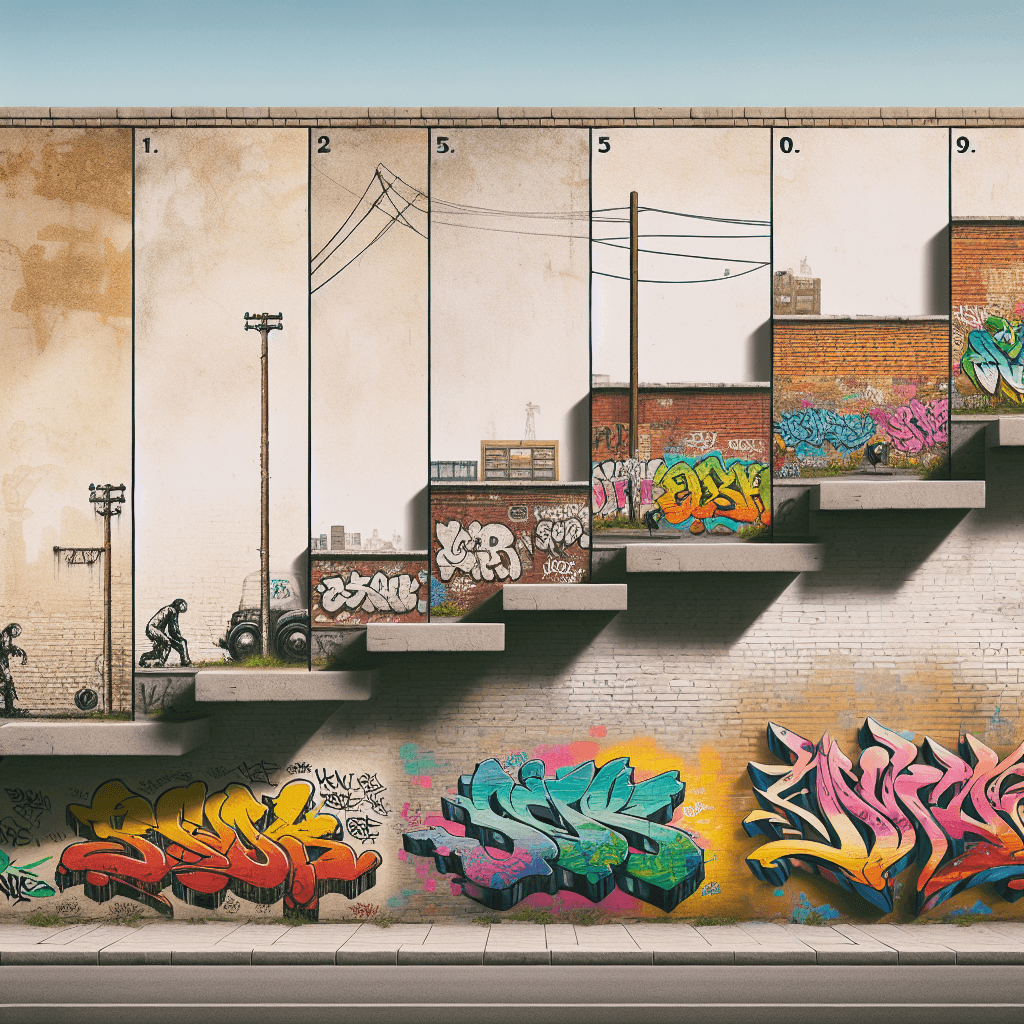
Vandalism to Vision: Curating the Evolution of Street Art
Inquiry Framework
Question Framework
Driving Question
The overarching question that guides the entire project.How can we, as museum curators, design an immersive exhibit that challenges public perception of graffiti by showcasing its transformation from an act of rebellion into a scientifically complex and mathematically precise form of global innovation?Essential Questions
Supporting questions that break down major concepts.- How can we, as curators, design a museum exhibit that captures the tension between graffiti's origins as an act of rebellion and its current status as a celebrated form of innovation and survival?
- How can we use persuasive writing and narrative techniques to bridge the gap between a graffiti artist’s intent and the public’s perception of the work? (English/ELA)
- How do ratios, proportions, and surface area calculations dictate the transition of large-scale street murals into a physical museum space? (Math)
- How does the chemistry of pigments and aerosols interact with different urban surfaces, and what scientific methods are required to preserve or remove these materials? (Science)
- How has the historical perception of graffiti evolved from a symptom of urban decay to a global tool for social change and survival? (History)
- How does the context of an environment (the street vs. the gallery) change the aesthetic value and ethical meaning of a work of art? (Art)
Standards & Learning Goals
Learning Goals
By the end of this project, students will be able to:- Students will design and curate a museum-grade exhibit that synthesizes historical, scientific, and mathematical data to reframe graffiti as a form of innovation.
- Students will write persuasive exhibit text and catalog entries that use rhetorical strategies to bridge the gap between street intent and public gallery perception.
- Students will apply proportional reasoning and surface area calculations to accurately scale and model large-scale urban murals for interior exhibition spaces.
- Students will conduct chemical analysis on various pigments and aerosols to determine the interaction between artistic media and urban surfaces, and propose scientific preservation methods.
- Students will evaluate the historical evolution of graffiti through primary and secondary sources, tracing its path from a symbol of urban decay to a global tool for social change.
- Students will critique the ethical and aesthetic implications of transitioning site-specific street art into commercial gallery settings.
TEKS English Language Arts and Reading (English I)
TEKS Art, Level I
TEKS Geometry
TEKS Chemistry
TEKS World Geography
TEKS World History
Entry Events
Events that will be used to introduce the project to studentsCrime Scene or Cultural Heritage?
The classroom is divided by yellow 'caution' tape: one side is labeled 'Evidence Locker: Vandalism' and the other 'Cultural Heritage: Archive.' Students must sort through historical artifacts—from ancient Pompeii scratchings to modern subway tags—and justify why certain 'crimes' are preserved in museums while others are erased from the streets.Portfolio Activities
Portfolio Activities
These activities progressively build towards your learning goals, with each submission contributing to the student's final portfolio.The Evolution Archive: From Vandalism to Voice
In this initial phase, students act as historical researchers. They will investigate three distinct 'eras' or locations of graffiti: ancient inscriptions (like Pompeii), the 1970s New York subway movement, and modern global street art. The goal is to document how the cultural context of the environment changes the perception of the work. Students will curate a 'Timeline of Intent' that highlights the universal themes of survival and identity.Steps
Here is some basic scaffolding to help students complete the activity.Final Product
What students will submit as the final product of the activityA 'Comparative Context Portfolio' featuring three annotated artifacts, a written analysis of how 'place' affects meaning, and a draft 'Curatorial Thesis' for their upcoming exhibit.Alignment
How this activity aligns with the learning objectives & standardsThis activity aligns with TEKS 113.43.c.17.A (perception of place) and TEKS 113.42.c.27.B (universal themes). It requires students to analyze how cultural backgrounds influence the perception of graffiti as either 'vandalism' or 'art' and identify themes that transcend specific cultures.The Alchemy of Aerosol: Lab Report & Surface Analysis
A curator must understand the materiality of their collection. In this activity, students transition from historians to conservation scientists. They will analyze the chemical composition of spray paint (suspensions/mixtures) and how these substances interact with various urban surfaces (porous brick vs. non-porous glass). They will then propose a 'Preservation Plan' for their chosen exhibit pieces, explaining the science of how to protect or remove these materials.Steps
Here is some basic scaffolding to help students complete the activity.Final Product
What students will submit as the final product of the activityA 'Material Science Lab Report' that classifies the mixtures used in graffiti and outlines a scientific protocol for the preservation of an outdoor mural moved to an indoor museum.Alignment
How this activity aligns with the learning objectives & standardsThis activity aligns with TEKS 112.35.c.4.A, focusing on the classification of matter. Students investigate the physical and chemical properties of aerosols and pigments to understand their interaction with urban surfaces.Murals to Scale: The Geometric Blueprint
Large-scale street murals cannot be moved physically; they must be reimagined for the museum. Students will select a real-world mural and use proportional reasoning to create a 1:20 scale model of an exhibit room. They must calculate the total surface area available in their 'gallery' and determine the ratios needed to ensure the artwork maintains its visual impact when scaled down.Steps
Here is some basic scaffolding to help students complete the activity.Final Product
What students will submit as the final product of the activityA 'Geometric Gallery Blueprint' and a 3D scale model (physical or digital) of their exhibit space, including precise surface area and volume calculations.Alignment
How this activity aligns with the learning objectives & standardsThis activity aligns with TEKS 111.41.c.11.C. Students apply geometric modeling and scaling to solve the problem of fitting large-scale street art into a confined museum gallery space.The Curator’s Manifesto: Argumentative Exhibit Guide
For the final portfolio piece, students write the 'Curatorial Manifesto'—the primary argumentative text that visitors read upon entering the exhibit. This text must use rhetorical strategies to convince a skeptical public that graffiti is a sophisticated form of innovation. Students will also write individual 'Catalog Entries' for their pieces, critiquing the work’s aesthetic value and ethical implications of moving it from the street to a gallery.Steps
Here is some basic scaffolding to help students complete the activity.Final Product
What students will submit as the final product of the activityThe 'Exhibition Catalog & Manifesto,' a multi-paragraph argumentative document that serves as the narrative guide for their curated exhibit.Alignment
How this activity aligns with the learning objectives & standardsThis activity aligns with TEKS 110.36.b.11.C (argumentative composition) and TEKS 117.302.c.4.B (art critique/evaluation). Students synthesize their historical, scientific, and mathematical findings into a persuasive piece of writing.Rubric & Reflection
Portfolio Rubric
Grading criteria for assessing the overall project portfolioStreet to Sanctuary: Graffiti Curation Rubric
Historical Research & Contextualization
Evaluation of the student's ability to research, contextualize, and trace the evolution of graffiti as a tool for social change and survival.Historical Context & Universal Themes
Analyzes the evolution of graffiti from three distinct eras/locations, identifying universal themes and explaining how cultural context and 'place' influence public perception. (TEKS 113.43.c.17.A, 113.42.c.27.B)
Exemplary
4 PointsProvides a sophisticated analysis of three distinct eras, drawing profound connections between cultural context and perception. Identifies nuanced universal themes (e.g., survival, identity) and uses diverse primary/secondary evidence to support the 'Timeline of Intent.'
Proficient
3 PointsAnalyzes three distinct eras and explains how cultural context affects perception. Identifies clear universal themes and provides a cohesive 'Timeline of Intent' with appropriate evidence.
Developing
2 PointsDiscusses three eras of graffiti but the connection between 'place' and perception is inconsistent. Identifies basic themes, but the 'Timeline of Intent' lacks detailed evidence or historical depth.
Beginning
1 PointsMentions fewer than three eras or provides a superficial description without analyzing how context affects perception. Themes are vague or missing.
Scientific Inquiry & Materiality
Assessment of the student’s application of chemistry principles to the materiality of graffiti and its preservation in a museum setting.Chemical Analysis & Conservation Science
Classifies aerosol components as pure substances or mixtures and analyzes the chemical interaction between pigments and urban surfaces to develop a preservation protocol. (TEKS 112.35.c.4.A)
Exemplary
4 PointsDemonstrates advanced mastery of matter classification (solutions, colloids, suspensions). Provides a highly detailed preservation protocol based on complex chemical interactions (UV light, solvents, porosity) with precise scientific terminology.
Proficient
3 PointsAccurately classifies aerosol components and explains surface interactions. Provides a logical preservation protocol using appropriate scientific terminology to justify museum environmental controls.
Developing
2 PointsIdentifies most substances and mixtures correctly. Describes surface interactions in general terms. The preservation recommendation is present but lacks specific scientific justification or detail.
Beginning
1 PointsStruggles to classify matter correctly. Minimal analysis of chemical interactions or surface properties. Preservation plan is missing or lacks scientific basis.
Mathematical Modeling & Spatial Design
Evaluation of the mathematical precision and geometric modeling used to transition street art into a curated gallery space.Geometric Scaling & Spatial Modeling
Applies geometric concepts, scaling, and surface area/volume calculations to design an immersive museum exhibit from a large-scale mural. (TEKS 111.41.c.11.C)
Exemplary
4 PointsScale calculations are flawless. The 3D model/blueprint demonstrates innovative use of volume and surface area to create a highly immersive experience. Precise ratios are maintained throughout the design.
Proficient
3 PointsScaling and surface area calculations are accurate and clearly documented. The blueprint/model effectively translates a large-scale mural into the museum space using a consistent scale factor.
Developing
2 PointsScaling calculations are mostly correct but may contain minor errors. The blueprint shows the mural in the space, but surface area or volume calculations are incomplete or inconsistent.
Beginning
1 PointsScaling is inaccurate or missing. The layout does not demonstrate an understanding of proportional reasoning or the relationship between the mural and the physical room dimensions.
Curatorial Voice & Composition
Assessment of the student's ability to use language and critical evaluation to shape the narrative and public perception of the exhibit.Persuasive Argumentation & Art Critique
Composes a multi-paragraph argumentative manifesto using rhetorical strategies to reframe graffiti and evaluates specific works using formal art critique methods. (TEKS 110.36.b.11.C, 117.302.c.4.B)
Exemplary
4 PointsCompelling manifesto uses sophisticated rhetorical strategies and evidence to challenge public perception. Art critiques (wall plaques) provide profound insights using the describe, analyze, interpret, and evaluate method with professional polish.
Proficient
3 PointsWrite a clear, persuasive manifesto with a logical argument. Art critiques accurately follow the formal method and provide a professional evaluation of the work's aesthetic and ethical value.
Developing
2 PointsManifesto states a position but lacks strong rhetorical evidence or fails to address counter-arguments. Art critiques are present but may skip steps in the 'describe-evaluate' process.
Beginning
1 PointsThe argument is weak, disorganized, or purely subjective. Catalog entries are superficial and do not utilize the formal method of art critique.