
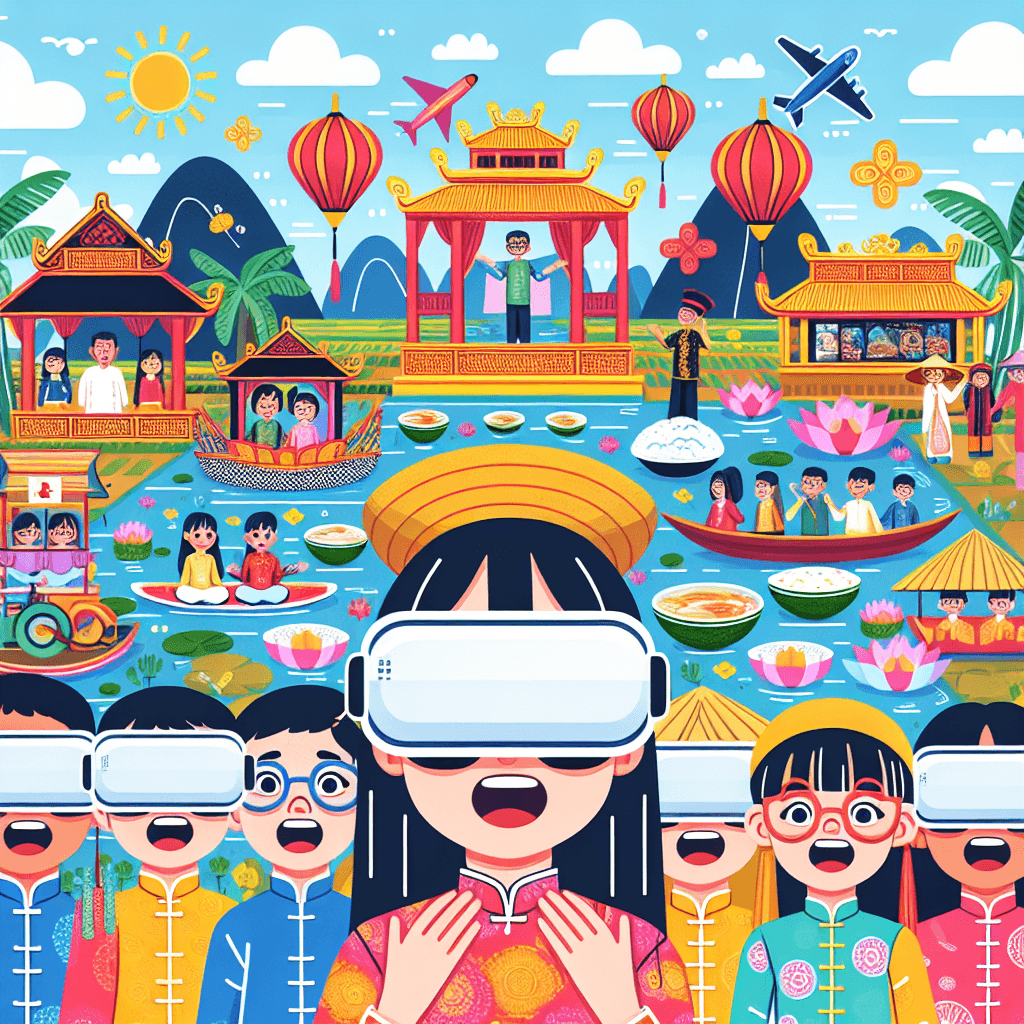
Vietnam Virtual Cultural Immersion Tour
Inquiry Framework
Question Framework
Driving Question
The overarching question that guides the entire project.How can we, as cultural ambassadors, design an engaging and informative virtual reality tour that showcases the unique tourist destinations, cultural experiences, and local traditions of Vietnam, while effectively communicating with an international audience?Essential Questions
Supporting questions that break down major concepts.- What are the key tourist destinations in Vietnam and what makes them unique?
- How does cultural context enhance the experience of visiting different sites in Vietnam?
- What are the best ways to present and market a tourist destination to an international audience?
- Which descriptive adjectives and vocabulary are essential for effectively communicating the qualities of Vietnam’s tourist attractions in a foreign language?
- How can we leverage virtual reality to enhance cultural understanding and immersion for virtual tourists?
- In what ways do cuisine, festivals, and local traditions contribute to the appeal of tourism in Vietnam?
Standards & Learning Goals
Learning Goals
By the end of this project, students will be able to:- Students will be able to identify and describe at least three major tourist destinations in Vietnam, highlighting their unique features and cultural significance.
- Students will enhance their foreign language skills by using descriptive adjectives and location-specific vocabulary to create a brochure in a foreign language.
- Students will develop research skills by gathering and synthesizing information about Vietnamese tourist attractions, weather, transportation, local cuisine, and traditions.
- Students will collaborate in groups to design and create an engaging and informative virtual reality tour of Vietnam.
- Students will explore and utilize digital tools and technologies to enhance cultural understanding and virtual tourist experiences.
- Students will learn and apply principles of effective communication to market tourist destinations to an international audience.
Foreign Language Standards
Common Core Standards for English Language Arts
Next Generation Science Standards
Digital Literacy Standards
Entry Events
Events that will be used to introduce the project to studentsVirtual Reality Sneak Peek
Students are introduced to the project with a short, immersive virtual reality experience of a famous Vietnamese destination. This teaser sets the stage for exploring Vietnam's diverse travel offerings, challenging students to think beyond typical tourist paths and consider how they can bring these vibrant locations to life in a leaflet.Culinary Tasting Session
Host a tasting session featuring traditional Vietnamese dishes. Each dish introduced relates to a particular region in Vietnam, prompting students to inquire about local sites, weather, and cultural events that might influence the cuisine and thereby connect these culinary experiences to broader travel contexts.Portfolio Activities
Portfolio Activities
These activities progressively build towards your learning goals, with each submission contributing to the student's final portfolio.Destination Discovery Dive
Students kickstart their exploration by selecting three Vietnamese tourist destinations to research, understanding their cultural significance, and unique features.Steps
Here is some basic scaffolding to help students complete the activity.Final Product
What students will submit as the final product of the activityA summary document outlining preliminary insights and organizational structure for further exploration of each chosen destination.Alignment
How this activity aligns with the learning objectives & standardsAligns with FL.CULT.INT.1 by focusing on understanding and describing cultural products and practices from Vietnamese culture. It also supports CCSS.ELA-LITERACY.CCRA.W.7 through preliminary research and information gathering.Culinary and Culture Canvas
In this activity, students dive deeper into the culinary traditions and cultural practices associated with their chosen destinations, linking food to broader cultural contexts.Steps
Here is some basic scaffolding to help students complete the activity.Final Product
What students will submit as the final product of the activityA visual presentation that illustrates the relationship between local cuisine, cultural practices, and the attractiveness of each destination.Alignment
How this activity aligns with the learning objectives & standardsSupports FL.CULT.INT.1 by describing cultural practices and FL.COMM.2.1 through information exchange in a foreign language. Fosters understanding of cultural context and culinary traditions.Transport Trekking Tactics
This activity emphasizes understanding transportation options and practical travel tips for navigating each selected destination, preparing students to guide hypothetical tourists effectively.Steps
Here is some basic scaffolding to help students complete the activity.Final Product
What students will submit as the final product of the activityAn informative guide focusing on transportation and practical travel tips for tourists visiting each chosen destination.Alignment
How this activity aligns with the learning objectives & standardsAligns with CCSS.ELA-LITERACY.CCRA.W.7 by expanding research skills into transportation and practical travel contexts.VR Visionary Voyage
In this core activity, students use their gathered research to conceptualize and storyboard a virtual reality tour, enhancing the immersive experience for future tourists.Steps
Here is some basic scaffolding to help students complete the activity.Final Product
What students will submit as the final product of the activityA detailed storyboard and initial virtual reality scenes previewing the tourist journey through Vietnamese destinations.Alignment
How this activity aligns with the learning objectives & standardsSupports FL.CULT.INT.1 through cultural immersion elements and aligns with NGSS.ETS1.B and DL.IT.3 by using digital tools and problem-solving to design the VR experience.Rubric & Reflection
Portfolio Rubric
Grading criteria for assessing the overall project portfolioCultural Immersion Tour Assessment Rubric
Research and Content Understanding
Assessment of students' ability to research and synthesize information about Vietnamese tourist destinations, including cultural, historical, and practical aspects.Cultural Research Depth
The level to which students have researched and understood the cultural significance and unique features of tourist destinations.
Exemplary
4 PointsDemonstrates comprehensive and deep understanding of cultural significance and unique features of all destinations, supported by a wide range of reliable sources.
Proficient
3 PointsShows a thorough understanding of cultural significance with only minor gaps, supported by multiple reliable sources.
Developing
2 PointsDisplays a basic understanding, with some accurate details but also notable gaps and a limited number of sources.
Beginning
1 PointsShows superficial understanding with minimal and often inaccurate information and sources.
Integration of Culinary and Cultural Practices
How well students connect local culinary traditions and cultural practices to the overall appeal of destinations.
Exemplary
4 PointsExpertly integrates culinary and cultural practices, clearly explaining their contribution to the destination's tourism appeal.
Proficient
3 PointsEffectively integrates culinary and cultural practices, explaining their general impact on tourism appeal.
Developing
2 PointsAttempts to connect culinary and cultural practices, but connections and their impact on tourism are underdeveloped.
Beginning
1 PointsConnections between culinary practices and cultural contexts are unclear or absent.
Practical Travel Understanding
Evaluation of understanding and communication of practical travel information like transportation and local tips.
Exemplary
4 PointsProvides detailed, practical travel information including various transportation methods and essential local tips.
Proficient
3 PointsProvides practical travel information with clear descriptions and reliable sources.
Developing
2 PointsOffers basic travel tips with some gaps in clarity or detail.
Beginning
1 PointsContains minimal travel information, lacking clarity and detail.
Communication Skills
Evaluation of students’ ability to effectively communicate information in a foreign language and to an international audience.Language Use and Accuracy
Accuracy and appropriateness of foreign language use, including correct vocabulary and grammar.
Exemplary
4 PointsUses foreign language accurately and creatively with excellent vocabulary and no grammatical errors.
Proficient
3 PointsUses foreign language accurately with appropriate vocabulary and few minor grammatical errors.
Developing
2 PointsUses basic vocabulary with some appropriate language use and notable grammatical errors.
Beginning
1 PointsStruggles with vocabulary and grammar, leading to frequent misunderstanding.
Presentation Clarity and Engagement
The effectiveness of presenting information clearly and engagingly to the audience.
Exemplary
4 PointsPresents information exceptionally clearly with engaging elements that captivate the audience.
Proficient
3 PointsPresents information clearly with some engaging elements.
Developing
2 PointsPresents information with partial clarity and limited engagement.
Beginning
1 PointsPresents information unclearly with minimal audience engagement.
Digital Literacy and Problem-Solving
Assessment of students' abilities to use digital tools in creating immersive experiences and solving design problems.Use of Digital Tools
Effectiveness in using digital technologies to design and adapt learning experiences.
Exemplary
4 PointsSkillfully uses digital tools to create highly innovative and personalized learning experiences.
Proficient
3 PointsEffectively uses digital tools to create competent and mostly innovative learning experiences.
Developing
2 PointsUses digital tools with basic efficiency, creating adequate learning experiences.
Beginning
1 PointsStruggles to use digital tools effectively, resulting in limited learning enhancements.
Problem-Solving and Creativity
Creativity and problem-solving skills applied in the design and execution of the virtual reality tour.
Exemplary
4 PointsDemonstrates exceptional creativity and problem-solving skills, overcoming challenges innovatively.
Proficient
3 PointsShows good problem-solving ability with some creative approaches.
Developing
2 PointsDemonstrates limited problem-solving with straightforward solutions.
Beginning
1 PointsFaces difficulty in problem-solving, showing minimal creativity.
Collaboration and Independent Learning
Evaluation of students’ ability to collaborate effectively and manage independent learning.Collaboration Effectiveness
The ability to collaborate productively within a group, contributing positively to collective goals.
Exemplary
4 PointsDemonstrates leadership and cooperation, facilitating group success and cohesion.
Proficient
3 PointsWorks well with peers, contributing to group objectives effectively.
Developing
2 PointsParticipates in group work with moderate contribution.
Beginning
1 PointsShows limited participation and contribution in group settings.
Independent Learning Initiative
The degree of initiative shown in undertaking independent research and learning.
Exemplary
4 PointsTakes significant initiative in independent research, showing high self-direction.
Proficient
3 PointsEngages in independent learning with noticeable initiative.
Developing
2 PointsShows some initiative in independent research, but often relies on guidance.
Beginning
1 PointsRequires substantial support to engage in independent learning.