
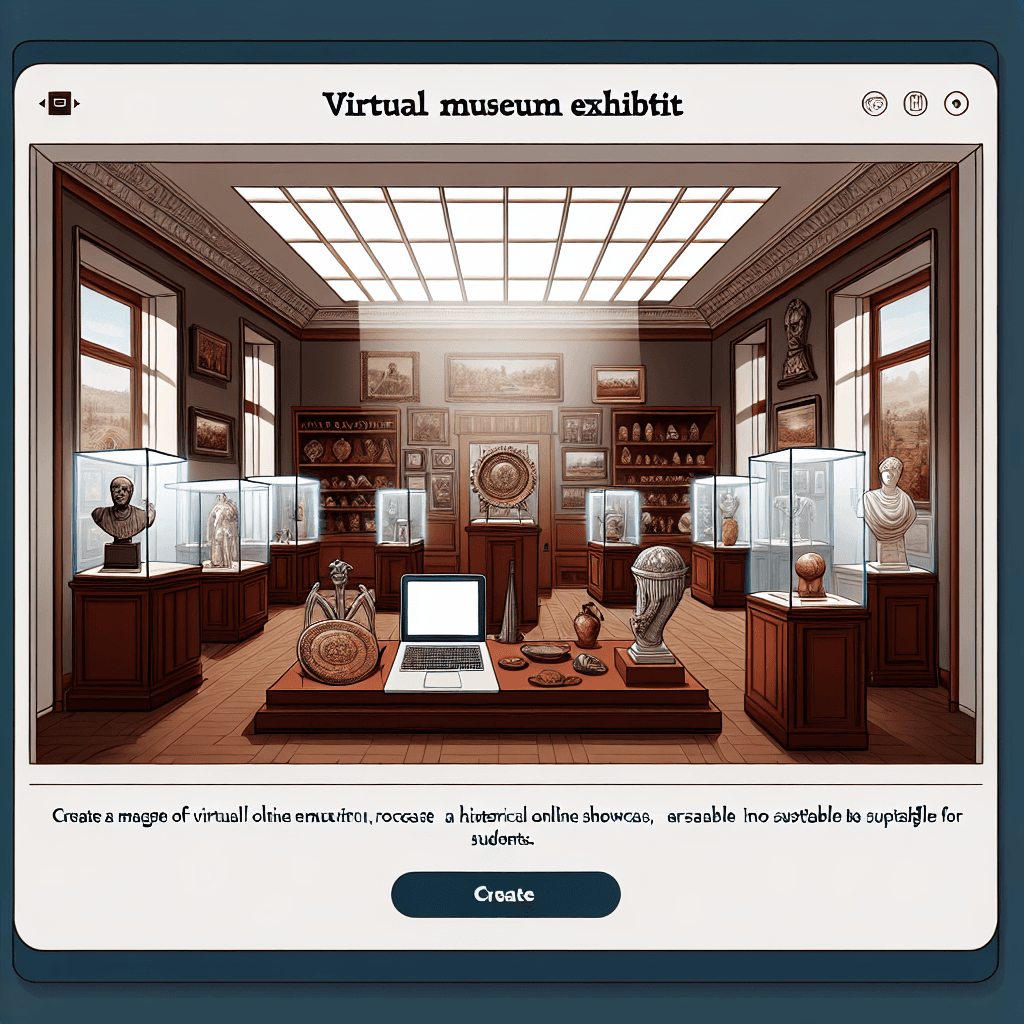
Virtual Museum Exhibit: Curate a Historical Online Showcase
Inquiry Framework
Question Framework
Driving Question
The overarching question that guides the entire project.How can we design and curate a compelling virtual museum exhibit that not only informs but also engages and educates our audience on a historical subject?Essential Questions
Supporting questions that break down major concepts.- What elements are crucial in curating a compelling and informative virtual museum exhibit?
- How does organizing ideas and information enhance the understanding of a historical subject?
- In what ways can multimedia and visual elements aid in the comprehension of historical topics?
- Why are facts, definitions, and details important when developing informative content about history?
- How do transitions contribute to the coherence and clarity of an exhibit narrative?
- What role does language and vocabulary play in effectively communicating historical information to an audience?
- How can I ensure that my exhibit is engaging and maintains the interest of my audience throughout?
- Why is it important to conclude a museum exhibit effectively, and how can a conclusion support and reinforce the information provided?
Standards & Learning Goals
Learning Goals
By the end of this project, students will be able to:- Students will be able to research and organize historical information to create an online museum exhibit.
- Students will learn to use multimedia elements to enhance the presentation of historical content.
- Students will develop skills in writing clear and informative text, appropriate for a public audience.
- Students will understand the role of narrative structure in maintaining engagement and coherence in informational content.
- Students will practice using precise vocabulary and language appropriate for explaining historical topics.
- Students will be able to effectively conclude an informative exhibit, reinforcing the learning objectives.
Common Core Standards
Entry Events
Events that will be used to introduce the project to studentsStory Behind the Object
Students start by choosing a personal item from home that has a historical connection and relate its story. This personal connection ignites interest and serves as the basis for a larger exhibit exploring similar real-world artifacts.Mystery Artifact Challenge
Students are presented with a mysterious artifact with no context. Their task is to research and infer its origins, use, and historical significance, sparking curiosity to create their exhibit based on detailed investigation and storytelling.Curator for a Day
Invite a local museum curator to discuss exhibit creation. Students participate in a hands-on workshop to curate a small exhibit based on provided artifacts, inspiring them to create unique virtual exhibits online.Exhibit Remix Competition
Organize a competition where students remix current museum exhibits with new perspectives or artifacts they believe should be included, fostering innovative thinking and multimedia creativity in exhibit presentation.Portfolio Activities
Portfolio Activities
These activities progressively build towards your learning goals, with each submission contributing to the student's final portfolio.Fact Finder Chronicle
Students compile facts, concrete details, and quotations relating to their chosen artifact into a comprehensive dossier.Steps
Here is some basic scaffolding to help students complete the activity.Final Product
What students will submit as the final product of the activityA detailed dossier featuring organized facts, quotations, and evidence about the artifact.Alignment
How this activity aligns with the learning objectives & standardsSupports CCSS.ELA-LITERACY.W.7.2.B, focusing on developing the topic with details.Transition Trailblazer
Students learn to use transitions to create a coherent flow of ideas between informational segments or exhibit sections.Steps
Here is some basic scaffolding to help students complete the activity.Final Product
What students will submit as the final product of the activityA mapped narrative with clear and effective transitions between sections of the exhibit.Alignment
How this activity aligns with the learning objectives & standardsSupports CCSS.ELA-LITERACY.W.7.2.C, using transitions for cohesion.Vocabulary Virtuoso
Focuses on choosing precise, domain-specific vocabulary to enhance clarity and precision in describing historical data.Steps
Here is some basic scaffolding to help students complete the activity.Final Product
What students will submit as the final product of the activityAn exhibit description enriched with precise vocabulary, suitable for a formal audience.Alignment
How this activity aligns with the learning objectives & standardsAligns with CCSS.ELA-LITERACY.W.7.2.D, emphasizing precise language and vocabulary.Exhibit Style Masterclass
Students focus on establishing an appropriate style that aligns with their exhibit's purpose and audience.Steps
Here is some basic scaffolding to help students complete the activity.Final Product
What students will submit as the final product of the activityExhibit sections with a clear and formal style, guided by audience and purpose.Alignment
How this activity aligns with the learning objectives & standardsAligns with CCSS.ELA-LITERACY.W.7.2.E, focusing on maintaining an appropriate style.Conclusion Crafting Quest
Students design impactful concluding sections that reinforce the entire exhibit's informational narrative.Steps
Here is some basic scaffolding to help students complete the activity.Final Product
What students will submit as the final product of the activityA well-composed conclusion that enhances and summarizes the key points of the exhibit.Alignment
How this activity aligns with the learning objectives & standardsMeets CCSS.ELA-LITERACY.W.7.2.F, focusing on a strong conclusion.Rubric & Reflection
Portfolio Rubric
Grading criteria for assessing the overall project portfolioVirtual Museum Exhibit Rubric
Content Development
Evaluates the thoroughness and relevance of content gathered and presented.Depth and Relevance of Research
Measures how well students conduct research and compile relevant facts and details for their exhibit.
Exemplary
4 PointsResearch includes comprehensive, well-validated facts, diverse sources, and a deep understanding of the topic.
Proficient
3 PointsResearch includes pertinent facts and a variety of sources, showing a clear understanding of the topic.
Developing
2 PointsResearch includes some relevant facts with limited sources, demonstrating emerging understanding.
Beginning
1 PointsResearch includes few relevant facts and lacks diversity in sources, showing minimal understanding.
Use of Transitions
Assesses how effectively transitions are used to connect sections and ideas within the exhibit.
Exemplary
4 PointsTransitions are seamlessly integrated, enhancing comprehension and narrative flow.
Proficient
3 PointsTransitions are clear and functional, aiding in comprehension and narrative flow.
Developing
2 PointsTransitions are present but may be inconsistent, partially aiding comprehension.
Beginning
1 PointsTransitions are minimal or disjointed, leading to a fragmented narrative.
Language and Style
Assesses the appropriateness of language and style for the exhibit's purpose and audience.Precision of Vocabulary
Measures the accuracy and appropriateness of vocabulary used in the exhibit.
Exemplary
4 PointsVocabulary is precise, sophisticated, and greatly enhances understanding.
Proficient
3 PointsVocabulary is suitable and clearly enhances understanding.
Developing
2 PointsVocabulary is appropriate but occasionally lacks precision.
Beginning
1 PointsVocabulary is overly simple or inappropriate, hindering understanding.
Consistency of Style
Evaluates the consistency in maintaining an appropriate style throughout the exhibit.
Exemplary
4 PointsStyle is consistently formal and perfectly suits the subject matter and audience.
Proficient
3 PointsStyle is generally formal and suits the subject matter and audience well.
Developing
2 PointsStyle is occasionally inconsistent, somewhat matching the subject matter.
Beginning
1 PointsStyle is informal or inconsistent, inadequately matching the subject matter.
Synthesis and Conclusion
Evaluates the ability to draw together elements of the exhibit into a coherent conclusion.Coherence and Effectiveness of Conclusion
Assesses how effectively the exhibit's conclusion synthesizes content and reinforces the overall narrative.
Exemplary
4 PointsConclusion is insightful, thoroughly synthesizes content, and powerfully reinforces the exhibit narrative.
Proficient
3 PointsConclusion effectively synthesizes content and reinforces the exhibit narrative.
Developing
2 PointsConclusion attempts to synthesize content but may be somewhat vague.
Beginning
1 PointsConclusion is weak or disconnected from the preceding content.