
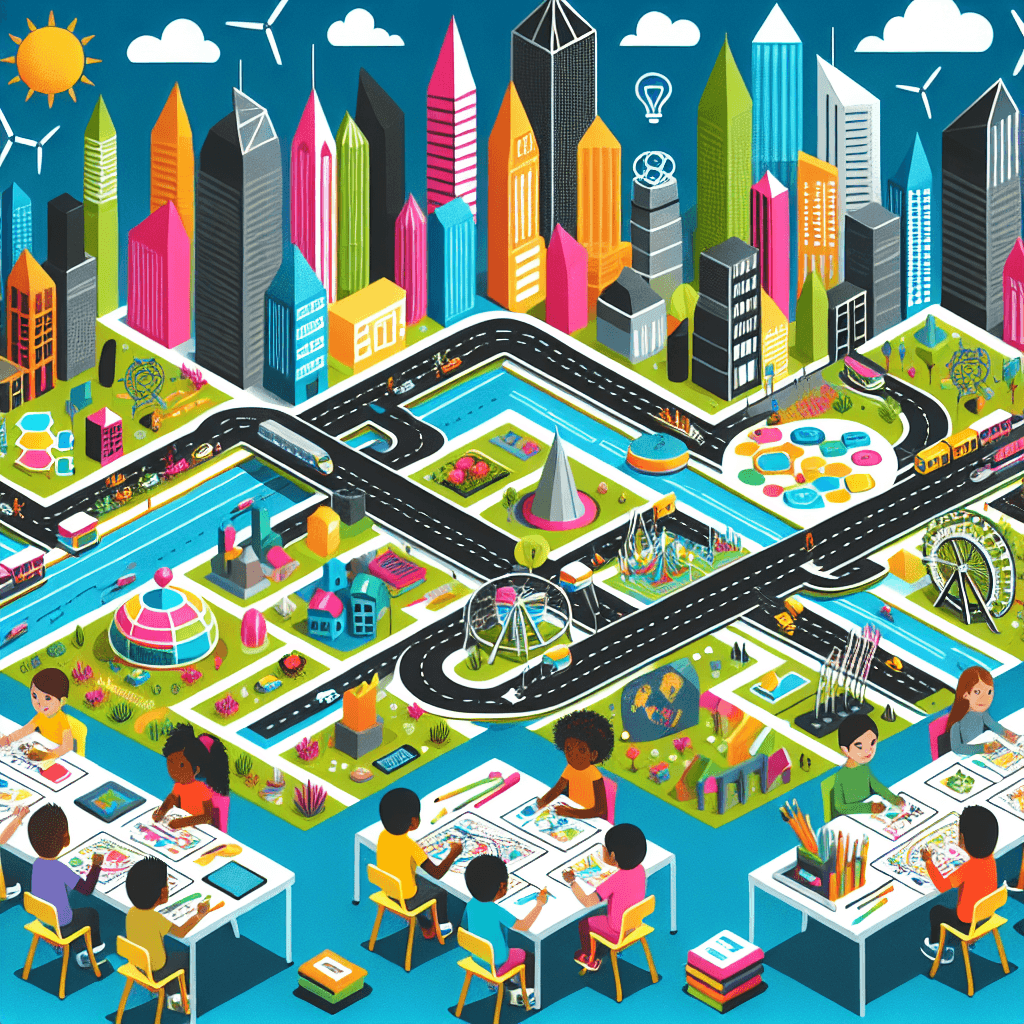
Vision 2030: Designing Saudi Arabia’s Future Cities with Geometry
Inquiry Framework
Question Framework
Driving Question
The overarching question that guides the entire project.How can we, as urban planning consultants, apply geometric transformations and coordinate geometry to design a functional, scalable, and sustainable city that supports the goals of Saudi Vision 2030?Essential Questions
Supporting questions that break down major concepts.- How does a coordinate plane allow urban planners to precisely organize and locate the diverse needs of a community?
- In what ways can translations be used to create efficient, repeatable patterns for residential and industrial districts?
- How do reflections create balance and symmetry in public spaces, and why is this important for city aesthetics?
- How can rotations be used to optimize building orientation for better accessibility or environmental impact?
- How do dilations and scale factors help planners predict and manage a city's growth over time while maintaining its design integrity?
- What is the relationship between rigid motions and congruence when designing a professional brand identity or logo?
- How do geometric transformations allow us to design cities that are both functional and sustainable according to the goals of Saudi Vision 2030?
- How does using scale models and coordinate geometry help a consultant communicate complex ideas to stakeholders effectively?
Standards & Learning Goals
Learning Goals
By the end of this project, students will be able to:- Students will accurately apply and represent geometric transformations (translations, reflections, rotations, and dilations) on a coordinate plane to design and organize urban districts.
- Students will demonstrate an understanding of congruence and similarity by using rigid motions for repeatable city features and scale factors for planned urban growth.
- Students will justify urban planning decisions by connecting geometric principles (like symmetry and orientation) to functional city outcomes such as accessibility, efficiency, and aesthetic balance.
- Students will synthesize mathematical data, 2D coordinate maps, and 3D design principles to construct a professional-grade scale model of a sustainable city.
- Students will communicate complex technical and design concepts to stakeholders through a formal presentation, utilizing a custom-designed logo and clear mathematical justifications.
Common Core State Standards for Mathematics
Common Core State Standards for English Language Arts
Next Generation Science Standards
Entry Events
Events that will be used to introduce the project to studentsThe Scale-Up Simulation
Teams are given a 'Micro-City' model that is perfect but too small for its growing population. They are told a massive migration is coming in 'Week 5' and they must use 'Dilation' logic to scale their infrastructure perfectly without losing the city’s identity, forcing them to think about growth and scale from day one.Portfolio Activities
Portfolio Activities
These activities progressively build towards your learning goals, with each submission contributing to the student's final portfolio.The Blueprint of Progress: Mapping the Sustainable Grid
Now that students have researched the theoretical pillars of sustainability, they must transition from concepts to spatial planning. In this activity, students act as lead consultants to translate their five sustainable features into a physical layout. They will establish a coordinate plane as the city's foundation, designating the origin (0,0) as the sustainable 'City Center.' Using geometric polygons, they will map out specific zones (Residential, Industrial, Commercial, and Green Space) while ensuring their layout reflects the sustainability goals they identified in their research.Steps
Here is some basic scaffolding to help students complete the activity.Final Product
What students will submit as the final product of the activityA color-coded '2D Master Zone Map' on a large coordinate grid, accompanied by a 'Coordinate Geometric Log' that lists the vertices of each zone and a brief justification of how the layout supports a sustainable feature.Alignment
How this activity aligns with the learning objectives & standardsAligns with 8.G.A.3 (describing locations using coordinates), MS-ESS3-3 (minimizing environmental impact through design), and Saudi Vision 2030 urban planning standards.The Modular Move: Efficient Residential Growth
Efficiency in urban design often comes from modularity. Students will design a single, highly efficient 'Residential Block' and use translations to replicate it across their city map. This demonstrates how a city can grow while maintaining consistent standards of living.Steps
Here is some basic scaffolding to help students complete the activity.Final Product
What students will submit as the final product of the activityA 'Translation Tablet' documenting the original block coordinates and the translated image coordinates using algebraic notation (x+h, y+k).Alignment
How this activity aligns with the learning objectives & standardsAligns with 8.G.A.1 (properties of translations) and 8.G.A.2 (congruence through rigid motions).Reflections of Heritage: Symmetrical Public Spaces
Balance is key to city aesthetics. Students will design a central public space, such as a grand park or a cultural plaza, and use reflections to create a symmetrical layout. This reflects the importance of harmony in Saudi architecture and urban design.Steps
Here is some basic scaffolding to help students complete the activity.Final Product
What students will submit as the final product of the activityThe 'Symmetry Square' map section featuring a perfectly reflected public landmark across a chosen axis.Alignment
How this activity aligns with the learning objectives & standardsAligns with 8.G.A.1 (properties of reflections) and 8.G.A.3 (describing transformations using coordinates).The Solar Pivot: Optimizing Infrastructure Orientation
To maximize solar energy or provide better views, buildings often need to be oriented at specific angles. Students will take a 'Green Energy Hub' (like a solar farm) and rotate it to find the optimal placement on their map.Steps
Here is some basic scaffolding to help students complete the activity.Final Product
What students will submit as the final product of the activityA 'Rotational Alignment Report' showing the landmark at 0, 90, and 180 degrees of rotation with corresponding coordinate lists.Alignment
How this activity aligns with the learning objectives & standardsAligns with 8.G.A.1 (properties of rotations) and MS-ESS3-3 (minimizing human impact on the environment through design).The Vision 2050 Expansion: Scaling for Growth
Cities must plan for the future. In this activity, students use the 'Scale-Up Simulation' to expand their commercial district. They will apply a scale factor to their original design to show how the district will look after 20 years of growth.Steps
Here is some basic scaffolding to help students complete the activity.Final Product
What students will submit as the final product of the activityA 'Future Growth Overlay' showing the original district and its dilated, similar version with the scale factor (r) clearly labeled.Alignment
How this activity aligns with the learning objectives & standardsAligns with 8.G.A.4 (establishing similarity through dilations) and 8.G.A.3 (describing dilations with coordinates).Identity in Motion: Sequence-Based Logo Design
Every consulting firm needs a brand. Students will design a logo that represents their urban planning philosophy. The catch: the logo must be created by taking a base shape and applying a sequence of exactly three different transformations.Steps
Here is some basic scaffolding to help students complete the activity.Final Product
What students will submit as the final product of the activityA professional 'Consultant Branding Sheet' showing the evolution of the logo through three distinct mathematical steps.Alignment
How this activity aligns with the learning objectives & standardsAligns with 8.G.A.2 (sequence of rigid motions) and SL.8.5 (integrating visual displays into presentations).Rubric & Reflection
Portfolio Rubric
Grading criteria for assessing the overall project portfolioVision 2030: Geometric Urban Planning Portfolio Rubric
Mathematical Foundations & Geometric Logic
Focuses on the core mathematical standards (8.G.A.1-5) regarding the execution and understanding of geometric transformations.Geometric Accuracy & Coordinate Notation
Assessment of the student's ability to accurately perform and label translations, reflections, rotations, and dilations on a coordinate plane.
Exemplary
4 PointsAll transformations are executed with 100% mathematical accuracy. Algebraic coordinate notation (x, y) is used flawlessly for every vertex. Transformations show sophisticated use of non-origin centers or complex vectors.
Proficient
3 PointsTransformations are accurately plotted with minimal errors. Algebraic notation is consistently used and mostly correct. The relationship between the pre-image and image is clear.
Developing
2 PointsTransformations are attempted but contain several plotting errors. Coordinate notation is present but inconsistent or contains mistakes in sign or operation.
Beginning
1 PointsTransformations are incorrectly applied or missing. Coordinate notation is absent or largely incorrect, making the geometric movement difficult to follow.
Conceptual Logic: Congruence & Similarity
Evaluation of the student's understanding of how rigid motions preserve congruence and how dilations create similarity.
Exemplary
4 PointsProvides insightful proof of congruence and similarity. Explains how properties (side length, angle measure) are preserved or scaled. Expertly connects scale factors to city growth logic.
Proficient
3 PointsCorrectly identifies figures as congruent or similar based on the transformation applied. Uses mathematical terminology (ratios, rigid motion) accurately to describe relationships.
Developing
2 PointsDemonstrates basic understanding that shapes look the same, but struggles to use formal math language like 'congruence' or 'similarity' to justify the relationship.
Beginning
1 PointsFails to distinguish between congruence and similarity. Shows little understanding of how transformations affect the size or shape of city districts.
Application & Urban Strategy
Evaluates the interdisciplinary application of math to science (MS-ESS3-3) and Saudi Vision 2030 social goals.Sustainable Urban Planning Integration
Assessment of how geometric principles are applied to solve urban challenges like sustainability, accessibility, and land-use efficiency.
Exemplary
4 PointsInnovative application of geometry; rotations and reflections are used strategically to maximize solar gain or community balance. Design choices exceed sustainability requirements and align perfectly with Saudi Vision 2030.
Proficient
3 PointsLogical application of geometry; transformations are used to create organized districts and functional public spaces. The city design shows a clear commitment to sustainability and efficiency.
Developing
2 PointsBasic application of geometry; some zones are placed logically, but the connection between the transformation (e.g., rotation) and the urban benefit (e.g., solar energy) is weak or unclear.
Beginning
1 PointsDesign appears random; geometric transformations are applied without regard for city functionality or sustainability goals. Minimal connection to Saudi Vision 2030.
Strategic Justification & Critical Thinking
Evaluation of the written and verbal justifications for why specific transformations were chosen for the city's layout.
Exemplary
4 PointsJustifications provide compelling, evidence-based reasoning. The student acts as a true 'consultant,' connecting every math choice to a specific environmental or social outcome.
Proficient
3 PointsJustifications are clear and logically sound. The student explains the 'why' behind their coordinate placements and transformations using relevant math and science vocabulary.
Developing
2 PointsJustifications are brief or lack detail. The student describes 'what' they did but struggles to explain 'why' it benefits the city or its residents.
Beginning
1 PointsJustifications are missing, circular, or logically flawed. Reasoning does not support the design choices made on the map or model.
Professional Communication & Visual Literacy
Focuses on the ELA (SL.8.4, SL.8.5) and Art standards regarding the communication of complex ideas through modeling and branding.Design Craftsmanship & Visual Identity
Assessment of the professional branding (logo) and the physical 3D model's craftsmanship and scale.
Exemplary
4 PointsLogo sequence is complex and professional. 3D model is meticulously crafted to scale, showing high attention to detail, symmetry, and aesthetic balance. Reflects a high-level consulting firm.
Proficient
3 PointsLogo follows the three-transformation sequence correctly. 3D model is neat, clearly labeled, and represents the coordinate map accurately. Visuals are effective and professional.
Developing
2 PointsLogo is missing one of the three required transformations. 3D model is somewhat messy or does not fully align with the coordinates on the 2D map. Visual impact is limited.
Beginning
1 PointsLogo and 3D model are incomplete or lack professional quality. The link between the math and the visual product is indiscernible.
Consultant Communication & Presentation
Assessment of the final presentation to stakeholders, focusing on clarity, use of visuals, and persuasive speaking.
Exemplary
4 PointsPresentation is highly persuasive and engaging. Multimedia (map, logo, model) is integrated seamlessly to clarify complex data. Claims are supported by robust geometric evidence.
Proficient
3 PointsPresentation is clear and organized. Visual aids are used effectively to support the urban plan. Findings are presented with relevant evidence and sound reasoning.
Developing
2 PointsPresentation is mostly clear but lacks focus. Visual aids are present but not always referenced. Reasoning is sometimes hard to follow for the audience.
Beginning
1 PointsPresentation is disorganized or incoherent. Fails to use visual aids to support claims. Lacks the professionalism required for a consultant role.