
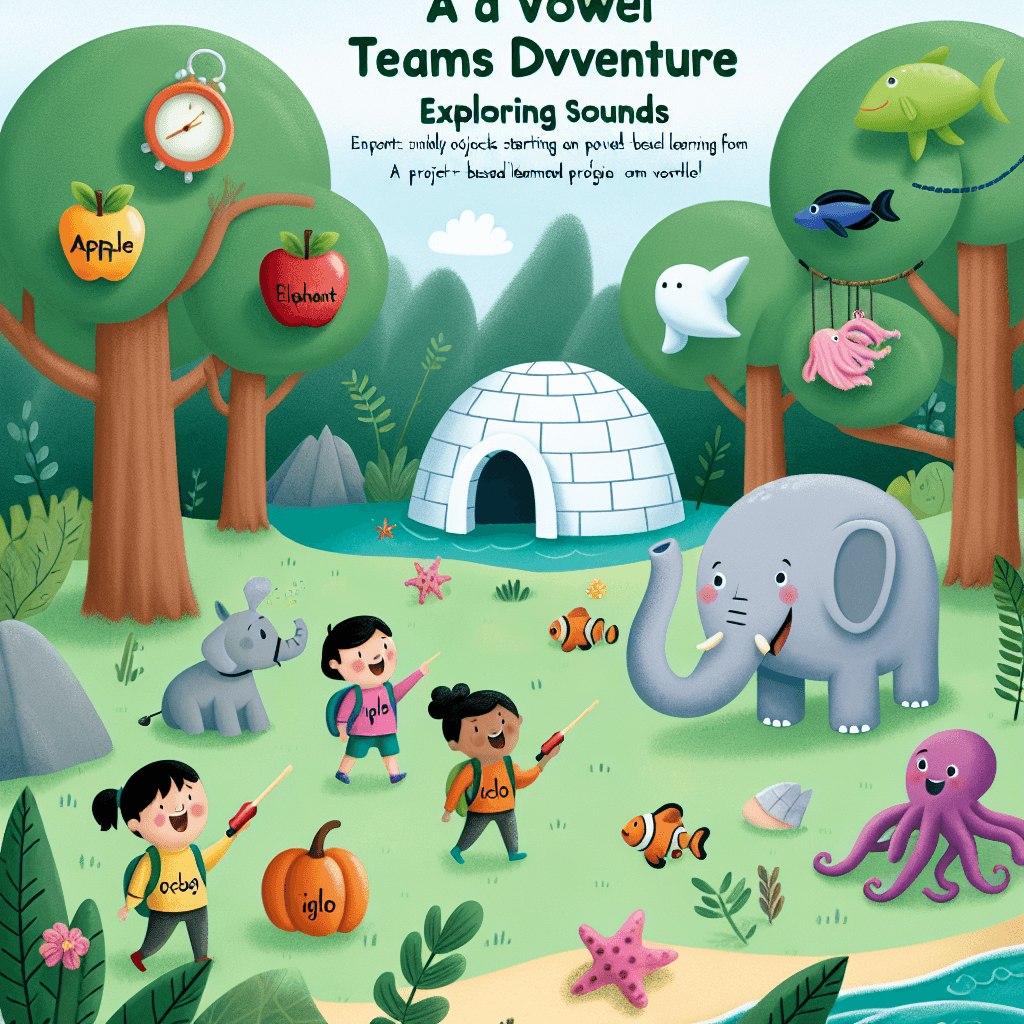
Vowel Teams Adventure: Exploring Sounds
Inquiry Framework
Question Framework
Driving Question
The overarching question that guides the entire project.How can we explore and understand the role of vowel teams in words to become better readers and writers?Essential Questions
Supporting questions that break down major concepts.- What is a vowel team, and how do vowel teams function in words?
- How does changing a vowel team in a word affect the pronunciation and meaning of the word?
- What strategies can we use to identify vowel teams in reading and writing?
Standards & Learning Goals
Learning Goals
By the end of this project, students will be able to:- Students will identify and define vowel teams in words, recognizing their role in pronunciation.
- Students will decode words that include vowel teams to improve reading fluency.
- Students will analyze how changing a vowel team in a word affects its pronunciation and meaning.
- Students will apply strategies to use vowel teams effectively in writing for clear communication.
Common Core Standards
Entry Events
Events that will be used to introduce the project to studentsInteractive Vowel Team Quest
An adventure-themed video introduces a fantastical world where vowel teams hold magical powers. Students embark on a 'quest' to discover these powers by studying and using vowel teams in tasks that affect their journey's outcome, blending inquiry with creative storytelling.Portfolio Activities
Portfolio Activities
These activities progressively build towards your learning goals, with each submission contributing to the student's final portfolio.Vowel Team Discovery Lab
Students will explore what vowel teams are and how they function in words. This activity will serve as the foundation for understanding vowel teams by introducing the concept with hands-on activities and collaborative exploration.Steps
Here is some basic scaffolding to help students complete the activity.Final Product
What students will submit as the final product of the activityWord lists categorized by vowel team sound, created by students and read aloud for practice.Alignment
How this activity aligns with the learning objectives & standardsAligns with RF.1.3b (Decode regularly spelled one-syllable words) by allowing students to explore the construction of words using vowel teams.Vowel Team Change-Up Challenge
Students will analyze how the vowel team in a word affects its pronunciation and meaning. They will engage in activities where changing a vowel team results in a different word, enhancing their understanding of vowels' impact on word meaning and sound.Steps
Here is some basic scaffolding to help students complete the activity.Final Product
What students will submit as the final product of the activityCharts showing original and altered words with vowel teams, including meanings and pronunciation.Alignment
How this activity aligns with the learning objectives & standardsAligns with RF.1.3c (Know common vowel team conventions) by teaching students about vowel sounds and word meaning changes.Vowel Team Detective Hunt
In this activity, students will practice identifying vowel teams in reading passages. They will become 'detectives,' searching for words with vowel teams and analyzing how they contribute to reading fluency and comprehension.Steps
Here is some basic scaffolding to help students complete the activity.Final Product
What students will submit as the final product of the activityHighlighted passages with annotated notes on vowel teams and group reports on their impact on fluency and comprehension.Alignment
How this activity aligns with the learning objectives & standardsSupports RF.1.4 (Read with sufficient accuracy and fluency to support comprehension) by emphasizing practice and understanding.Rubric & Reflection
Portfolio Rubric
Grading criteria for assessing the overall project portfolioVowel Team Mastery Rubric
Vowel Team Identification
Evaluates the student's ability to identify and categorize vowel teams in words.Vowel Team Recognition
Assesses if students can accurately identify and categorize words by their vowel team sounds.
Exemplary
4 PointsIdentifies and categorizes all vowel teams accurately with advanced insight into their pronunciation patterns.
Proficient
3 PointsIdentifies most vowel teams correctly, showing solid understanding of their sounds.
Developing
2 PointsIdentifies some vowel teams but with errors in categorization or pronunciation assumptions.
Beginning
1 PointsStruggles to identify vowel teams or misclassifies them frequently.
Vowel Team Analysis
Assesses the student's ability to analyze the role of vowel teams in altering word pronunciation and meaning.Word Alteration Insight
Measures the ability to understand how changing vowel teams affects pronunciation and meaning.
Exemplary
4 PointsInsightfully explains the changes in pronunciation and meaning when vowel teams are altered, with thorough examples.
Proficient
3 PointsExplains most changes accurately, showing a solid grasp on how vowel team adjustments impact words.
Developing
2 PointsProvides basic explanations of changes with some inaccuracies in understanding the impact of vowel teams.
Beginning
1 PointsHas difficulty explaining changes or makes incorrect assumptions about word alterations.
Reading Fluency with Vowel Teams
Evaluates the student's ability to read passages fluently, focusing on accuracy with vowel team words.Fluency and Comprehension
Assesses reading fluency and comprehension, focusing on vowel team words within passages.
Exemplary
4 PointsReads passages smoothly with high accuracy, demonstrating thorough comprehension and adept reading fluency with vowel team words.
Proficient
3 PointsReads most passages accurately, showing overall good comprehension and fluency with vowel teams.
Developing
2 PointsReads with some hesitations and occasional inaccuracies, occasionally struggling with vowel team words.
Beginning
1 PointsFrequently stumbles over vowel team words, affecting fluency and comprehension.