
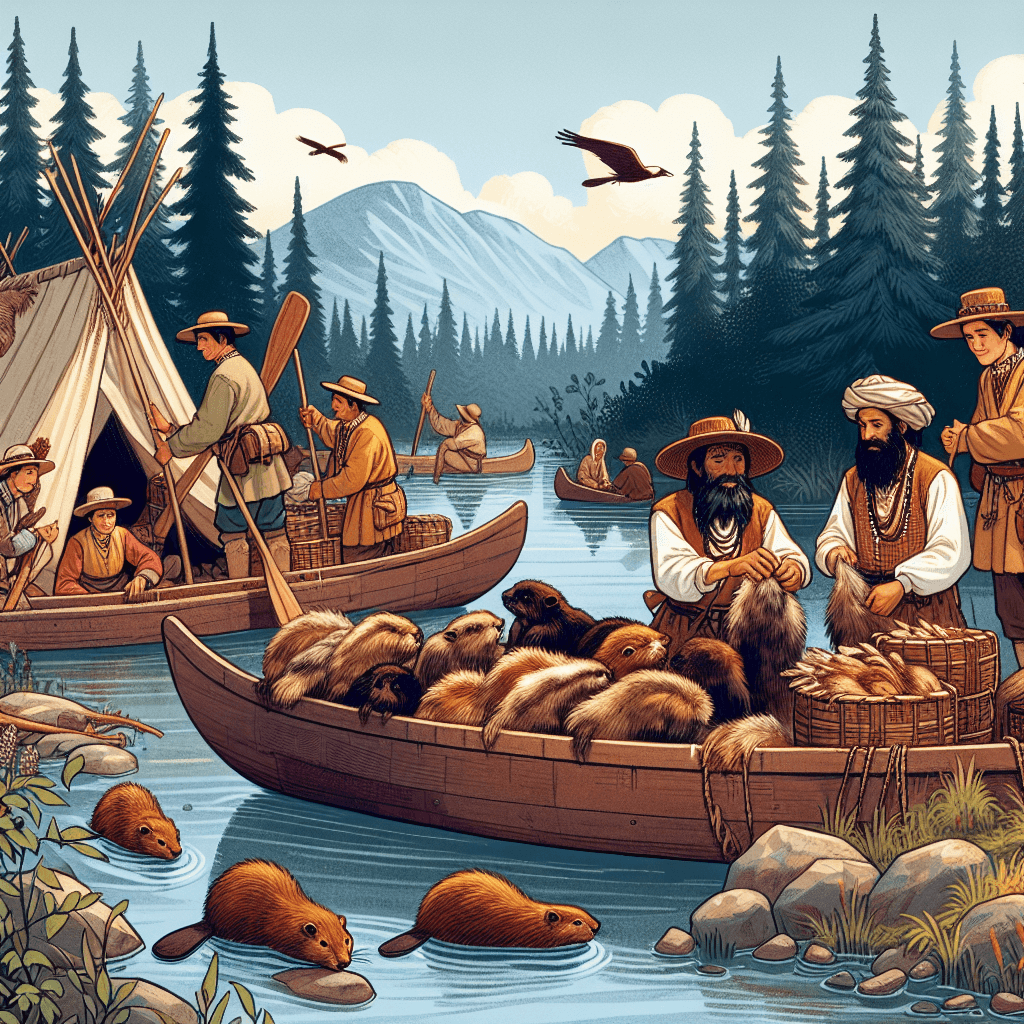
Voyageurs of the Fur Trade: A Living History
Inquiry Framework
Question Framework
Driving Question
The overarching question that guides the entire project.How can we construct and present an engaging and informative living history of the fur trade, embodying diverse roles and contributions, to explore the economic exchanges, cultural interactions, and personal connections during that era?Essential Questions
Supporting questions that break down major concepts.- What diverse roles were involved in the fur trade, and how did they contribute to its success?
- How did the fur trade system function as an economic exchange?
- What were the key interactions between First Nations, Métis, and Europeans during the fur trade, and what were their impacts?
- In what ways did women contribute to the fur trade, and why are these contributions significant?
- How do personal connections to spirit, land, universe, time, or people get revealed through oral traditions?
- How can I present information on the fur trade in an engaging, informative, or entertaining way?
- What are the elements needed to write a diary entry that realistically represents the life of a voyageur?
Standards & Learning Goals
Learning Goals
By the end of this project, students will be able to:- Students will be able to simulate and describe diverse roles within the fur trade, demonstrating understanding of social dynamics of the time.
- Students will model and analyze the fur trade’s system of exchange and evaluate its economic impact.
- Students will explore key interactions between First Nations, Métis, and Europeans, identifying impacts on each group.
- Students will identify and analyze the contributions made by women to the fur trade.
- Students will create personal responses to literature and historical records by synthesizing information on the fur trade.
- Students will develop and present written diaries, reflecting the experiences of individuals in the fur trade, demonstrating literacy skills.
- Students will apply basic arithmetic operations to model economic exchanges in the fur trade.
Social Studies Standards
English Language Arts Standards
Mathematics Standards
Science Standards
Entry Events
Events that will be used to introduce the project to studentsVirtual Trading Route Expedition
Kick-off the project with a virtual reality tour of a historic fur trading route, allowing students to 'step into the shoes' of traders and experience the challenging journeys. This immersive experience spurs interest and provides a compelling entry point to explore the geographical, social, and personal dynamics of the fur trade era.Portfolio Activities
Portfolio Activities
These activities progressively build towards your learning goals, with each submission contributing to the student's final portfolio.Role-Playing the Fur Trade: Meet Your Character
Students begin their journey into the fur trade era by being assigned a character role – either a voyageur, trader, First Nations individual, Métis, or European settler. They will research their character's role, responsibilities, and daily life, setting the groundwork for understanding diverse perspectives.Steps
Here is some basic scaffolding to help students complete the activity.Final Product
What students will submit as the final product of the activityA character profile poster that outlines the student's assigned role in the fur trade, including responsibilities and social dynamics.Alignment
How this activity aligns with the learning objectives & standardsSS.4.5.1 - Simulate diverse roles in historical events or time periods, specifically the fur trade, to understand social dynamics and individual contributions.Trade Route Economics: Mapping Exchanges
In this activity, students will create a map of a fur trading route, identifying key trading posts and exchanges between different groups. They will learn about the economic aspects and geographic challenges that shaped the trade.Steps
Here is some basic scaffolding to help students complete the activity.Final Product
What students will submit as the final product of the activityA detailed map of a fur trading route, complete with labeled trading posts and annotations about economic exchanges.Alignment
How this activity aligns with the learning objectives & standardsSS.4.5.2 - Analyze economic systems and exchanges, focusing on trade and commerce during historical periods, such as the fur trade. MATH.4.2.3 - Apply basic arithmetic operations within the context of historical economics to understand trade and value.Rubric & Reflection
Portfolio Rubric
Grading criteria for assessing the overall project portfolioFur Trade Simulation and Role-Playing Rubric
Role Understanding and Character Development
Assessment of the ability to simulate and articulate diverse roles during the fur trade era through character creation and understanding social dynamics.Character Profile Detail
Evaluation of the detail and accuracy in the student's character profile, demonstrating understanding of the character's role and social interactions.
Exemplary
4 PointsThe character profile is comprehensive and insightful, showing a deep understanding of the character's role, responsibilities, and interactions with others in the fur trade.
Proficient
3 PointsThe character profile is detailed and shows a thorough understanding of the character's role and interactions.
Developing
2 PointsThe character profile is basic, with some understanding of the character's role and interactions.
Beginning
1 PointsThe character profile lacks detail and shows minimal understanding of the character's role or social interactions.
Historical Role Simulation
Measures the ability to embody a historical role and simulate interactions based on historical social dynamics.
Exemplary
4 PointsSimulation of the character shows exceptional creativity and accuracy in contextualizing the character's role within the fur trade's social dynamics.
Proficient
3 PointsSimulation accurately reflects the character role and social dynamics in the fur trade.
Developing
2 PointsSimulation shows limited creativity or accuracy, with some understanding of role and social dynamics.
Beginning
1 PointsSimulation is minimal and lacks clarity regarding the character's historical role and dynamics.
Trade Route Mapping and Economics
Evaluates the creation of the trade route map, including accuracy of locations, distances, and understanding of trade exchange values and challenges.Map Accuracy and Detail
Assessment of the map's accuracy, including labeling of key locations, distances, and geographic challenges.
Exemplary
4 PointsThe map is detailed and precise, with all major trading posts, distances, and geographic features accurately represented.
Proficient
3 PointsThe map is accurate with most trading posts and geographic features correctly labeled.
Developing
2 PointsThe map includes basic features but lacks precision or has notable inaccuracies.
Beginning
1 PointsThe map is incomplete or contains several inaccuracies, lacking key components of the trade route.
Economic Exchange Analysis
Evaluation of the student's ability to apply arithmetic operations in modeling economic exchanges and discussing trade values.
Exemplary
4 PointsShows advanced ability to calculate and explain trade values and economics, with thorough discussion on challenges faced.
Proficient
3 PointsAccurately calculates trade values and discusses economic challenges with clarity.
Developing
2 PointsShows basic calculation skills but lacks depth in economic exchange analysis.
Beginning
1 PointsCalculations are incorrect or incomplete, with limited discussion on economic exchanges.