
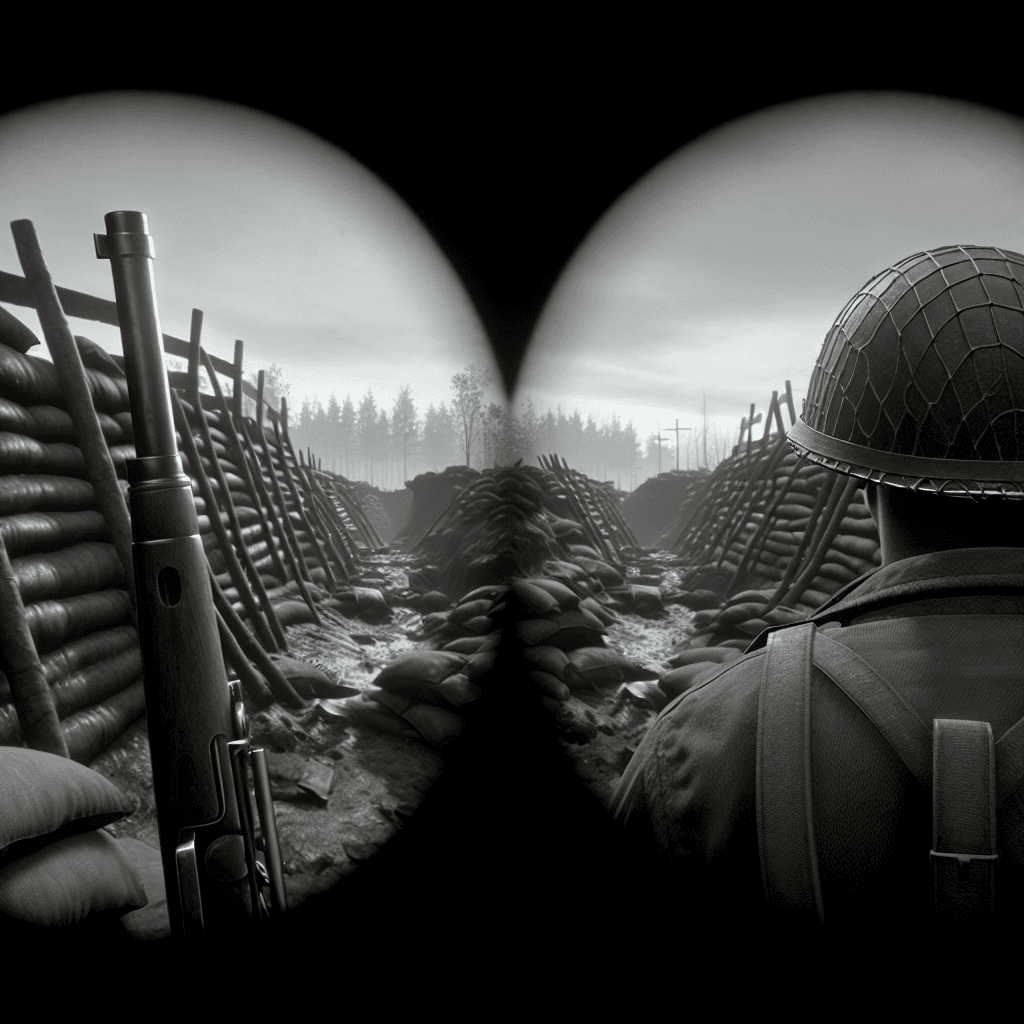
VR Diary: WW2 Soldier's Perspective
Inquiry Framework
Question Framework
Driving Question
The overarching question that guides the entire project.How can we use virtual reality to recreate and understand the experiences of soldiers in World War II, focusing on both the causes and effects of the war?Essential Questions
Supporting questions that break down major concepts.- What were the key causes and effects of World War II?
- How did individual soldiers experience and perceive key events during World War II?
- In what ways can technology, such as virtual reality, enhance our understanding of historical events?
Standards & Learning Goals
Learning Goals
By the end of this project, students will be able to:- Understand and analyze the major causes and effects of World War II.
- Develop empathy and insights into the experiences of individual soldiers during World War II.
- Utilize virtual reality technology to create an immersive historical experience.
- Enhance communication skills through creative digital expression.
California History-Social Science Content Standards
ISTE Standards for Students
Entry Events
Events that will be used to introduce the project to studentsVR Time Capsule Discovery
Students 'discover' a time capsule containing various WW2 soldier artifacts, which lead to the idea of preserving these stories through a VR experience. This sparks curiosity about history and the technology to showcase it.Portfolio Activities
Portfolio Activities
These activities progressively build towards your learning goals, with each submission contributing to the student's final portfolio.Artifact Analysis Workshop
Students will analyze the artifacts discovered in the VR Time Capsule to understand and contextualize a soldier's experience during World War II. This will serve as the foundation for the VR narrative they will create.Steps
Here is some basic scaffolding to help students complete the activity.Final Product
What students will submit as the final product of the activityA detailed group report analyzing one or more artifacts, focusing on their historical context and relevance.Alignment
How this activity aligns with the learning objectives & standardsAligns with HSS-10.8 (Analyze the causes and consequences of World War II) by exploring evidence of historical events through artifacts.Virtual Reality Storyline Sketch
Students will create a storyboard outlining their VR experience from a WW2 soldier's perspective, incorporating historical accuracy based on their artifact analysis.Steps
Here is some basic scaffolding to help students complete the activity.Final Product
What students will submit as the final product of the activityA comprehensive storyboard with detailed scenes and character profiles for the VR experience.Alignment
How this activity aligns with the learning objectives & standardsSupports HSS-10.8 and ISTE-1 by connecting historical analysis with digital storytelling techniques.Tech Tools Exploration Lab
In this activity, students will experiment with VR platforms and tools to learn how to bring their storyboards to life in a virtual environment.Steps
Here is some basic scaffolding to help students complete the activity.Final Product
What students will submit as the final product of the activityA reflective journal documenting their experiences, challenges, and the potential of each tool for their project.Alignment
How this activity aligns with the learning objectives & standardsSupports ISTE-1 and ISTE-6 by actively engaging students in learning about and applying technology tools for creative communication.VR Experience Development Sprint
Students will begin developing their VR world, integrating historical data, soldier narratives, and artistic elements to create an immersive experience.Steps
Here is some basic scaffolding to help students complete the activity.Final Product
What students will submit as the final product of the activityAn initial version of the VR experience that integrates research and narrative elements, ready for further refinement.Alignment
How this activity aligns with the learning objectives & standardsAligns with HSS-10.8, ISTE-1, and ISTE-6 by combining historical understanding with immersive digital media production.Final VR Showcase and Reflection
Students will present their completed VR experiences to the class and reflect on their learning journey, the causes and effects of WW2 explored, and the potential of VR in historical storytelling.Steps
Here is some basic scaffolding to help students complete the activity.Final Product
What students will submit as the final product of the activityA completed VR project and a reflective essay discussing the learning outcomes and potential of VR in history education.Alignment
How this activity aligns with the learning objectives & standardsWraps up the lessons on HSS-10.8, ISTE-1, and ISTE-6 by assessing the integration of historical and technological insights.Rubric & Reflection
Portfolio Rubric
Grading criteria for assessing the overall project portfolioWW2 VR Experience Rubric
Historical Understanding
Assesses students' ability to accurately represent World War II causes and effects through artifacts and narrative in the VR experience.Historical Accuracy
Measures the correctness of historical facts and events represented in the VR project.
Exemplary
4 PointsAll historical elements are meticulously accurate with clear connections to primary sources.
Proficient
3 PointsMost historical elements are accurate with minor errors in details or interpretation.
Developing
2 PointsSome historical inaccuracies present; understanding appears basic or incomplete.
Beginning
1 PointsMany inaccuracies and a fundamental misunderstanding of key events.
Artifact Analysis
Assesses the depth of analysis regarding the artifacts and their historical context.
Exemplary
4 PointsAnalysis is detailed and insightful, clearly connecting artifacts to historical context and soldier experiences.
Proficient
3 PointsAnalysis is accurate and reasonable, showing good connection to historical context.
Developing
2 PointsLimited analysis with some unclear connections to historical context.
Beginning
1 PointsConnections to historical context are minimal or incorrect.
Creative Communication
Evaluates the effectiveness and creativity of the VR storytelling and communication skills.Narrative Cohesion
Assesses how well the story is structured and the clarity of its message.
Exemplary
4 PointsStory is compelling, well-structured, and conveys emotional and historical depth seamlessly.
Proficient
3 PointsStory is coherent and conveys the message clearly with minor issues in structure.
Developing
2 PointsStory has some inconsistencies and lacks emotional or historical depth.
Beginning
1 PointsStory is confusing or incomplete, lacking a clear message or structure.
Use of Digital Media
Measures creativity and aptitude in using digital tools to express historical narratives.
Exemplary
4 PointsDigital media is used innovatively to enhance the storytelling experience.
Proficient
3 PointsDigital media is used appropriately, supporting the storytelling experience.
Developing
2 PointsDigital media use is basic or inconsistent, offering limited narrative support.
Beginning
1 PointsDigital tools are minimally or poorly used, detracting from storytelling.
Technical Implementation
Assesses the technical skills and innovation in developing the VR experience.Technological Innovation
Evaluates the originality and effectiveness of the technical execution.
Exemplary
4 PointsThe VR experience is technically sophisticated and innovative.
Proficient
3 PointsThe VR experience is well-executed with some innovative use of technology.
Developing
2 PointsThe VR experience is functional but lacks technical refinement.
Beginning
1 PointsTechnical execution is flawed, resulting in an incomplete or non-functional experience.
Problem Solving
Measures ability to identify and solve technical challenges during VR development.
Exemplary
4 PointsConsistently identifies and solves problems creatively and efficiently.
Proficient
3 PointsEffectively addresses most technical challenges encountered.
Developing
2 PointsShows some ability to address challenges, but uses limited solutions.
Beginning
1 PointsStruggles to identify or solve issues without external assistance.