
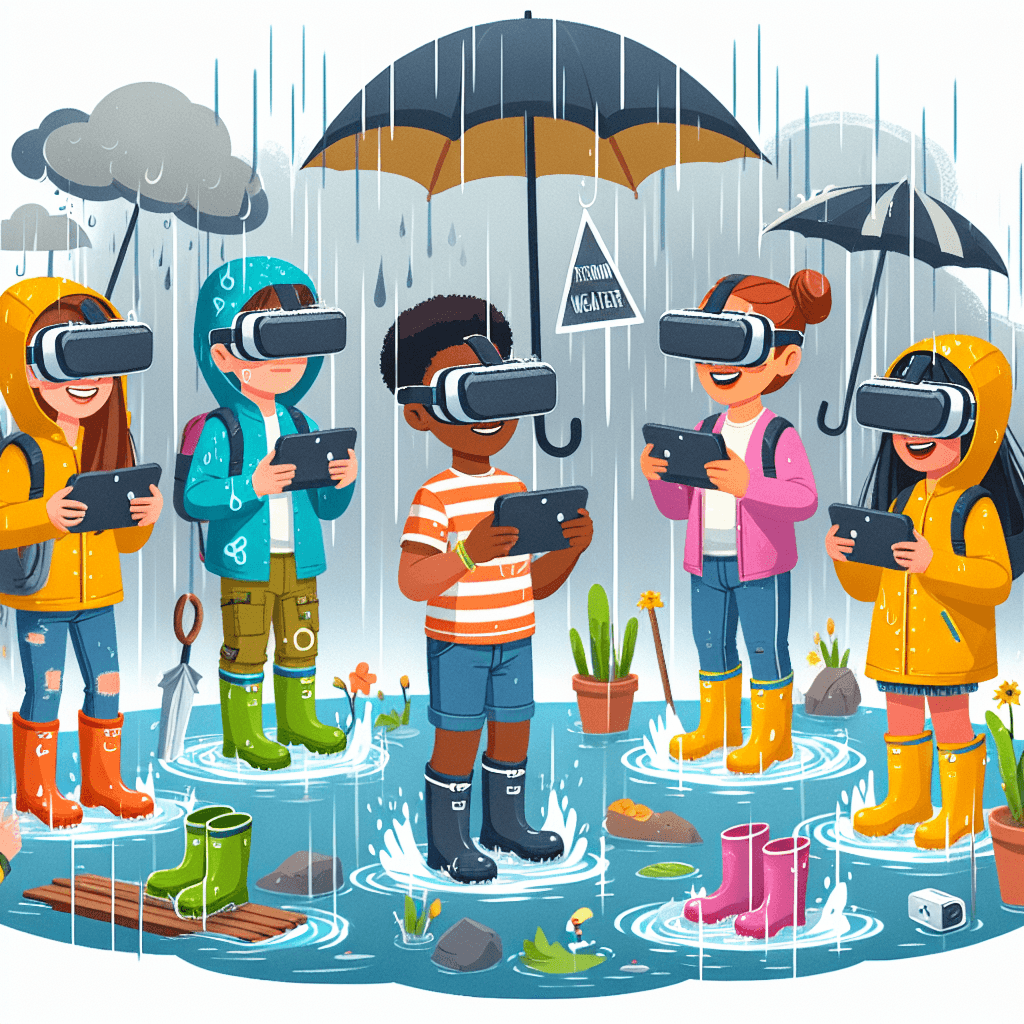
VR Extreme Weather Rain Gear Test
Inquiry Framework
Question Framework
Driving Question
The overarching question that guides the entire project.How can we design and utilize a virtual reality simulation to effectively test and enhance the performance of rain gear under extreme weather conditions, considering the advantages, disadvantages, and key performance indicators compared to traditional testing methods?Essential Questions
Supporting questions that break down major concepts.- How can we use virtual reality to simulate extreme weather conditions?
- What are the key performance indicators for rain gear in extreme weather?
- How can we design a virtual reality test that accurately measures these indicators?
- What are the advantages and disadvantages of using virtual reality for testing compared to traditional methods?
- How can we use the results of our virtual reality test to improve the design of rain gear?
Standards & Learning Goals
Learning Goals
By the end of this project, students will be able to:- Students will be able to design and implement a virtual reality simulation for testing rain gear.
- Students will be able to identify and measure key performance indicators (KPIs) for rain gear in extreme weather conditions.
- Students will be able to compare and contrast the advantages and disadvantages of virtual reality testing versus traditional testing methods.
- Students will be able to analyze data from virtual reality simulations and propose design improvements for rain gear.
Teacher-Provided Standard
Entry Events
Events that will be used to introduce the project to studentsSurprise Shower
Students experience a sudden downpour in the classroom, unexpectedly getting soaked. They then explore various rain gear designs, discussing their effectiveness and flaws, sparking curiosity about optimal rain protection. This leads into exploring virtual reality as a tool for testing and design.Portfolio Activities
Portfolio Activities
These activities progressively build towards your learning goals, with each submission contributing to the student's final portfolio.VR Test Design Blueprint
Students will brainstorm and outline the steps involved in testing rain gear, both in traditional settings and within a virtual reality environment. This activity focuses on establishing a clear testing procedure that can be replicated and measured within the virtual simulation.Steps
Here is some basic scaffolding to help students complete the activity.Final Product
What students will submit as the final product of the activityA detailed outline of testing procedures for rain gear in both real-world and virtual reality environments.Alignment
How this activity aligns with the learning objectives & standardstesting procedures for a new design of rain gear; Students will be able to design and implement a virtual reality simulation for testing rain gear.VR vs. Reality: A Testing Showdown
Students analyze the advantages and disadvantages of VR testing versus real-world methods for rain gear, fostering critical thinking about the chosen testing methodology.Steps
Here is some basic scaffolding to help students complete the activity.Final Product
What students will submit as the final product of the activityA comparative analysis of VR and traditional rain gear testing methods in a table format.Alignment
How this activity aligns with the learning objectives & standardstesting procedures for a new design of rain gear; Students will be able to compare and contrast the advantages and disadvantages of virtual reality testing versus traditional testing methods.Data-Driven Design: Improving Rain Gear Through VR
Using sample or simulated VR test results, students interpret data, connect it to KPIs, and recommend design improvements.Steps
Here is some basic scaffolding to help students complete the activity.Final Product
What students will submit as the final product of the activityA report analyzing simulated VR test results, linking them to KPIs, and proposing design improvements for rain gear.Alignment
How this activity aligns with the learning objectives & standardstesting procedures for a new design of rain gear; Students will be able to analyze data from virtual reality simulations and propose design improvements for rain gear.KPI Identification and Measurement
Students identify the Key Performance Indicators (KPIs) for evaluating rain gear effectiveness. They learn how to quantify these KPIs for measurement within the virtual reality simulation.Steps
Here is some basic scaffolding to help students complete the activity.Final Product
What students will submit as the final product of the activityA list of KPIs with descriptions of how they will be measured in the virtual reality simulation.Alignment
How this activity aligns with the learning objectives & standardstesting procedures for a new design of rain gear; Students will be able to identify and measure key performance indicators (KPIs) for rain gear in extreme weather conditions.Rubric & Reflection
Portfolio Rubric
Grading criteria for assessing the overall project portfolioVirtual Reality Rain Gear Testing Rubric
Design and Implementation
Evaluates the student's ability to design and implement a comprehensive virtual reality simulation for testing rain gear.Simulated Environment Design
The extent to which students can design a virtual reality environment that effectively simulates extreme weather conditions for testing rain gear.
Exemplary
4 PointsDesigns a sophisticated VR environment that precisely simulates extreme weather conditions with innovative elements improving realism and accuracy.
Proficient
3 PointsDesigns an effective VR environment that accurately simulates extreme weather conditions with clear objectives and realistic elements.
Developing
2 PointsDesigns a basic VR environment that simulates weather conditions with some elements lacking clarity or realism.
Beginning
1 PointsStruggles to design a VR environment that simulates weather conditions, lacking clarity and essential elements.
Testing Procedure Execution
The ability to effectively create and execute detailed virtual and real-world testing procedures.
Exemplary
4 PointsExecutes a comprehensive, highly detailed testing procedure that includes innovative data collection and thorough analysis techniques.
Proficient
3 PointsExecutes a well-organized testing procedure with detailed steps and effective data analysis methods.
Developing
2 PointsExecutes a basic testing procedure with most necessary steps and data analysis but requires further detail and refinement.
Beginning
1 PointsStruggles to execute a coherent testing procedure with unclear steps and minimal data analysis.
Critical Analysis and Comparison
Assesses the student's ability to analyze results from VR simulations versus traditional testing and draw insightful conclusions.Comparison of Testing Methods
Evaluation of students' ability to compare the advantages and disadvantages of VR versus traditional testing methods.
Exemplary
4 PointsPresents a nuanced and comprehensive analysis of VR and traditional testing methods, providing significant insights and original comparisons.
Proficient
3 PointsProvides a thorough and well-structured analysis of VR and traditional testing methods, highlighting key similarities and differences.
Developing
2 PointsOffers a basic comparison of VR and traditional testing methods with limited insights or connections.
Beginning
1 PointsAttempts to compare testing methods but lacks clear insight and comprehensive understanding.
KPI Identification and Analysis
The degree to which students identify, measure, and analyze key performance indicators within the VR simulation.
Exemplary
4 PointsIdentifies and measures KPIs exceptionally well, demonstrating advanced analysis and insightful connections to performance improvements.
Proficient
3 PointsIdentifies and measures KPIs effectively, providing clear analysis and connections to potential improvements.
Developing
2 PointsIdentifies basic KPIs with limited analysis or unclear connections to rain gear performance improvements.
Beginning
1 PointsStruggles to identify and measure KPIs with minimal or inaccurate analysis related to performance improvements.
Data Interpretation and Improvement Suggestions
Focuses on students' ability to interpret data from simulations and propose feasible improvements to rain gear design.Data-Driven Design Improvement
Assessment of students' proficiency in interpreting simulation data and suggesting specific, logical improvements to rain gear design.
Exemplary
4 PointsProposes highly creative, feasible design improvements based on in-depth data interpretation and forward-thinking analysis.
Proficient
3 PointsProvides well-reasoned, effective design improvements supported by accurate data interpretation and clear analysis.
Developing
2 PointsSuggests basic design improvements with limited support from data interpretation and analysis.
Beginning
1 PointsStruggles to propose relevant design improvements with minimal data-based reasoning.