
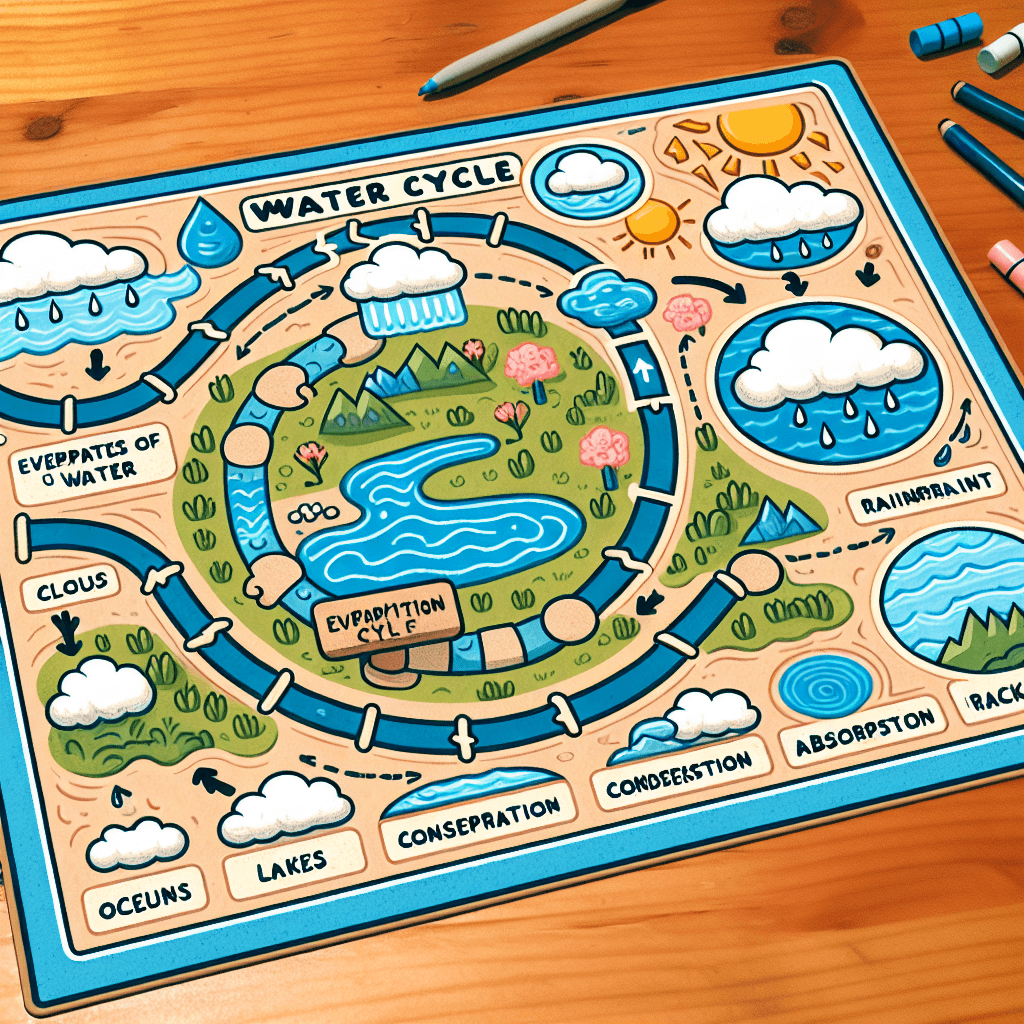
Water Cycle Journey: Board Game Design
Inquiry Framework
Question Framework
Driving Question
The overarching question that guides the entire project.How can we design an educational and entertaining board game that effectively models the stages and processes of the water cycle, and explains how water changes state as it moves through these phases?Essential Questions
Supporting questions that break down major concepts.- How does water change state as it moves through the different phases of the water cycle?
- What are the main processes involved in the water cycle, and how do they interact?
- How can we represent the stages of the water cycle in a fun and educational way?
Standards & Learning Goals
Learning Goals
By the end of this project, students will be able to:- Students will understand and explain the processes of the water cycle including evaporation, condensation, precipitation, and runoff.
- Students will develop models representing the water cycle that accurately depict the phases and state changes.
- Students will design and create an interactive board game that educates peers on the water cycle.
- Students will evaluate the effectiveness of their board game in teaching the water cycle concepts.
Next Generation Science Standards
Common Core Standards
Entry Events
Events that will be used to introduce the project to studentsAquatic Adventure Reality Show
Kick off the project by simulating a game show setting where students are contestants exploring different stages of the water cycle. They must perform quick challenges that demonstrate each process, such as evaporation races or condensation crafting, sparking excitement and deeper interest in the underlying science.Portfolio Activities
Portfolio Activities
These activities progressively build towards your learning goals, with each submission contributing to the student's final portfolio.Board Game Blueprint Design
Students will design a blueprint for their board game, planning how different processes of the water cycle will be represented as game mechanics.Steps
Here is some basic scaffolding to help students complete the activity.Final Product
What students will submit as the final product of the activityA detailed game board blueprint that visually represents the water cycle and includes interactive elements.Alignment
How this activity aligns with the learning objectives & standardsAligns with MS-ESS2-4 and CCSS.ELA-LITERACY.SL.7.5 by creating a model and including visual displays to communicate ideas effectively.Prototype Playtest Challenge
Students will create a prototype of their board game and test its effectiveness in conveying the educational content to peers.Steps
Here is some basic scaffolding to help students complete the activity.Final Product
What students will submit as the final product of the activityA tested and refined board game prototype that educates players about the water cycle processes.Alignment
How this activity aligns with the learning objectives & standardsAligns with MS-ESS2-4 and CCSS.ELA-LITERACY.SL.7.5 by using a model to explain processes and incorporating multimedia elements.Final Game Presentation Extravaganza
Students will present their finalized board game to the class, highlighting how effectively it teaches about the water cycle.Steps
Here is some basic scaffolding to help students complete the activity.Final Product
What students will submit as the final product of the activityA polished presentation and a finalized board game that serves as an educational model of the water cycle.Alignment
How this activity aligns with the learning objectives & standardsSupports MS-ESS2-4, MS-ESS2-6, and CCSS.ELA-LITERACY.SL.7.5 by developing models to describe the water cycle, explaining energy flow, and effectively using multimedia in presentations.Water Cycle Detective Assignment
Students will research each stage of the water cycle to understand the main processes: evaporation, condensation, precipitation, and runoff. They will gather data and visuals to get a deeper understanding of how each process works.Steps
Here is some basic scaffolding to help students complete the activity.Final Product
What students will submit as the final product of the activityA comprehensive graphic organizer that includes descriptions, visuals, and key features of each stage of the water cycle.Alignment
How this activity aligns with the learning objectives & standardsAligns with MS-ESS2-4 by developing a basic model to describe the cycling of water through Earth's systems.Rubric & Reflection
Portfolio Rubric
Grading criteria for assessing the overall project portfolioWater Cycle Board Game Portfolio Rubric
Understanding of Water Cycle Processes
Assessment of the student's understanding and accurate representation of the water cycle processes in their game design.Representation of Cycle Phases
How accurately and clearly the game represents the phases of the water cycle: evaporation, condensation, precipitation, and runoff.
Exemplary
4 PointsIncludes all phases with accurate scientific details, showing deep understanding and clear, innovative representation in the game design.
Proficient
3 PointsIncludes major phases with accurate details, demonstrating solid understanding and clear representation in the game design.
Developing
2 PointsIncludes some phases with basic details, showing partial understanding and inconsistent representation in the game design.
Beginning
1 PointsIncludes few phases with minimal details, showing limited understanding and unclear representation in the game design.
State Changes of Water
Assessment of how well the game illustrates the state changes of water as it progresses through the cycle.
Exemplary
4 PointsDetailed and clear illustration of all water state changes, using creative and scientifically accurate depictions throughout the game.
Proficient
3 PointsClear illustration of most water state changes, with correct and engaging depictions in the game.
Developing
2 PointsBasic illustration of some water state changes, with partial and correct depiction in the game.
Beginning
1 PointsMinimal illustration of water state changes, with unclear and incomplete depiction in the game.
Game Design and Innovation
Evaluation of the creativity, playability, and educational value of the board game design.Creativity and Innovation
Assessment of the game's originality, creativity, and appeal in representing the water cycle.
Exemplary
4 PointsExceptionally creative design that is both educational and highly engaging, showcasing innovative ideas and comprehensive coverage of the water cycle.
Proficient
3 PointsCreative design that is educational and engaging, with clear representation of the water cycle through thoughtful ideas.
Developing
2 PointsSomewhat creative design with basic educational elements, needing further development for engaging representation of the water cycle.
Beginning
1 PointsSimple and basic design lacking creativity, with limited educational elements and engagement.
Playability and User Engagement
Assessment of how engaging and playable the board game is for its users.
Exemplary
4 PointsHighly engaging game that is intuitive to play, with clear instructions and seamless transitions between phases making learning enjoyable.
Proficient
3 PointsEngaging game with generally clear instructions and mostly smooth transitions between phases, fostering learning.
Developing
2 PointsPartially engaging game with unclear instructions and some confusing transitions, needing improvements to enhance learning.
Beginning
1 PointsLimited engagement with unclear or missing instructions, causing confusion and hindering the learning experience.
Collaborative Testing and Iteration
Evaluation of the student's ability to collaborate and refine their game based on feedback.Feedback Incorporation
How effectively feedback from playtesting is used to refine the game design.
Exemplary
4 PointsActively incorporates comprehensive feedback to make significant improvements, demonstrating deep reflection and iterative design.
Proficient
3 PointsIncorporates key feedback to make noticeable improvements, demonstrating reflection and iterative design.
Developing
2 PointsIncorporates some feedback with minimal improvements, demonstrating limited reflection and iterative design.
Beginning
1 PointsRarely incorporates feedback, with few or no improvements, demonstrating little reflection and iterative design.
Collaboration and Teamwork
Assessment of the student's participation and contributions during group work and playtesting.
Exemplary
4 PointsDemonstrates leadership and active participation in group activities, effectively contributing to discussions and decision-making.
Proficient
3 PointsParticipates actively in group activities, contributing to discussions and decision-making processes.
Developing
2 PointsParticipates occasionally in group activities, with limited contributions to discussions and decision-making.
Beginning
1 PointsRarely participates in group activities, with minimal contributions to discussions and decision-making processes.
Presentation and Communication Skills
Evaluation of the effectiveness of the student's presentation and their ability to communicate their understanding of the water cycle and game design process.Presentation Clarity and Organization
Assessment of the clarity, organization, and delivery of the final presentation.
Exemplary
4 PointsPresentation is exceptionally clear, well-organized, and engaging, with seamless integration of multimedia elements that highlight key points effectively.
Proficient
3 PointsPresentation is clear, organized, and engaging, effectively using multimedia elements to highlight key points.
Developing
2 PointsPresentation is somewhat clear and organized, with basic use of multimedia elements, lacking in engagement or focus on key points.
Beginning
1 PointsPresentation lacks clarity and organization, with minimal use of multimedia elements and ineffective communication of key points.
Visual and Multimedia Integration
How well the student integrates multimedia elements to enhance their presentation.
Exemplary
4 PointsSeamlessly integrates multimedia components, including visuals, diagrams, and videos, enriching the presentation and reinforcing key ideas.
Proficient
3 PointsEffectively integrates multimedia components that enhance the presentation and clarify key ideas.
Developing
2 PointsIntegrates some multimedia components, which partially support the presentation but may not fully reinforce key ideas.
Beginning
1 PointsMinimal integration of multimedia components with little contribution to enhancing the presentation or clarifying key ideas.