
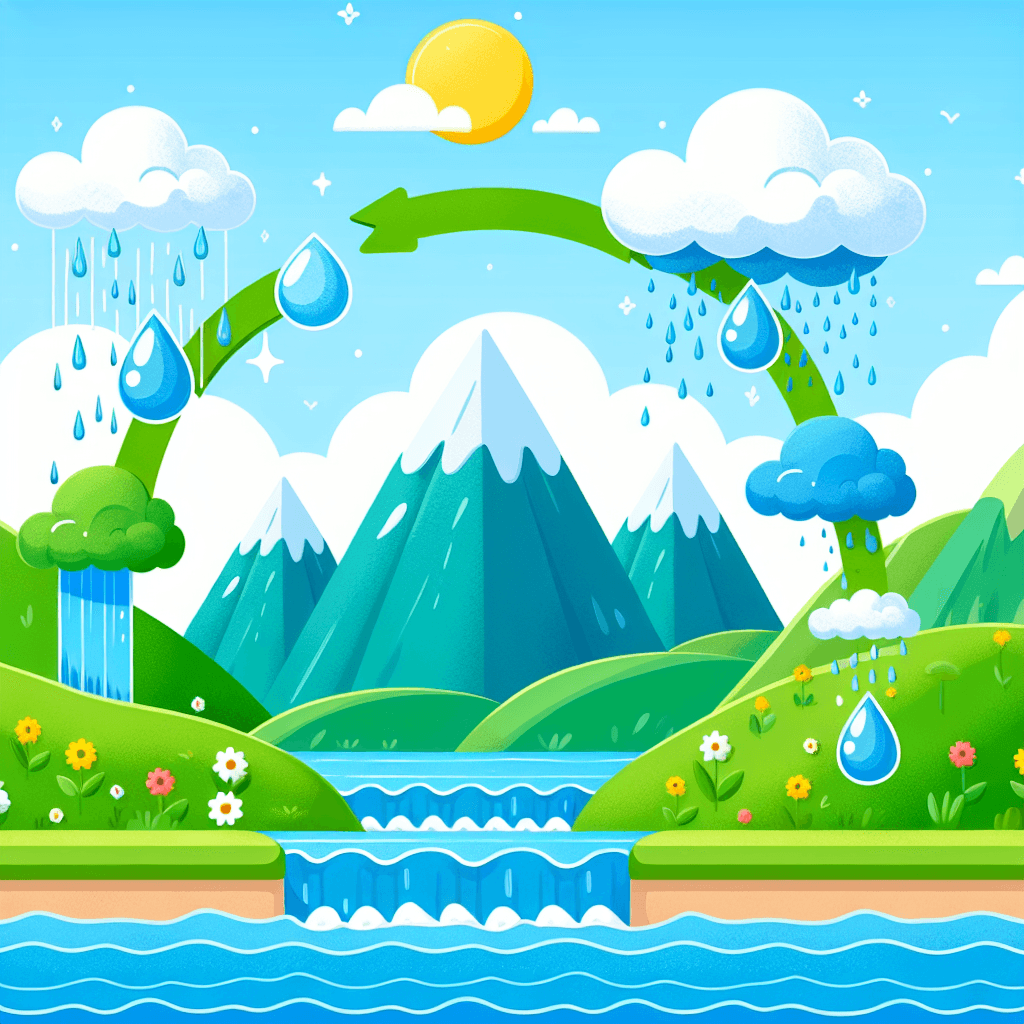
Water Cycle Storybook Adventure
Inquiry Framework
Question Framework
Driving Question
The overarching question that guides the entire project.How can we creatively illustrate the journey of water through its cycle, showing its different forms and stages, while understanding the role of the sun and human impact?Essential Questions
Supporting questions that break down major concepts.- What are the main components of the water cycle?
- How does water change form during each phase of the water cycle?
- What role does the sun play in the water cycle?
- How do different forms of precipitation occur in the water cycle?
- Why is the water cycle important for maintaining life on Earth?
- What impact do human activities have on the water cycle?
Standards & Learning Goals
Learning Goals
By the end of this project, students will be able to:- Students will be able to describe the water cycle and its components through a creative storybook.
- Learners will illustrate the phases of evaporation, condensation, precipitation, and runoff.
- Students will explain the sun's role in the energy transfer processes of the water cycle.
- Participants will investigate and portray how human activities impact the water cycle.
- Students will enhance narrative writing skills by sequencing and describing the water cycle stages in a storybook format.
Next Generation Science Standards
Common Core Standards
South Carolina Department of Education
Entry Events
Events that will be used to introduce the project to studentsWeather Forecast Challenge
Students receive a mock urgent weather broadcast alerting them to unusual weather patterns in the area. They have to investigate how the water cycle may be influencing these patterns.Portfolio Activities
Portfolio Activities
These activities progressively build towards your learning goals, with each submission contributing to the student's final portfolio.Stage 1: Water Cycle Detective Notebook
Students create a detective notebook to gather and organize research on the water cycle, its phases, and the sun's role. This foundational activity helps students understand the basic components of the water cycle in preparation for their storybook creation.Steps
Here is some basic scaffolding to help students complete the activity.Final Product
What students will submit as the final product of the activityA comprehensive detective notebook filled with diagrams, explanations, and reflections on the water cycle.Alignment
How this activity aligns with the learning objectives & standards4-ESS2-1: Students create models to describe interactions within the water cycle. Aligns with 4-PS3-2 by including energy transfer from the sun.Stage 2: Storyboard Blueprint
Before diving into writing, students outline their storybook's content by creating a storyboard. This activity involves organizing their research into a narrative sequence, setting the stage for their final storybook creation.Steps
Here is some basic scaffolding to help students complete the activity.Final Product
What students will submit as the final product of the activityA detailed storyboard blueprint that maps out the storybook's narrative and illustrations.Alignment
How this activity aligns with the learning objectives & standardsW.4.3: Write narratives about the water cycle. Connects to 4-E.2A.2 by explaining water changes throughout its cycle and human impact.Stage 3: Draft & Develop
Students start writing their storybook draft, incorporating researched information and storyboard ideas. They focus on crafting a narrative that effectively illustrates the water cycle and its stages creatively.Steps
Here is some basic scaffolding to help students complete the activity.Final Product
What students will submit as the final product of the activityA comprehensive draft of the water cycle storybook with well-crafted sequences and descriptions.Alignment
How this activity aligns with the learning objectives & standardsW.4.3: Develop narratives using techniques, details, and sequences. Aligns with W.4.7 by researching the story's content.Stage 4: Illustrate with Impact
In this activity, students focus on illustrating their storybook. They bring their narrative to life visually, using artistic techniques to enhance the story's impact and clarity.Steps
Here is some basic scaffolding to help students complete the activity.Final Product
What students will submit as the final product of the activityA fully-illustrated storybook ready for final presentation and sharing.Alignment
How this activity aligns with the learning objectives & standards4-ESS2-1: Develop models (illustrations) to describe interactions in the water cycle. Supports W.4.3 by adding details to the story.Stage 5: Storybook Showcase & Reflection
Students present their completed storybooks to the class, reflecting on the creation process and sharing their insights on both the water cycle and the narrative journey they crafted.Steps
Here is some basic scaffolding to help students complete the activity.Final Product
What students will submit as the final product of the activityA classroom presentation of each student's storybook along with a personal reflection paper on the learning experience.Alignment
How this activity aligns with the learning objectives & standardsW.4.3: Showcasing narratives and engaging in reflection. 4-E.2A.2: Explaining water changes and interactions based on illustrated models.Rubric & Reflection
Portfolio Rubric
Grading criteria for assessing the overall project portfolioWater Cycle Storybook Rubric
Scientific Understanding
Evaluates the student's grasp of the water cycle concepts and accurate representation of its stages and energy transfer processes.Water Cycle Stages and Processes
Accuracy and detail in describing evaporation, condensation, precipitation, and runoff, including energy transfer roles.
Exemplary
4 PointsThe storybook accurately and creatively depicts all stages of the water cycle, clearly explaining energy transfer processes with comprehensive detail and originality.
Proficient
3 PointsThe storybook accurately depicts all stages of the water cycle, with some explanation of energy transfer processes and clear detail.
Developing
2 PointsThe storybook depicts most stages of the water cycle with basic explanations and some inaccuracies in energy transfer processes.
Beginning
1 PointsThe storybook depicts few stages of the water cycle inaccurately, with minimal explanation of energy transfer processes.
Human Impact on the Water Cycle
Understanding and illustration of how human activities affect the water cycle.
Exemplary
4 PointsThe narrative insightfully integrates impactful human activities affecting the water cycle, with clear examples and illustrations.
Proficient
3 PointsThe narrative describes human activities affecting the water cycle, using appropriate examples.
Developing
2 PointsThe narrative mentions human activities affecting the water cycle but lacks depth and detailed examples.
Beginning
1 PointsThe storybook minimally addresses human impact without specific examples or clarity.
Narrative and Artistic Quality
Assessment of narrative flow, creativity, and the visual depiction that complements the storybook.Narrative Coherence and Creativity
Structure, originality, and engagement level of the storyline and characters.
Exemplary
4 PointsThe story is exceptionally creative and coherent, with a compelling narrative structure and original characters that engage the audience.
Proficient
3 PointsThe story is coherent and creative, with a logical structure and engaging characters.
Developing
2 PointsThe story lacks some coherence and creativity, with a basic structure and somewhat engaging characters.
Beginning
1 PointsThe story lacks coherence and creativity, with a minimal or confusing structure and unengaging characters.
Illustrative Detail and Impact
Quality and relevance of illustrations in enhancing narrative engagement and clarity.
Exemplary
4 PointsThe illustrations are exceptionally detailed and enhance the narrative significantly, reflecting excellent artistic choices and clarity.
Proficient
3 PointsThe illustrations are detailed and support the narrative well with clear artistic choices.
Developing
2 PointsThe illustrations provide basic support to the narrative, lacking detail and impact.
Beginning
1 PointsThe illustrations are minimal and offer little support to the narrative, lacking detail and relevance.
Research and Reflection
Evaluates the depth of research and reflective insights in enhancing the student's learning journey.Research Depth and Application
Quality of researched content and its integration into the storybook.
Exemplary
4 PointsThe storybook reflects extensive research and integrates information seamlessly into the narrative, showcasing deep understanding.
Proficient
3 PointsThe storybook reflects sound research, integrating informative content effectively into the narrative.
Developing
2 PointsThe storybook reflects basic research, with some integration into the narrative.
Beginning
1 PointsThe storybook reflects minimal research and poor content integration.
Reflective Insights
Clarity and depth of reflections concerning the learning journey and understanding of the water cycle.
Exemplary
4 PointsThe reflection paper provides deep insights with clear, thoughtful connections to the learning objectives and project impact.
Proficient
3 PointsThe reflection paper provides clear insights with some connections to the learning objectives and project impact.
Developing
2 PointsThe reflection paper offers basic insights, with limited connections to the learning objectives.
Beginning
1 PointsThe reflection paper lacks clarity and insights, with little reference to learning objectives.