
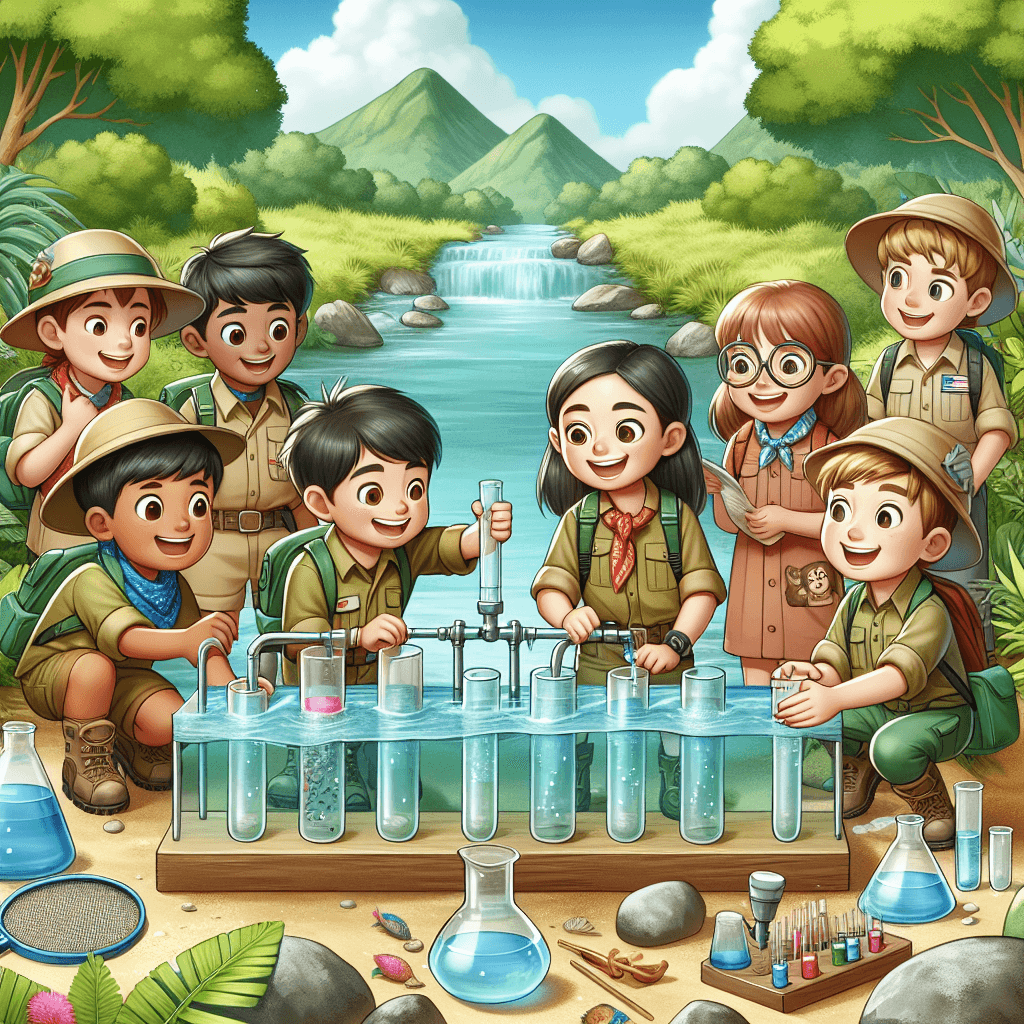
Water Filtration Survivor Challenge
Inquiry Framework
Question Framework
Driving Question
The overarching question that guides the entire project.How can we collaboratively design and construct a water filtration system that effectively purifies dirty water, evaluating and improving our models using scientific principles while considering constraints like materials, time, and cost?Essential Questions
Supporting questions that break down major concepts.- What are the essential components needed to create a simple water filtration system?
- How can we evaluate the effectiveness of different water filtration designs?
- What scientific principles are involved in the filtration and purification of water?
- How do constraints such as materials, time, and cost affect the design and functionality of a water filtration system?
- In what ways can we test and improve our water filtration models to ensure maximum effectiveness?
Standards & Learning Goals
Learning Goals
By the end of this project, students will be able to:- Students will understand the essential components required to design a simple water filtration system.
- Students will learn to evaluate the effectiveness of different water filtration designs using scientific principles.
- Students will explore and apply scientific principles in the filtration and purification of water.
- Students will analyze the impact of constraints such as materials, time, and cost on the design and functionality of water filtration systems.
- Students will develop skills to test and improve their water filtration models to achieve maximum effectiveness.
Next Generation Science Standards
Entry Events
Events that will be used to introduce the project to studentsMystery Liquid Arrival
Imagine the scene: a mysterious brown liquid is delivered to the classroom with an urgent message claiming it's from a nearby swamp. Students open the package to reveal murky water and a challenge: 'Can you purify this swamp water for safe drinking?' This prompts immediate investigation and brainstorming about possible filtration systems, entwining curiosity with real-world urgency.Portfolio Activities
Portfolio Activities
These activities progressively build towards your learning goals, with each submission contributing to the student's final portfolio.Design Dilemma Detectives
In this activity, students will define the problem of purifying dirty water and identify the specified criteria for success and constraints on materials, time, or cost. They will use these details to shape their approach to the challenge, effectively acting as detectives to define the design problem.Steps
Here is some basic scaffolding to help students complete the activity.Final Product
What students will submit as the final product of the activityA well-defined design problem statement that includes criteria for success and constraints.Alignment
How this activity aligns with the learning objectives & standards3–5-ETS1-1 (Define a simple design problem with clear criteria and constraints).Solution Showcase
Students will brainstorm and generate multiple possible solutions for a water filtration design. They will compare the proposed designs based on the likelihood of meeting the criteria and constraints established previously.Steps
Here is some basic scaffolding to help students complete the activity.Final Product
What students will submit as the final product of the activityA portfolio of potential water filtration designs, each evaluated for effectiveness against criteria and constraints.Alignment
How this activity aligns with the learning objectives & standards3–5-ETS1-2 (Generate and compare multiple solutions based on criteria and constraints).Testing Troubleshooters
In this activity, students will plan and execute fair tests of their water filters, ensuring control of variables. They will identify failure points in their prototypes and determine how to improve their designs.Steps
Here is some basic scaffolding to help students complete the activity.Final Product
What students will submit as the final product of the activityA tested and refined water filtration system, with documented observations and identified improvement areas.Alignment
How this activity aligns with the learning objectives & standards3–5-ETS1-3 (Plan and carry out fair tests with controlled variables to improve a model).Rubric & Reflection
Portfolio Rubric
Grading criteria for assessing the overall project portfolioWater Filtration Design Challenge Rubric
Problem Definition
Assesses the student's ability to clearly define the water filtration problem with specific criteria and constraints for successful purification.Criteria Identification
Evaluates the student's ability to identify and articulate criteria for success of the water filtration project.
Exemplary
4 PointsThoroughly identifies clear, detailed, and realistic criteria for water filtration success, showing a deep understanding of project requirements.
Proficient
3 PointsIdentifies clear and realistic criteria for water filtration success, understanding the basic requirements of the project.
Developing
2 PointsIdentifies some criteria for water filtration success but with gaps or inconsistencies in understanding.
Beginning
1 PointsStruggles to identify relevant criteria for water filtration success, showing minimal understanding of project requirements.
Constraints Recognition
Evaluates the student's recognition of project constraints related to materials, time, and cost.
Exemplary
4 PointsAccurately identifies and explains constraints with insight into their impact on the project design and outcome.
Proficient
3 PointsIdentifies constraints with an understanding of their basic impact on the project.
Developing
2 PointsIdentifies some constraints but lacks depth in understanding their role in the project.
Beginning
1 PointsStruggles to identify constraints, showing little understanding of their importance in the project.
Solution Generation
Assesses the student's ability to generate and evaluate multiple water filtration designs against established criteria and constraints.Design Creativity
Measures the creativity and variety in generating possible water filtration systems.
Exemplary
4 PointsProposes multiple innovative and diverse designs, each clearly thought out and feasible within constraints.
Proficient
3 PointsProposes multiple solid designs that are feasible and adhere to constraints.
Developing
2 PointsGenerates some design ideas, but with limitations in creativity or feasibility.
Beginning
1 PointsStruggles to generate design ideas with minimal variability or feasibility consideration.
Evaluation and Selection
Assesses the ability to critically evaluate and select appropriate designs based on effectiveness and constraints.
Exemplary
4 PointsThoughtfully evaluates designs with comprehensive analysis, selecting optimal solutions based on detailed criteria and constraint considerations.
Proficient
3 PointsEffectively evaluates and selects designs based on established criteria and constraints.
Developing
2 PointsEvaluates designs but with superficial analysis; selections may not fully align with criteria or constraints.
Beginning
1 PointsStruggles to evaluate or select appropriate designs, showing minimal understanding of evaluation criteria.
Testing and Refinement
Assesses the student's ability to test and improve their water filtration system through iterative design processes.Testing and Data Analysis
Evaluates the planning and execution of fair tests, as well as the analysis of results.
Exemplary
4 PointsConducts systematic and comprehensive tests, meticulously analyzing data to identify precise areas for improvement.
Proficient
3 PointsConducts appropriate tests and effectively analyzes data to identify improvement areas.
Developing
2 PointsConducts tests with guidance but struggles with thorough data analysis or identifying improvements.
Beginning
1 PointsStruggles to conduct relevant tests or analyze data, needing support to understand test results.
Iterative Improvement
Assesses the application of feedback and observations to refine and improve the water filtration model.
Exemplary
4 PointsEffectively applies observations and feedback to make significant improvements, demonstrating iterative thinking and problem-solving excellence.
Proficient
3 PointsApplies feedback to make reasonable improvements, showing understanding of iterative processes.
Developing
2 PointsAttempts to use feedback for improvements, with varying success and minimal refining.
Beginning
1 PointsStruggles to apply feedback or make meaningful improvements, showing limited understanding of iterative design.