
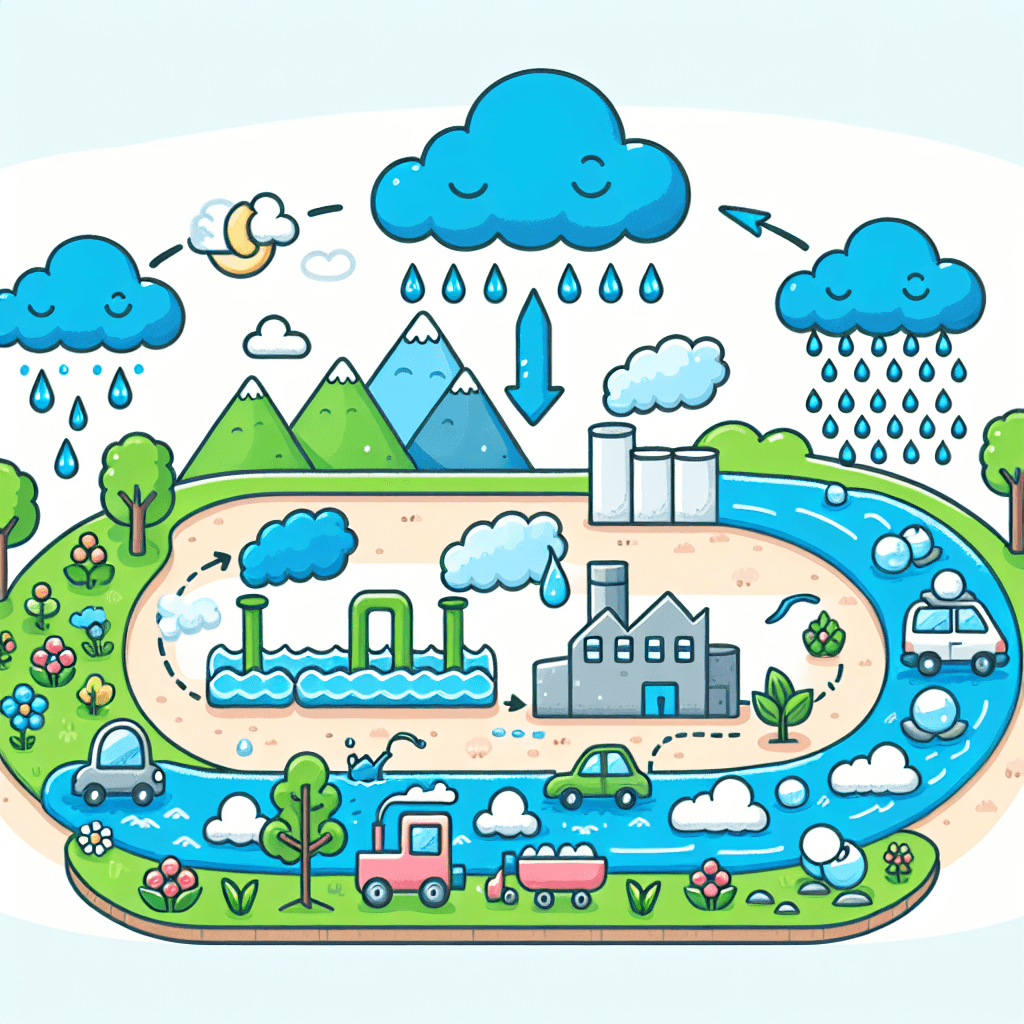
Water Wonders: Cycle, Usage, Pollution Insights
Inquiry Framework
Question Framework
Driving Question
The overarching question that guides the entire project.How can we, as responsible citizens, devise a sustainable plan to manage water usage and reduce water pollution in our community while considering the natural processes of the water cycle?Essential Questions
Supporting questions that break down major concepts.- How does water pollution affect the water cycle and ecosystems?
- What role do humans play in water usage and pollution?
- What are the steps of the water cycle, and why is it important for our planet?
- How can we reduce water pollution in our community?
- Why is fresh water a limited resource, and how can we manage it sustainably?
- What are the main sources of water pollution, and how do they impact life on Earth?
Standards & Learning Goals
Learning Goals
By the end of this project, students will be able to:- Identify and describe the steps of the water cycle and understand its significance for Earth's ecosystems.
- Analyze and communicate the role humans play in water usage and pollution and the impact on the water cycle.
- Develop a sustainable plan to manage community water usage and reduce pollution, integrating scientific principles and community considerations.
- Investigate and report on local and global water pollution sources and their effects on both human health and ecosystems.
NGSS
Common Core Standards
Entry Events
Events that will be used to introduce the project to studentsMystery of the Polluted Pond
Students are presented with a mystery case involving a local polluted pond affecting plant and animal life. They will need to act as environmental detectives, gathering clues, conducting water tests, and interviewing local 'witnesses' to uncover the pollution sources and propose remedies.Portfolio Activities
Portfolio Activities
These activities progressively build towards your learning goals, with each submission contributing to the student's final portfolio.Water Cycle Wonderland
Students will explore the steps of the water cycle through hands-on activities and multimedia resources to understand its components and significance.Steps
Here is some basic scaffolding to help students complete the activity.Final Product
What students will submit as the final product of the activityA colorful and labeled diagram of the water cycle with an accompanying explanatory paragraph.Alignment
How this activity aligns with the learning objectives & standardsAligns with 5-ESS2-1: Develop a model to describe ways the geosphere, biosphere, hydrosphere, and/or atmosphere interact.Pollution Investigation Lab
Acting as environmental scientists, students will conduct experiments to observe the effects of pollutants on water quality, understanding their physical properties.Steps
Here is some basic scaffolding to help students complete the activity.Final Product
What students will submit as the final product of the activityAn investigative report detailing the effects of pollutants on water samples, including pH measurements and observations.Alignment
How this activity aligns with the learning objectives & standardsAligns with 5-PS1-3: Make observations and measurements to identify materials based on their properties.Ecosystem Impact Exploration
Students will examine how pollution affects local ecosystems by simulating the impact on plants and animals.Steps
Here is some basic scaffolding to help students complete the activity.Final Product
What students will submit as the final product of the activityA scientific journal with documented observations and reflections on the impact of water pollution on ecosystems.Alignment
How this activity aligns with the learning objectives & standardsAligns with standards focused on understanding and communicating the impact of human activities on ecosystems.Sustainable Water Conservation Campaign
As a concluding activity, students will create a campaign to promote water conservation, using artwork, informational texts, and presentations.Steps
Here is some basic scaffolding to help students complete the activity.Final Product
What students will submit as the final product of the activityA water conservation campaign including varied student-created materials aimed at raising awareness and promoting sustainable practices.Alignment
How this activity aligns with the learning objectives & standardsSupports the development of communication skills and the practical application of scientific knowledge in community action.Rubric & Reflection
Portfolio Rubric
Grading criteria for assessing the overall project portfolioWater Cycle and Pollution Project Rubric
Scientific Understanding and Application
Evaluates students' grasp of scientific concepts regarding the water cycle, water pollution, and ecosystem impacts.Understanding of the Water Cycle
Assesses comprehension of the water cycle's stages and importance within Earth's systems.
Exemplary
4 PointsDemonstrates comprehensive understanding of all water cycle stages, clearly depicting their interactions and significance in a thoroughly labeled diagram with detailed paragraph explanation.
Proficient
3 PointsShows a thorough understanding of most water cycle stages, accurately labeling and explaining their importance.
Developing
2 PointsExhibits basic understanding of some water cycle stages, with incomplete labeling and explanations lacking depth.
Beginning
1 PointsShows limited understanding of water cycle stages, with significant errors in labeling and no substantial explanation.
Identification of Pollution Impact
Evaluates ability to observe, measure, and report on the effects of pollution on water and ecosystems.
Exemplary
4 PointsConducts detailed and accurate observations and measurements, clearly explaining the effects of various pollutants on water quality and ecosystem health with comprehensive investigative reporting.
Proficient
3 PointsPerforms accurate observations and measurements, explaining the effects of some pollutants with a clear investigative report.
Developing
2 PointsMakes observations with some inaccuracies and struggles to link pollutants to their effects, with a basic investigative report.
Beginning
1 PointsMakes minimal observations or measurements with significant inaccuracies and incomplete reporting on pollution effects.
Creativity and Innovation
Assesses creativity and innovative thinking applied in project creation, such as designing a conservation campaign.Creativity in Communication
Evaluates creativity and effectiveness in communicating water conservation and pollution information through various media.
Exemplary
4 PointsCreates exceptionally engaging and creative visual, verbal, and written materials that effectively communicate the importance of water conservation and pollution reduction with high originality.
Proficient
3 PointsDevelops creative and clear materials to communicate water conservation and pollution information effectively.
Developing
2 PointsProduces materials that are somewhat engaging, requiring improvement in clarity and creativity in communication.
Beginning
1 PointsGenerates materials that have limited engagement or creativity, failing to clearly communicate essential messages.
Research and Inquiry
Evaluates ability to conduct research, gather information, and apply inquiry skills in scientific investigation.Inquiry and Investigation Skills
Assesses skill in researching and investigating water usage, pollution, and ecosystem impacts through experiments and inquiry projects.
Exemplary
4 PointsDemonstrates exceptional research and inquiry skills, collecting diverse information sources and offering insightful analysis in projects and experiments.
Proficient
3 PointsShows strong research and inquiry skills with reliable information gathering and sound investigation methods.
Developing
2 PointsExhibits some research and inquiry skills, needing improvement in breadth and depth of information collection and analysis.
Beginning
1 PointsDisplays minimal research and inquiry skills with limited information gathering and analysis.