
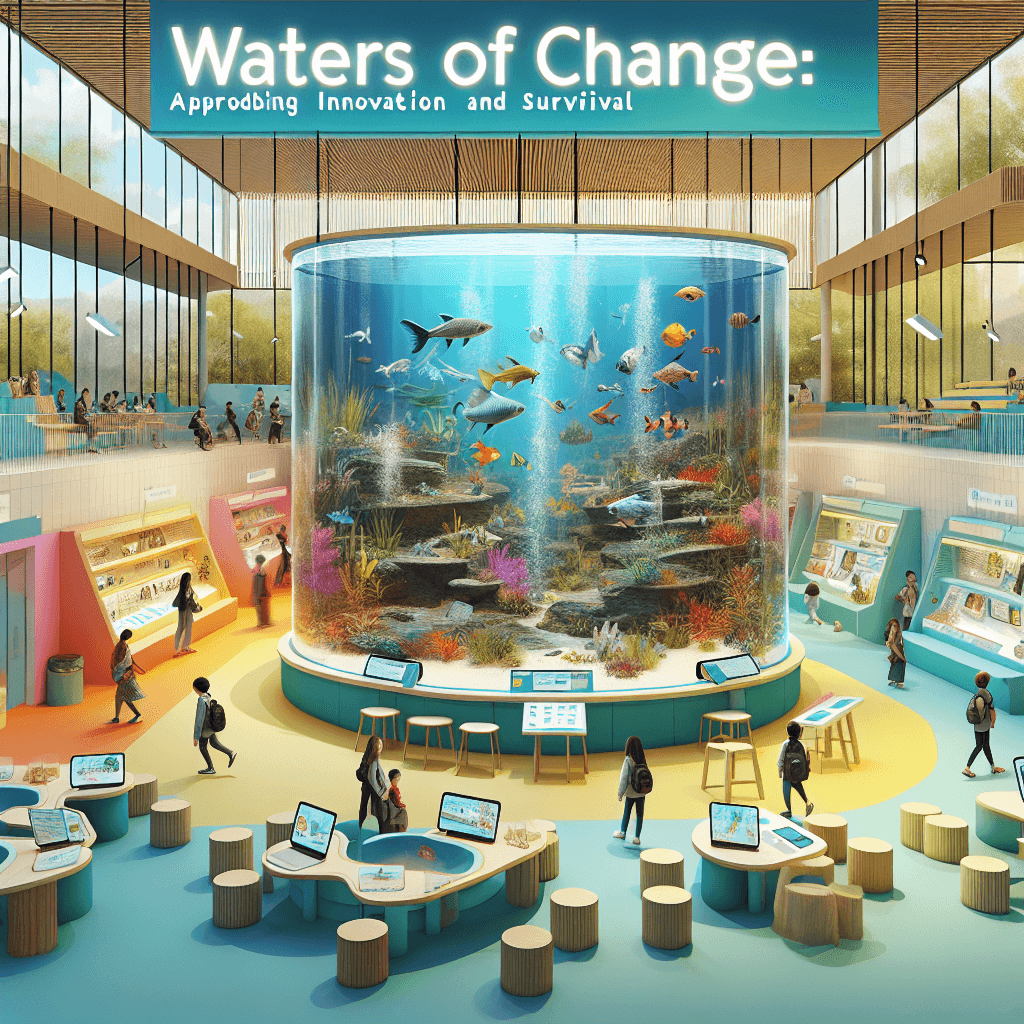
Waters of Change: An Innovation and Survival Museum Exhibit
Inquiry Framework
Question Framework
Driving Question
The overarching question that guides the entire project.How can we, as museum curators, design an immersive exhibit that uses history, science, and data to tell the story of human survival and persuade our community to address the global clean water crisis?Essential Questions
Supporting questions that break down major concepts.- How has the availability of clean water influenced where and how human civilizations have developed throughout history?
- What scientific properties determine water quality, and how have human innovations in filtration and treatment evolved to ensure survival?
- How can we use mathematical ratios, percentages, and data analysis to represent the current state of global water scarcity and individual consumption habits?
- In what ways can a museum curator use persuasive writing and visual storytelling to effectively communicate the urgency of environmental change to a diverse audience?
- How do we apply geometric principles and scale to design an exhibit space that balances educational content with visitor engagement?
Standards & Learning Goals
Learning Goals
By the end of this project, students will be able to:- Analyze and describe the historical correlation between water access and the development of human civilizations across different geographical regions.
- Conduct scientific investigations into water quality and design an effective filtration prototype to demonstrate human innovation in survival.
- Calculate and represent global water scarcity data using ratios, rates, and percentages to quantify the impact of the water crisis.
- Apply geometric principles and scale modeling to design a physical or digital museum exhibit layout that maximizes visitor engagement and educational flow.
- Compose a compelling persuasive argument and curate visual narratives that motivate the local community to take action on global water issues.
TEKS Social Studies Grade 6
TEKS Mathematics Grade 6
TEKS Science Grade 6
TEKS ELAR Grade 6
Entry Events
Events that will be used to introduce the project to studentsThe Crate from the Future
Students discover a weathered shipping container in the classroom labeled "TOP SECRET: ARCHAEOLOGICAL RECOVERY 2124." Inside are common modern items (a Brita filter, a plastic bottle, a LifeStraw) treated like ancient relics, accompanied by a digital transmission from a future museum director begging the students to document how these 'primitive' innovations saved humanity during the Great Water Shift.Portfolio Activities
Portfolio Activities
These activities progressively build towards your learning goals, with each submission contributing to the student's final portfolio.The Civilization Compass: Mapping Ancient Thirst
In this first portfolio activity, students step into their roles as historical researchers for the museum. They will investigate three ancient civilizations (e.g., Mesopotamia, Egypt, and the Indus Valley) and map their proximity to major water sources. Students will analyze how these water sources dictated not just survival, but the 'economic' activities of the time, such as trade and agriculture.Steps
Here is some basic scaffolding to help students complete the activity.Final Product
What students will submit as the final product of the activityAn 'Origin Map' and 'Settle-Report' that identifies three historical sites, their water sources, and an explanation of how that water enabled the civilization to thrive.Alignment
How this activity aligns with the learning objectives & standardsTEKS SS 6.3.A: Identify and explain the geographic factors responsible for the location of economic activities. This activity specifically targets the geographic factor of water access as a primary driver for settlement and economic growth.Survival by Design: The Filtration Lab
Acting as the 'Innovation Branch' of the museum, students will design and test a water filtration system. Using 'contaminated' water (water with soil, coffee grounds, and vinegar), students must use the materials found in the 'Crate from the Future' (sand, charcoal, gravel, coffee filters) to create the most effective filtration prototype. This simulates the human need to modify the environment to survive.Steps
Here is some basic scaffolding to help students complete the activity.Final Product
What students will submit as the final product of the activityA 'Filtration Lab Report' that includes a diagram of their prototype, a log of the materials used, and a 'Transparency Test' result comparing the before and after states of their water sample.Alignment
How this activity aligns with the learning objectives & standardsTEKS SCI 6.1.A: Plans and safely conducts classroom investigations. TEKS SCI 6.11.B: Describe the impact of conservation of resources such as water. This aligns by having students investigate the science of filtration as a means of conservation and survival.The Scarcity Scorecard: Tracking the Flow
To provide the 'Data' portion of the exhibit, students must quantify the crisis. They will track their own water usage for 24 hours (gallons used for showering, brushing teeth, etc.) and then use unit rates and proportions to compare their usage to a person living in a water-scarce region. They will convert these measurements into various units (liters vs. gallons) to ensure the exhibit is accessible to a global audience.Steps
Here is some basic scaffolding to help students complete the activity.Final Product
What students will submit as the final product of the activityAn 'Impact Infographic' that uses ratios and unit rates to show the disparity between 'Modern Consumption' and 'Global Scarcity.'Alignment
How this activity aligns with the learning objectives & standardsTEKS MATH 6.4.H: Convert units within a measurement system, including the use of proportions and unit rates. This aligns by requiring students to calculate individual water use and convert it into global scale comparisons.The Curator’s Voice: Storytelling for Change
Students will now synthesize their historical research, scientific findings, and math data into the 'Exhibit Narrative.' They will write the persuasive text that will appear on the museum walls. Using the 'Point of View' of a curator from 2124, they must write a compelling argument that explains why clean water was the most valuable 'relic' of the past and why it must be protected now.Steps
Here is some basic scaffolding to help students complete the activity.Final Product
What students will submit as the final product of the activityA 'Curator’s Script' for an audio guide or a series of 'Exhibition Panels' that combine history, science, and math into a persuasive story.Alignment
How this activity aligns with the learning objectives & standardsTEKS ELA 6.12.B: Synthesize information from a variety of sources. TEKS ELA 6.10.E: Analyze the use of literary devices (point of view) to influence the reader. This aligns by having students take the 'Future Curator' point of view to persuade the modern audience.The Blueprint of Innovation: Designing the Gallery
The final step is the physical or digital design of the museum floor plan. Students must use geometry to ensure the exhibit fits within a specified 'Gallery Space.' They will calculate the area of the floor for walking paths and the volume of the display cases (rectangular prisms) needed to hold their 'Future Relics' and filtration prototypes.Steps
Here is some basic scaffolding to help students complete the activity.Final Product
What students will submit as the final product of the activityA 'Scale Blueprint' of the exhibit space, including a legend and a set of 'Space Calculations' showing the area and volume of all major components.Alignment
How this activity aligns with the learning objectives & standardsTEKS MATH 6.8.D: Determine solutions for problems involving the area of rectangles and volume of right rectangular prisms. This aligns by requiring students to calculate the physical space requirements for their museum exhibit.Rubric & Reflection
Portfolio Rubric
Grading criteria for assessing the overall project portfolioThe Great Water Shift: Interdisciplinary Curator Portfolio Rubric
Historical Foundations & Geography
Evaluates the student's ability to map ancient civilizations and explain the historical correlation between water access and societal development.Geographic & Historical Analysis
Identify and explain geographic factors (specifically water) responsible for the location of historical economic activities and settlement patterns. (TEKS SS 6.3.A, 6.4.B)
Exemplary
4 PointsProvides a sophisticated analysis of three civilizations, identifying complex geographic and economic links; Curator’s Note offers profound insights into human adaptation patterns.
Proficient
3 PointsAccurately identifies water sources for three civilizations and explains how they enabled trade or agriculture; Curator’s Note clearly explains settlement patterns.
Developing
2 PointsIdentifies water sources for civilizations but offers limited or inconsistent explanations of the economic benefits or geographic factors.
Beginning
1 PointsIdentifies fewer than three civilizations or water sources; Curator's Note is incomplete or fails to explain the pattern of settlement.
Scientific Inquiry & Innovation
Assesses the scientific investigation of water quality and the engineering of a filtration prototype.Engineering Design & Scientific Log
Design, test, and document a tiered filtration device, explaining the scientific properties of materials used to improve water quality. (TEKS SCI 6.1.A, 6.11.B)
Exemplary
4 PointsInnovative filter design with exceptional documentation; scientific log provides a deep explanation of how specific material properties impact conservation and survival.
Proficient
3 PointsSuccessfully constructs and tests a filter; lab report includes a clear diagram, material log, and accurate transparency results.
Developing
2 PointsFilter is constructed but testing or documentation is incomplete; scientific explanation of the 'Science of Survival' lacks detail.
Beginning
1 PointsFilter design is non-functional or missing; lab report lacks required scientific observations or diagrams.
Quantitative Reasoning & Scarcity Data
Measures the ability to quantify the water crisis using ratios, rates, unit conversions, and data visualization.Data Analysis & Unit Conversion
Accurately convert units (gallons to liters) and calculate ratios to represent the disparity between individual use and global scarcity. (TEKS MATH 6.4.H)
Exemplary
4 PointsCalculations are flawless and presented through a highly impactful infographic that provides deep context for global water disparity.
Proficient
3 PointsCorrectly converts gallons to liters and calculates usage ratios; infographic clearly illustrates the difference between consumption and scarcity.
Developing
2 PointsCalculations contain minor errors; infographic is present but may not clearly communicate the ratio or the scale of the crisis.
Beginning
1 PointsConversions or ratios are incorrect or missing; data representation is unclear or fails to use required units.
Exhibit Engineering & Geometry
Evaluates the application of geometric principles and scale modeling in the design of the physical exhibit space.Spatial Design & Geometry
Apply area and volume formulas to design a scale floor plan for the museum exhibit. (TEKS MATH 6.8.D)
Exemplary
4 PointsScale blueprint is professionally executed with precise calculations for area and volume; maximizes visitor flow through innovative spatial design.
Proficient
3 PointsScale blueprint accurately depicts the gallery space; includes correct calculations for the area of paths and volume of display cases.
Developing
2 PointsBlueprint is mostly to scale, but contains errors in area or volume calculations; layout lacks clear distinction between paths and stations.
Beginning
1 PointsBlueprint is not to scale or lacks required calculations; floor plan is incomplete or unorganized.
Curatorial Voice & Communication
Assesses the student's ability to weave together diverse data points into a compelling, professional museum narrative.Synthesis & Persuasive Storytelling
Synthesize information from history, science, and math to create a persuasive narrative from a specific point of view. (TEKS ELA 6.10.E, 6.12.B)
Exemplary
4 PointsCurator’s script is masterfully synthesized; uses the '2124' POV to create an emotionally resonant and data-backed call to action.
Proficient
3 PointsEffective synthesis of history, science, and math facts; narrative uses the curator’s POV to clearly persuade the audience toward conservation.
Developing
2 PointsIncludes information from multiple subjects, but synthesis is weak; persuasive message or point of view is inconsistent.
Beginning
1 PointsFails to synthesize subject areas; script lacks a clear persuasive argument or fails to adopt the required curator persona.