
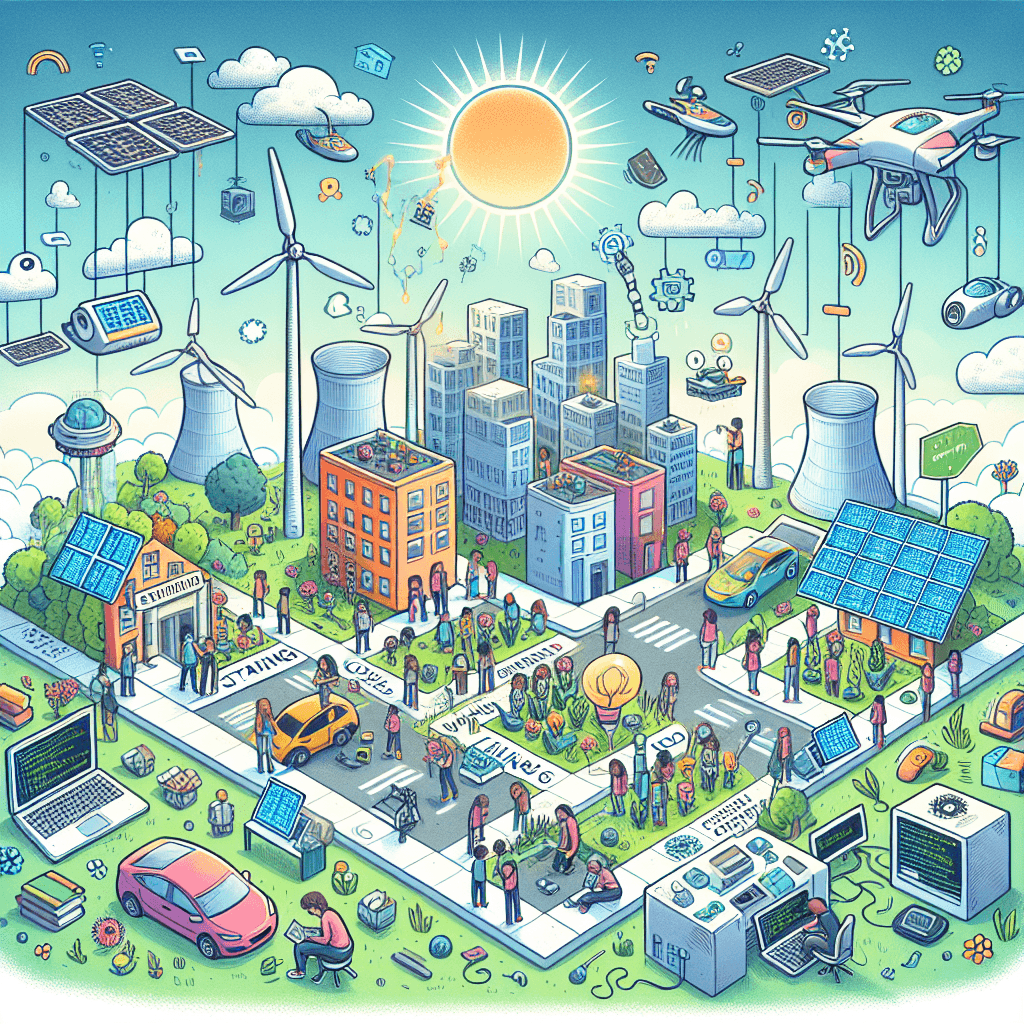
Watts Next: Engineering a Coding-Based Sustainable City Grid
Inquiry Framework
Question Framework
Driving Question
The overarching question that guides the entire project.How can we, as green technology engineers, design and code a smart city grid that balances the physics of renewable energy with environmental conservation and urban efficiency?Essential Questions
Supporting questions that break down major concepts.- How do the laws of physics govern the generation, transmission, and storage of electricity in a renewable-only system?
- How can we use mathematical modeling and coding to balance energy supply and demand in real-time?
- In what ways do various renewable energy sources (wind, solar, hydro) impact local ecosystems, and how can we design to minimize these biological disruptions?
- How does the layout and aesthetic design of a city influence its overall energy efficiency and sustainability?
- What role does automation and algorithmic thinking play in managing a grid that relies on intermittent natural resources?
- How do we measure the "success" of a green energy grid beyond just power output (e.g., cost, environmental impact, reliability)?
Standards & Learning Goals
Learning Goals
By the end of this project, students will be able to:- Analyze and explain the transformation of energy from natural sources (solar, wind, hydro) into electrical energy using the laws of physics.
- Design and implement a coded algorithm or simulation that dynamically balances energy supply and demand within a virtual city grid.
- Evaluate the ecological trade-offs of different renewable energy technologies and propose design solutions that minimize disruption to local biodiversity.
- Apply mathematical modeling to calculate energy efficiency, storage requirements, and cost-effectiveness of a multi-source renewable grid.
- Create a sustainable urban plan that integrates aesthetic design with functional energy efficiency to maximize the utility of a smart city.
- Demonstrate systems thinking by managing the interplay between intermittent energy resources and consistent urban power needs.
Next Generation Science Standards (NGSS)
CSTA K-12 Computer Science Standards
Common Core State Standards - Mathematics
ISTE Standards for Students
Entry Events
Events that will be used to introduce the project to studentsThe 2075 Blackout Transmission
Students receive a 'glitched' video transmission from a 'Climate Architect' in the year 2075, who claims that their current power grid has failed, leaving the city in total darkness. The architect provides a 'Digital Time Capsule' containing corrupted code and physics data that students must repair and optimize to reboot the grid using only renewable sources.The Aeolus Project Pitch
Students are invited to a 'Shark Tank' style pitch session where a fictional billionaire developer wants to build 'Aeolus,' the world’s first 100% green smart-city. However, the developer only provides the aesthetic vision; students must use physics and coding to prove that the developer's 'impossible' artistic designs can actually generate and distribute enough power to be viable.Portfolio Activities
Portfolio Activities
These activities progressively build towards your learning goals, with each submission contributing to the student's final portfolio.The Energy Alchemist Lab: Harnessing the Forces
In this foundational activity, students act as Energy Analysts investigating the physics behind renewable sources. They will explore how kinetic energy from moving air or water is captured and transformed into electricity, calculating the efficiency of different turbine designs or solar placements. This ensures students understand the 'how' before they start building the 'what.'Steps
Here is some basic scaffolding to help students complete the activity.Final Product
What students will submit as the final product of the activityAn 'Energy Transformation Lab Report' containing diagrams of energy flow and a written argument explaining the most efficient method for energy transfer in their specific city climate.Alignment
How this activity aligns with the learning objectives & standardsThis activity aligns with NGSS MS-PS3-5 by requiring students to construct arguments based on data about how kinetic energy (from wind/water) is transferred and converted into electrical energy.Guardian of the Wild Grid: Ecological Impact Mapping
Students become Environmental Consultants tasked with evaluating the 'Digital Time Capsule' city map. They must identify local ecosystems—such as bird migration paths near wind farms or fish spawning grounds near hydro dams—and propose design modifications to protect biodiversity while still generating power.Steps
Here is some basic scaffolding to help students complete the activity.Final Product
What students will submit as the final product of the activityAn Interactive Ecological Impact Map that highlights 'Red Zones' (vulnerable habitats) and 'Green Zones' (optimized energy sites) with a list of mitigation strategies for each source.Alignment
How this activity aligns with the learning objectives & standardsThis activity aligns with NGSS MS-ESS3-3 by having students design a method to monitor and minimize the human impact on the environment through strategic placement of energy infrastructure.The Grid Logic Blueprint: Algorithmic Thinking
Before touching any actual code, students must design the 'Brain' of their smart grid. They will develop the logic for how the city handles energy fluctuations (e.g., what happens to the grid when the sun goes down, or when a storm increases wind power?). They will map out the decision-making process using algorithmic thinking.Steps
Here is some basic scaffolding to help students complete the activity.Final Product
What students will submit as the final product of the activityA comprehensive Smart Grid Logic Flowchart that outlines 'If/Then' scenarios for energy distribution, storage, and emergency shutdowns.Alignment
How this activity aligns with the learning objectives & standardsThis activity aligns with CSTA 2-AP-10 by requiring students to use flowcharts and pseudocode to address the complex problem of grid management as an algorithm.The Watts & Volts Ledger: Balancing the Power Budget
Students step into the role of Grid Accountants. They will receive a 'Daily Energy Load' spreadsheet representing a typical day in the city. Using mathematical modeling, they must calculate the total kilowatt-hours needed and balance that against the output of their designed energy sources, ensuring the city never hits a deficit.Steps
Here is some basic scaffolding to help students complete the activity.Final Product
What students will submit as the final product of the activityA 'Watts & Volts Ledger' (spreadsheet or data table) that mathematically proves the grid's viability through various weather scenarios.Alignment
How this activity aligns with the learning objectives & standardsThis activity aligns with CCSS.MATH.CONTENT.7.EE.B.3 by requiring students to solve multi-step problems with rational numbers to balance energy supply and demand.The 2075 Reboot: Optimized Grid Simulation
For the grand finale, students synthesize their physics, math, and logic into a 'Live Grid Simulation.' Using a coding platform (like Scratch, Python, or a specialized simulator) or a physical gamified model, they will attempt to 'Reboot the Grid.' They must demonstrate that their city can survive a simulated 48-hour cycle of varying weather and demand.Steps
Here is some basic scaffolding to help students complete the activity.Final Product
What students will submit as the final product of the activityA functional 'Renewable City Simulation' (digital or physical) accompanied by a 'Refined Design Pitch' that explains the iterations made during testing.Alignment
How this activity aligns with the learning objectives & standardsThis activity aligns with NGSS MS-ETS1-4 (iterative testing) and ISTE 1.4 (Innovative Designer) by having students build, test, and refine a simulation to achieve an optimal design.Rubric & Reflection
Portfolio Rubric
Grading criteria for assessing the overall project portfolioWatts Next? The Renewable Grid Comprehensive Assessment Rubric
Physics and Energy Dynamics
Assessment of the scientific principles governing renewable energy generation and the transfer of kinetic energy (MS-PS3-5).Energy Transformation & Physics Analysis
Evaluates the student's ability to explain the transfer of kinetic and electromagnetic energy into electrical power and the accuracy of their annotated energy flow diagrams.
Exemplary
4 PointsDemonstrates a sophisticated understanding of physics; energy transfer diagrams are exceptionally detailed, showing specific mechanical or chemical interactions. The argument for source reliability is backed by nuanced data and physics-based evidence.
Proficient
3 PointsDemonstrates a thorough understanding of energy transfer; diagrams accurately show the journey from source to grid. The argument for source reliability is clear and supported by experimental data.
Developing
2 PointsShows emerging understanding of energy transformation; diagrams are present but may lack detail or contain minor inaccuracies in the flow of energy. The argument for reliability is basic or partially supported.
Beginning
1 PointsShows initial understanding; energy diagrams are incomplete or reflect significant misconceptions about how kinetic or solar energy is converted to electricity. Argument lacks evidence.
Environmental Stewardship
Assessment of the ability to design methods for monitoring and minimizing human impact on the environment (MS-ESS3-3).Ecological Impact Mapping & Mitigation
Evaluates the identification of ecological 'Red Zones' and the creativity/viability of 'Eco-Engineering' solutions to minimize human impact on local biomes.
Exemplary
4 PointsMapping is exceptionally precise, identifying subtle ecological risks. Mitigation strategies (e.g., fish ladders, ultrasonic sensors) are highly innovative, research-based, and integrate seamlessly into the grid design.
Proficient
3 PointsAccurately identifies major ecological impacts for each energy source. Proposes effective and appropriate mitigation strategies that clearly reduce environmental disturbance.
Developing
2 PointsIdentifies some ecological impacts but may miss key biological disruptions. Mitigation strategies are generic or inconsistently applied to the specific city biome.
Beginning
1 PointsIdentifies few or no ecological impacts. Strategies to minimize human impact are missing, unrealistic, or do not address the specific renewable technology used.
Computational Thinking
Assessment of computational thinking and the use of flowcharts/pseudocode to solve complex problems (CSTA 2-AP-10).Algorithmic Logic & Flowcharting
Evaluates the logic and structure of the smart grid's decision-making process, including 'If/Then' scenarios and handling of intermittent energy sources.
Exemplary
4 PointsFlowchart demonstrates sophisticated algorithmic thinking, successfully accounting for complex 'edge cases' and multi-step logic. The pseudocode is highly organized and ready for implementation.
Proficient
3 PointsFlowchart uses standardized symbols correctly to outline a logical sequence for energy distribution and storage. Correctly identifies major energy fluctuations (supply vs. demand).
Developing
2 PointsFlowchart shows basic logic but may contain gaps in the sequence or fail to address critical 'if/then' scenarios like battery depletion. Logic is partially functional.
Beginning
1 PointsLogic sequence is disjointed or missing key steps. Flowchart does not accurately represent a functional decision-making process for a grid.
Mathematical Modeling
Assessment of mathematical problem-solving using rational numbers to balance real-world supply and demand (CCSS.MATH.CONTENT.7.EE.B.3).Quantitative Energy Modeling
Evaluates the accuracy of multi-step calculations involving rational numbers to balance energy supply, demand, and storage efficiency.
Exemplary
4 PointsLedger is error-free and demonstrates an advanced grasp of rational numbers. Calculations include sophisticated efficiency coefficients and provide a clear mathematical proof of grid stability under extreme conditions.
Proficient
3 PointsSuccessfully uses positive and negative rational numbers to balance the energy budget. Most calculations are accurate and supply consistently meets or exceeds demand in the model.
Developing
2 PointsDemonstrates basic use of rational numbers to track energy, but calculations may contain errors that lead to energy deficits or unrealistic surpluses. Modeling is partially complete.
Beginning
1 PointsCalculations are incomplete or contain significant errors. Fails to demonstrate a mathematical balance between energy production and urban consumption.
Systems Engineering & Integration
Assessment of the ability to develop models for iterative testing and modification to achieve an optimal design (MS-ETS1-4).Iterative Simulation & Refinement
Evaluates the iterative process of testing the grid simulation, analyzing failure data, and refining the design to achieve an optimal solution.
Exemplary
4 PointsSimulation is highly functional and resilient. Design pitch provides deep insight into the iterative process, showing how failure data directly informed sophisticated improvements in the final grid.
Proficient
3 PointsSuccessfully reboots the grid in the simulation. Provides evidence of at least one significant design iteration based on testing data to achieve an optimal design.
Developing
2 PointsSimulation runs but fails under stress tests (storms/blackouts). Shows limited evidence of using data to modify the design; iterations are superficial.
Beginning
1 PointsSimulation is non-functional or does not reflect the physics/math/logic established in previous steps. No evidence of an iterative design process.