
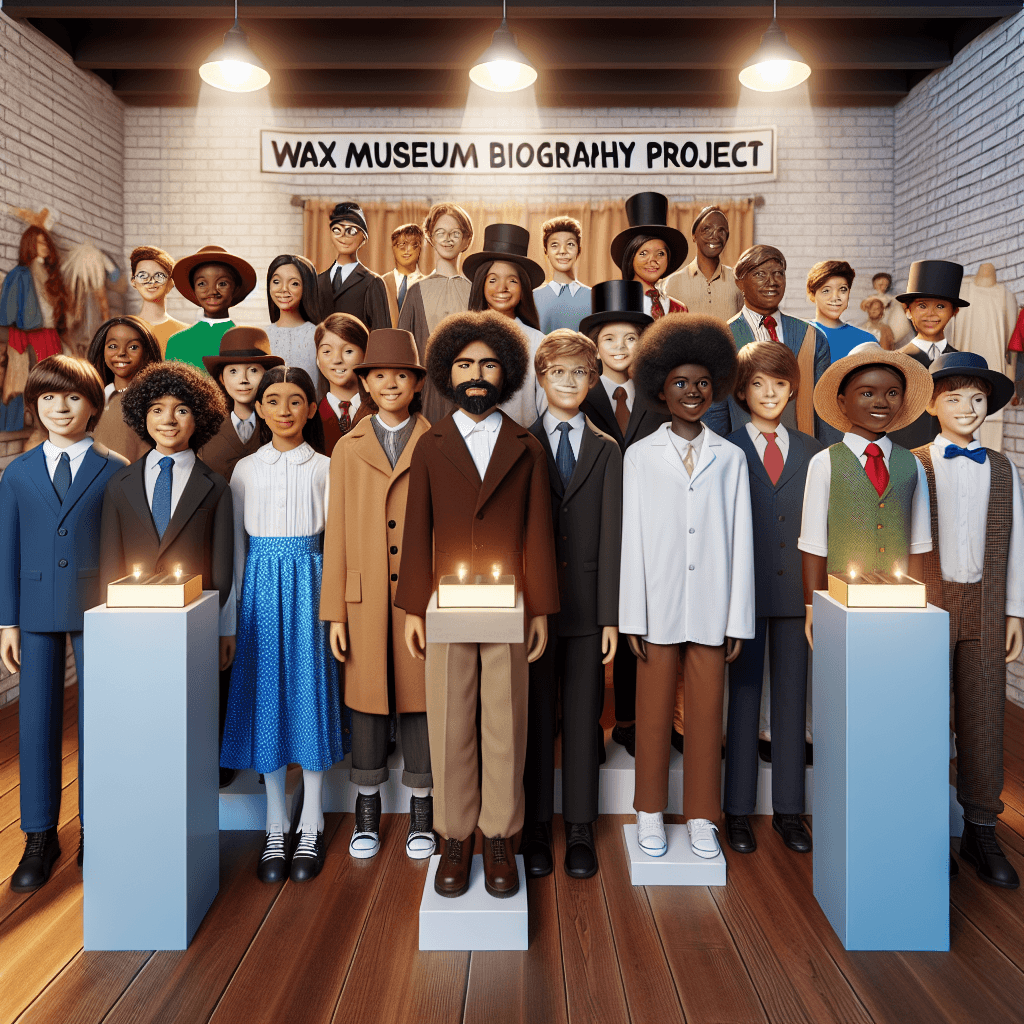
Wax Museum Biography Project
Inquiry Framework
Question Framework
Driving Question
The overarching question that guides the entire project.How can we bring the past to life and teach others about important historical figures through an engaging wax museum biography?Essential Questions
Supporting questions that break down major concepts.- How can you determine the most important events in a person's life?
- What makes a biography different from other types of writing?
- How do primary and secondary sources help us learn about historical figures?
- How can we create an engaging presentation that teaches others about our historical figure?
Standards & Learning Goals
Learning Goals
By the end of this project, students will be able to:- Students will research and identify key events in the life of a historical figure.
- Students will write a biography that accurately portrays the life and contributions of their chosen historical figure.
- Students will develop public speaking skills by presenting their historical figure in a wax museum format.
- Students will create a visual display (poster) that complements their presentation and provides additional information about their historical figure.
Entry Events
Events that will be used to introduce the project to students'If I Could Meet Anyone' Brainstorm
Start with a class-wide brainstorming session: "If you could meet anyone from the past, who would it be and why?". Encourage unconventional choices and explore the criteria that make a person worthy of biographical study, guiding them to think about impact and legacy.Portfolio Activities
Portfolio Activities
These activities progressively build towards your learning goals, with each submission contributing to the student's final portfolio.Who's Who Brainstorm
Kick off the project by identifying potential historical figures. This activity encourages students to think broadly about who might be worthy of study and presentation.Steps
Here is some basic scaffolding to help students complete the activity.Final Product
What students will submit as the final product of the activityA list of potential historical figures with brief justifications for their selection.Alignment
How this activity aligns with the learning objectives & standardsAddresses the learning goal: Students will research and identify key events in the life of a historical figure.Source Sorting Challenge
Students learn to differentiate between primary and secondary sources, crucial for accurate biographical research.Steps
Here is some basic scaffolding to help students complete the activity.Final Product
What students will submit as the final product of the activityA correctly sorted collection of sources with justifications for each categorization.Alignment
How this activity aligns with the learning objectives & standardsAddresses the driving question: How can we bring the past to life and teach others about important historical figures through an engaging wax museum biography? Also aligns with the essential question: How do primary and secondary sources help us learn about historical figures?Timeline Detective
Students create a timeline of key events in their chosen figure's life, helping them identify the most important moments for their biography.Steps
Here is some basic scaffolding to help students complete the activity.Final Product
What students will submit as the final product of the activityA detailed timeline of the historical figure's life, highlighting key events and their significance.Alignment
How this activity aligns with the learning objectives & standardsAddresses the learning goal: Students will research and identify key events in the life of a historical figure.Biography Blueprint
Students outline their biography, focusing on the structure and key elements needed to tell a compelling story.Steps
Here is some basic scaffolding to help students complete the activity.Final Product
What students will submit as the final product of the activityA detailed outline of their biography, including a clear structure and identified key elements.Alignment
How this activity aligns with the learning objectives & standardsAddresses the learning goal: Students will write a biography that accurately portrays the life and contributions of their chosen historical figure. Also aligns with the essential question: What makes a biography different from other types of writing?Wax Museum Speech Draft
Students write and revise a speech that they will deliver as their historical figure in the wax museum.Steps
Here is some basic scaffolding to help students complete the activity.Final Product
What students will submit as the final product of the activityA well-written and practiced speech for their wax museum presentation.Alignment
How this activity aligns with the learning objectives & standardsAddresses the learning goal: Students will develop public speaking skills by presenting their historical figure in a wax museum format.Poster Power-Up
Students design and create a visual poster to accompany their wax museum presentation, providing additional information and visual appeal.Steps
Here is some basic scaffolding to help students complete the activity.Final Product
What students will submit as the final product of the activityA visually appealing and informative poster to accompany their wax museum presentation.Alignment
How this activity aligns with the learning objectives & standardsAddresses the learning goal: Students will create a visual display (poster) that complements their presentation and provides additional information about their historical figure.Rubric & Reflection
Portfolio Rubric
Grading criteria for assessing the overall project portfolioWax Museum Biography Portfolio Rubric
Historical Accuracy & Research
Demonstrates the depth and accuracy of the student's research on their chosen historical figure. Focuses on the identification and understanding of key events and their significance.Key Events Identification
Identifies and describes the most important events in the historical figure's life, supported by evidence from research.
Exemplary
4 PointsIdentifies and thoroughly describes more than 7 key events with detailed explanations of their historical significance, demonstrating comprehensive research.
Proficient
3 PointsIdentifies and describes 5 to 6 key events with clear explanations of their historical significance, demonstrating solid research.
Developing
2 PointsIdentifies and describes 3 to 4 key events with some explanation of their historical significance, demonstrating basic research.
Beginning
1 PointsIdentifies and describes fewer than 3 key events with limited or no explanation of their historical significance, demonstrating minimal research.
Biographical Writing
Evaluates the quality and clarity of the written biography, including structure, content, and voice.Structure and Organization
Presents the biography in a clear, logical, and engaging manner with a well-defined introduction, body, and conclusion.
Exemplary
4 PointsPresents the biography with exceptional clarity and a compelling narrative structure that captivates the audience, with seamless transitions and a strong, memorable conclusion.
Proficient
3 PointsPresents the biography in a clear and organized manner with a well-defined introduction, body, and conclusion, enhancing understanding.
Developing
2 PointsPresents the biography with a recognizable structure, but the organization may be inconsistent or lack clarity in places.
Beginning
1 PointsLacks a clear structure, making it difficult to follow the biography; introduction, body, and conclusion are poorly defined or missing.
Clarity and Voice
Writes with clarity, precision, and an appropriate voice for the subject matter and audience.
Exemplary
4 PointsWrites with exceptional clarity and a distinctive voice that brings the historical figure to life, using vivid language and engaging storytelling techniques.
Proficient
3 PointsWrites with clarity and an appropriate voice for the subject matter, effectively conveying information to the audience.
Developing
2 PointsDemonstrates some clarity in writing, but the voice may be inconsistent or the language may be imprecise at times.
Beginning
1 PointsWriting lacks clarity and the voice is inappropriate or ineffective, making it difficult to understand the information presented.
Wax Museum Presentation
Assesses the student's ability to effectively present their historical figure in a wax museum setting. Focuses on speech delivery, character portrayal, and audience engagement.Speech Delivery
Delivers the speech with clarity, confidence, and appropriate pacing, projection, and enunciation.
Exemplary
4 PointsDelivers the speech with exceptional clarity, confidence, and dynamism, captivating the audience with polished pacing, projection, and enunciation, creating a memorable experience.
Proficient
3 PointsDelivers the speech with clarity and confidence, using appropriate pacing, projection, and enunciation to effectively engage the audience.
Developing
2 PointsDelivers the speech with some clarity, but may struggle with pacing, projection, or enunciation, which occasionally detracts from the presentation.
Beginning
1 PointsStruggles to deliver the speech with clarity or confidence, with significant issues in pacing, projection, and enunciation, hindering audience understanding.
Character Portrayal
Effectively embodies the historical figure through costume, mannerisms, and tone of voice.
Exemplary
4 PointsMasterfully embodies the historical figure, creating a believable and engaging portrayal through detailed costume, authentic mannerisms, and a convincing tone of voice that transports the audience.
Proficient
3 PointsEffectively embodies the historical figure through appropriate costume, mannerisms, and tone of voice, enhancing the presentation.
Developing
2 PointsShows some effort to embody the historical figure, but the costume, mannerisms, or tone of voice may be inconsistent or unconvincing.
Beginning
1 PointsMakes little effort to embody the historical figure, with a costume, mannerisms, or tone of voice that is inappropriate or distracting.
Visual Display (Poster)
Evaluates the design and content of the accompanying poster, focusing on visual appeal, information accuracy, and relevance to the presentation.Visual Appeal
Creates a visually appealing and engaging poster with effective use of images, text, and layout.
Exemplary
4 PointsCreates an exceptionally visually appealing poster with a creative and well-balanced layout, high-quality images, and engaging text that draws the audience in and enhances understanding.
Proficient
3 PointsCreates a visually appealing poster with a clear layout, relevant images, and informative text that complements the presentation.
Developing
2 PointsThe poster is somewhat visually appealing, but the layout may be cluttered, the images may be of poor quality, or the text may be difficult to read.
Beginning
1 PointsThe poster lacks visual appeal and is poorly designed, with distracting elements, irrelevant images, or illegible text.
Information Accuracy and Relevance
Presents accurate and relevant information about the historical figure that complements the presentation.
Exemplary
4 PointsPresents exceptionally accurate and insightful information about the historical figure that significantly enhances the presentation, demonstrating deep understanding and attention to detail.
Proficient
3 PointsPresents accurate and relevant information about the historical figure that effectively complements the presentation and provides additional context.
Developing
2 PointsPresents mostly accurate information, but some details may be missing, irrelevant, or slightly inaccurate.
Beginning
1 PointsPresents inaccurate or irrelevant information that does not complement the presentation, showing a lack of understanding.