
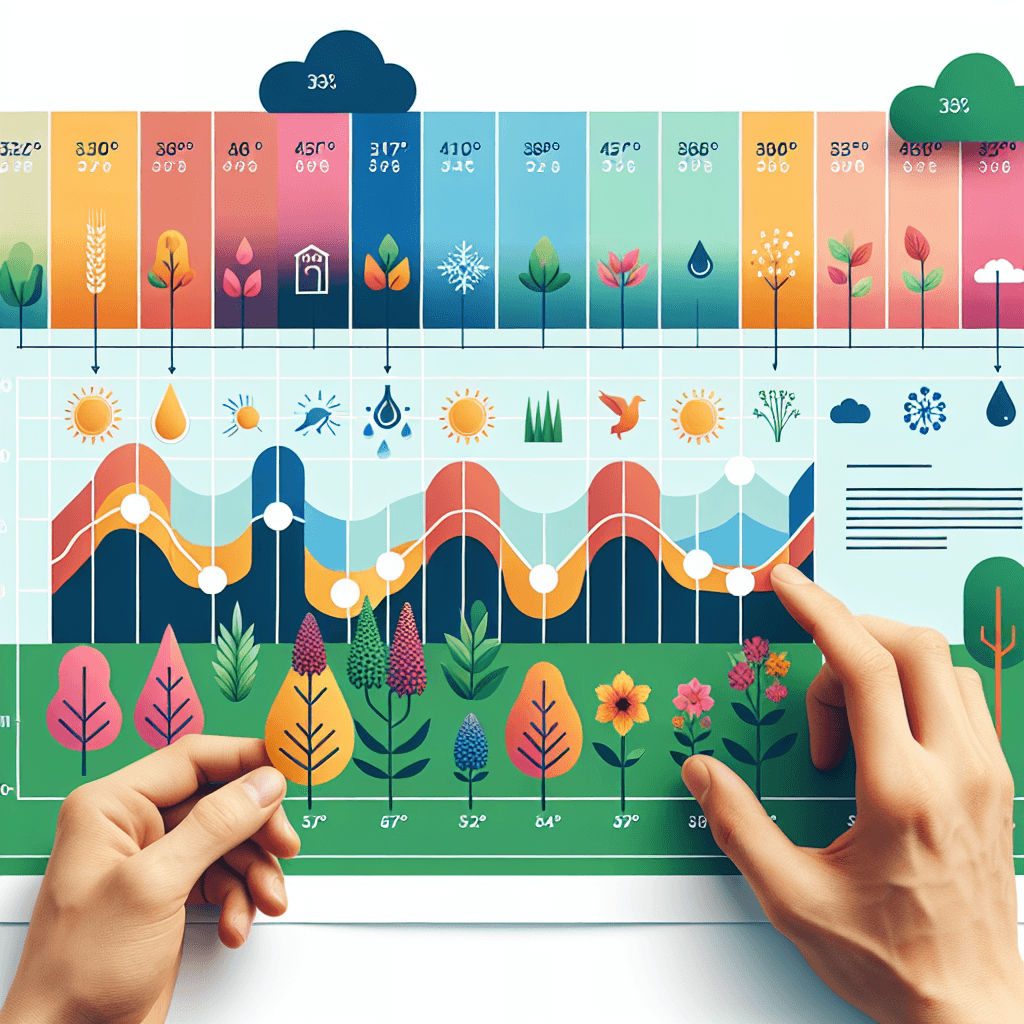
Weather Histograms: Planting Time Advisor for Community Gardens
Inquiry Framework
Question Framework
Driving Question
The overarching question that guides the entire project.How can we use local weather data, represented through histograms, to advise community gardens on the optimal planting times, while considering the impact of sample size, randomness, and interval selection on the reliability of our recommendations?Essential Questions
Supporting questions that break down major concepts.- How can we use histograms to represent weather patterns in our locality?
- In what ways do different histogram intervals affect data interpretation, and how can we choose the most appropriate intervals for our data?
- How can we advise community gardens on optimal planting times using weather data and histograms?
- How do sample size and randomness impact the reliability of weather data used for planting recommendations?
Standards & Learning Goals
Learning Goals
By the end of this project, students will be able to:- Apply the data cycle to formulate questions, collect data, organize data using histograms, analyze data, and communicate results related to local weather patterns.
- Determine the data needed to answer questions about optimal planting times and collect data using various methods.
- Evaluate how sample size and randomness affect the representativeness of collected weather data.
- Construct and interpret histograms to represent numerical weather data, with and without technology.
- Investigate the impact of different intervals on the representation of weather data in histograms.
- Compare weather data represented in histograms with other graphs and justify the best representation.
- Analyze weather data in histograms to identify patterns and draw conclusions to advise community gardens.
Entry Events
Events that will be used to introduce the project to studentsThe Case of the Unpredictable Onions
Local gardeners report crop failures due to unexpected weather. Students analyze weather data histograms to identify planting times that minimize risks, advising the community garden. This connects directly to their lives and encourages them to solve real problems.Portfolio Activities
Portfolio Activities
These activities progressively build towards your learning goals, with each submission contributing to the student's final portfolio.Data Collection Crew: Planning for Planting
Students explore different methods of collecting weather data (online databases, local weather stations) and discuss the importance of sample size and randomness in ensuring the data is representative of long-term weather patterns.Steps
Here is some basic scaffolding to help students complete the activity.Final Product
What students will submit as the final product of the activityA detailed data collection plan outlining sources, methods, and considerations for sample size and randomness.Alignment
How this activity aligns with the learning objectives & standardsFocuses on data collection methods, sample size, and randomness to ensure representative data, aligning with the standard.Graph Gurus: Histogram vs. The Field
Students represent the same weather data using various graph types (line plots, circle graphs) and compare them to histograms. They justify which representation best reveals patterns and insights relevant to advising community gardens on planting times.Steps
Here is some basic scaffolding to help students complete the activity.Final Product
What students will submit as the final product of the activityA comparative analysis of different graph types, justifying the use of histograms for identifying planting patterns.Alignment
How this activity aligns with the learning objectives & standardsCompares histograms with other graphs and justifies the best representation for the data.Rubric & Reflection
Portfolio Rubric
Grading criteria for assessing the overall project portfolioWeather-Based Planting Portfolio Rubric
Data Collection Planning
Assesses the quality and completeness of the data collection plan, focusing on the justification of methods and consideration of sample size and randomness.Data Collection Plan Quality
Quality and completeness of the data collection plan, considering sources, methods, sample size, and randomness.
Exemplary
4 PointsThe data collection plan is comprehensive, clearly outlining diverse and reliable data sources, robust collection methods, and a meticulous consideration of sample size and randomness to ensure highly representative data. The plan demonstrates innovative approaches to address potential biases.
Proficient
3 PointsThe data collection plan is thorough, detailing appropriate data sources, effective collection methods, and a clear consideration of sample size and randomness to ensure representative data.
Developing
2 PointsThe data collection plan is partially complete, outlining some data sources and collection methods, with a basic consideration of sample size and randomness. The representativeness of the data may be questionable.
Beginning
1 PointsThe data collection plan is incomplete, lacking clear data sources, methods, and consideration of sample size and randomness. The data is unlikely to be representative.
Methodological Justification
Clarity and justification of the chosen data collection methods in relation to the research question.
Exemplary
4 PointsThe justification for the chosen data collection methods is exceptionally clear, insightful, and directly links to the research question, demonstrating an advanced understanding of methodological strengths and limitations. Alternative methods are critically evaluated.
Proficient
3 PointsThe justification for the chosen data collection methods is clear, relevant, and links to the research question, demonstrating a good understanding of methodological strengths.
Developing
2 PointsThe justification for the chosen data collection methods is somewhat unclear and weakly linked to the research question, demonstrating a basic understanding of methodological strengths.
Beginning
1 PointsThe justification for the chosen data collection methods is unclear, irrelevant, and lacks a connection to the research question, demonstrating minimal understanding of methodological strengths.
Histogram Justification
Evaluates the comparative analysis of different graph types and the strength of the justification for using histograms.Graph Comparison Depth
Depth of comparative analysis between histograms and other graph types (line plots, circle graphs).
Exemplary
4 PointsThe comparative analysis is exceptionally insightful, demonstrating a sophisticated understanding of each graph type's strengths and weaknesses. The analysis reveals nuanced patterns and insights, innovatively connecting the choice of histograms to the specific needs of advising community gardens. Alternative representations are critically evaluated.
Proficient
3 PointsThe comparative analysis is thorough, demonstrating a strong understanding of each graph type's strengths and weaknesses. The analysis clearly reveals patterns and insights, connecting the choice of histograms to the needs of advising community gardens.
Developing
2 PointsThe comparative analysis is superficial, demonstrating a limited understanding of each graph type's strengths and weaknesses. The analysis reveals some patterns but lacks a clear connection to advising community gardens.
Beginning
1 PointsThe comparative analysis is minimal, demonstrating a poor understanding of each graph type's strengths and weaknesses. The analysis fails to reveal meaningful patterns or connect to advising community gardens.
Histogram Justification Strength
Clarity and strength of the justification for using histograms to identify planting patterns, considering audience and purpose.
Exemplary
4 PointsThe justification is exceptionally clear, persuasive, and tailored to the audience, demonstrating an advanced understanding of data representation and communication. The argument is logically sound, supported by compelling evidence, and shows innovative thinking in applying histograms to practical gardening advice.
Proficient
3 PointsThe justification is clear, well-reasoned, and appropriate for the audience, demonstrating a solid understanding of data representation and communication. The argument is logically sound and supported by evidence.
Developing
2 PointsThe justification is somewhat unclear and weakly reasoned, demonstrating a basic understanding of data representation and communication. The argument lacks sufficient evidence and may not be fully appropriate for the audience.
Beginning
1 PointsThe justification is unclear, poorly reasoned, and inappropriate for the audience, demonstrating minimal understanding of data representation and communication. The argument lacks evidence and logical coherence.