
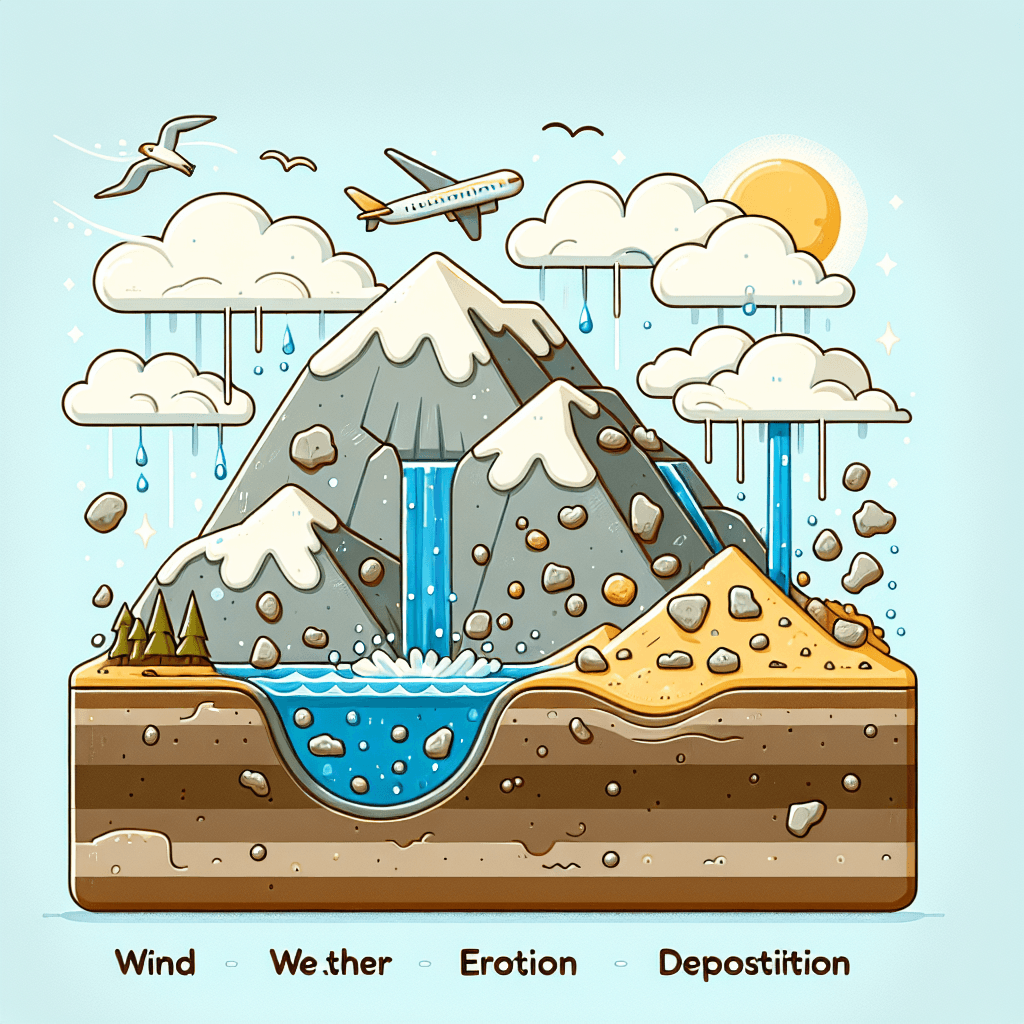
Weathering, Erosion, and Deposition: Rock Cycle Project
Inquiry Framework
Question Framework
Driving Question
The overarching question that guides the entire project.How do weathering, erosion, and deposition shape the Earth's surface and influence the rock cycle, and what impact do these processes have on our planet's systems?Essential Questions
Supporting questions that break down major concepts.- How do weathering, erosion, and deposition contribute to the rock cycle?
- What factors influence the rates of weathering and erosion?
- How does soil formation relate to weathering and erosion?
- In what ways do these processes impact Earth's systems?
Standards & Learning Goals
Learning Goals
By the end of this project, students will be able to:- Explain the roles of weathering, erosion, and deposition in the rock cycle.
- Investigate the factors that affect the rates of weathering and erosion.
- Describe the process of soil formation and its relationship to weathering and erosion.
- Analyze the impact of weathering, erosion, and deposition on Earth's systems.
Earth and Space Science
Entry Events
Events that will be used to introduce the project to studentsMystery of the Missing Beach
A local beach has mysteriously disappeared overnight! Students examine photographic evidence, sediment samples, and weather data to determine if weathering, erosion, or deposition are to blame, and propose solutions to restore the beach.Portfolio Activities
Portfolio Activities
These activities progressively build towards your learning goals, with each submission contributing to the student's final portfolio.Rock Cycle Relays
Students create a visual model and presentation to explain the roles of weathering, erosion, and deposition in the rock cycle.Steps
Here is some basic scaffolding to help students complete the activity.Final Product
What students will submit as the final product of the activityA visual model of the rock cycle with detailed explanations of weathering, erosion, and deposition.Alignment
How this activity aligns with the learning objectives & standardsLearning Goal: Explain the roles of weathering, erosion, and deposition in the rock cycle. Standard Alignment: ESS.EES.2.4Earth's Systems Impact Analysis
Students analyze and present the impact of weathering, erosion, and deposition on Earth's systems through case studies.Steps
Here is some basic scaffolding to help students complete the activity.Final Product
What students will submit as the final product of the activityA presentation analyzing the impact of weathering, erosion, and deposition on a specific Earth system, including causes, effects, and potential solutions.Alignment
How this activity aligns with the learning objectives & standardsLearning Goal: Analyze the impact of weathering, erosion, and deposition on Earth's systems. Standard Alignment: ESS.EES.2.4Rubric & Reflection
Portfolio Rubric
Grading criteria for assessing the overall project portfolioRock Cycle and Earth Systems Impact Rubric
Understanding of the Rock Cycle
Demonstrates comprehension of the rock cycle and the roles of weathering, erosion, and deposition within it.Accuracy of Model
The visual model accurately represents the rock cycle and clearly labels the processes of weathering, erosion, and deposition.
Exemplary
4 PointsModel is exceptionally accurate, detailed, and clearly illustrates the rock cycle and the roles of weathering, erosion, and deposition with innovative representations.
Proficient
3 PointsModel is accurate and clearly illustrates the rock cycle and the roles of weathering, erosion, and deposition.
Developing
2 PointsModel shows a basic understanding of the rock cycle, but may have some inaccuracies or lack clarity in representing weathering, erosion, and deposition.
Beginning
1 PointsModel is incomplete or inaccurate and demonstrates a limited understanding of the rock cycle and the roles of weathering, erosion, and deposition.
Explanation of Processes
The explanations of weathering, erosion, and deposition are thorough, accurate, and clearly articulate their roles in the rock cycle.
Exemplary
4 PointsExplanations are exceptionally thorough, insightful, and demonstrate a sophisticated understanding of the processes and their interrelationships within the rock cycle.
Proficient
3 PointsExplanations are thorough, accurate, and clearly articulate the roles of weathering, erosion, and deposition in the rock cycle.
Developing
2 PointsExplanations are basic and may contain some inaccuracies or lack detail in describing the roles of weathering, erosion, and deposition in the rock cycle.
Beginning
1 PointsExplanations are incomplete or inaccurate and demonstrate a limited understanding of the roles of weathering, erosion, and deposition in the rock cycle.
Analysis of Earth Systems Impact
Demonstrates the ability to analyze the impact of weathering, erosion, and deposition on Earth's systems through a case study.Case Study Selection and Research
The chosen case study is relevant, and the research is thorough and provides detailed information about the causes, effects, and potential solutions.
Exemplary
4 PointsCase study is exceptionally relevant and insightful, demonstrating innovative research and a comprehensive understanding of the causes, effects, and potential solutions with advanced insights.
Proficient
3 PointsCase study is relevant, and the research is thorough and provides detailed information about the causes, effects, and potential solutions.
Developing
2 PointsCase study is somewhat relevant, but the research may be incomplete or lack detail in explaining the causes, effects, and potential solutions.
Beginning
1 PointsCase study is not relevant, and the research is minimal and lacks essential information about the causes, effects, and potential solutions.
Presentation of Analysis
The presentation effectively explains the case study, its implications, and potential mitigation strategies.
Exemplary
4 PointsPresentation is exceptionally clear, engaging, and insightful, effectively communicating the case study, its implications, and innovative mitigation strategies with sophisticated analysis.
Proficient
3 PointsPresentation is clear, organized, and effectively explains the case study, its implications, and potential mitigation strategies.
Developing
2 PointsPresentation is understandable, but may lack clarity, organization, or detail in explaining the case study, its implications, or potential mitigation strategies.
Beginning
1 PointsPresentation is confusing, disorganized, and fails to adequately explain the case study, its implications, or potential mitigation strategies.
Presentation and Communication
Effectively communicates understanding and analysis through clear and engaging presentation skills.Clarity and Organization
Presents information in a clear, logical, and organized manner.
Exemplary
4 PointsPresentation is exceptionally clear, logical, and organized, enhancing audience understanding through innovative communication techniques and sophisticated structure.
Proficient
3 PointsPresentation is clear, logical, and organized.
Developing
2 PointsPresentation is generally understandable but may lack clarity or organization in some areas.
Beginning
1 PointsPresentation is confusing and disorganized, making it difficult to understand the information.
Engagement and Visuals
Engages the audience and uses visuals effectively to support the presentation.
Exemplary
4 PointsPresentation is highly engaging and uses visuals innovatively and effectively to enhance audience understanding and maintain interest throughout the presentation, demonstrating exceptional communication skills.
Proficient
3 PointsPresentation is engaging and uses visuals effectively to support the presentation.
Developing
2 PointsPresentation is somewhat engaging and uses visuals, but they may not always be relevant or effective.
Beginning
1 PointsPresentation is not engaging and lacks effective use of visuals.