
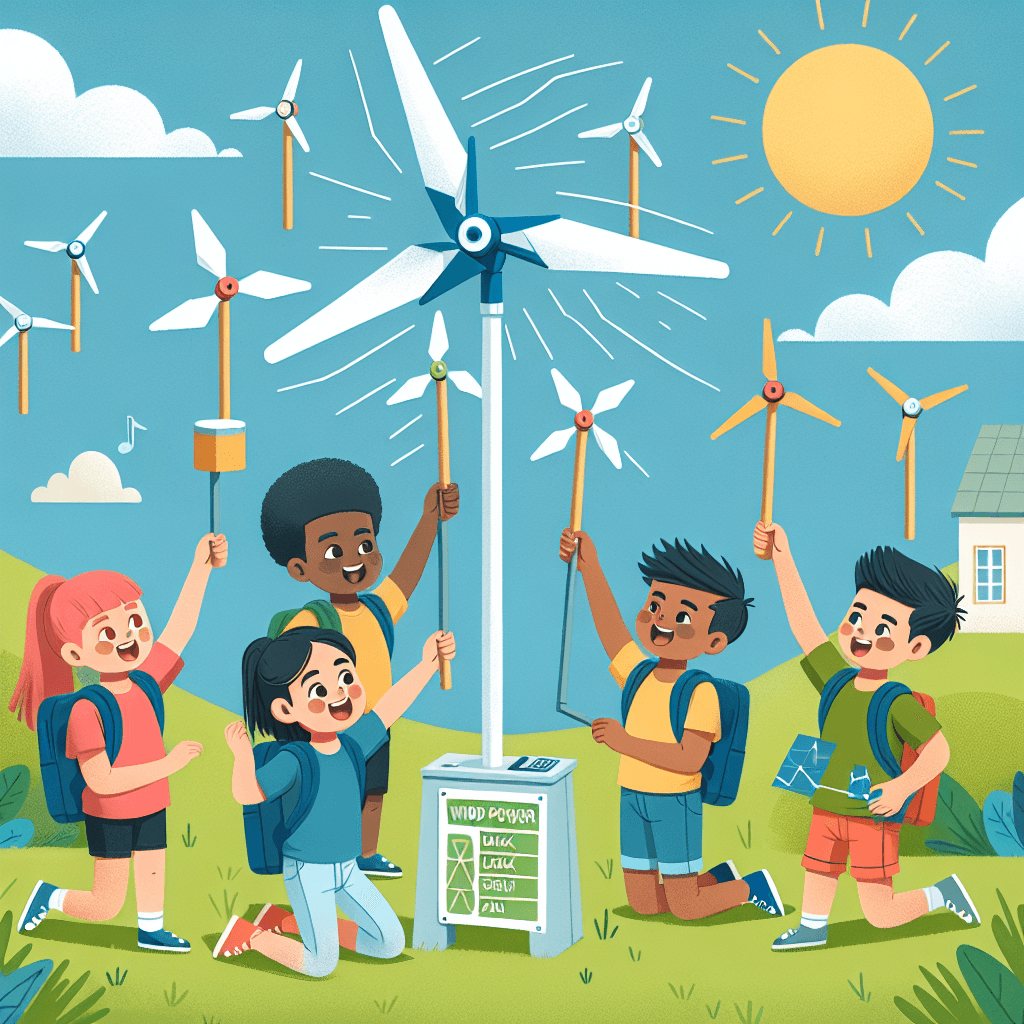
Wind Power Wonders: Exploring Force with Windmills
Inquiry Framework
Question Framework
Driving Question
The overarching question that guides the entire project.How can we design and build a windmill that effectively uses wind to create energy, while understanding the impacts of balanced and unbalanced forces on its function and movement?Essential Questions
Supporting questions that break down major concepts.- How do windmills work and how do they use the wind to create energy?
- What are the differences between balanced and unbalanced forces?
- How can we design an efficient windmill to harness wind energy?
- How does changing the design of a windmill affect its performance in terms of harnessing wind energy?
- What role do forces play in the movement and functionality of a windmill?
Standards & Learning Goals
Learning Goals
By the end of this project, students will be able to:- Students will understand the concept of balanced and unbalanced forces and how they impact the motion of objects.
- Students will be able to plan and conduct investigations related to windmills and wind energy.
- Students will design a windmill that demonstrates their understanding of force and motion.
- Students will analyze how different designs affect the performance of windmills in terms of harnessing wind energy.
- Students will evaluate the effectiveness of their windmill designs based on observed motion and energy generation.
Next Generation Science Standards (NGSS)
Entry Events
Events that will be used to introduce the project to studentsVirtual Wind Farm Tour
Take students on a virtual field trip to a contemporary wind farm to observe the technology in action. As they watch turbines convert wind into energy, students will be prompted to consider questions about engineering and the environment, paving the way for discussions about balanced and unbalanced forces in larger-than-life applications.Portfolio Activities
Portfolio Activities
These activities progressively build towards your learning goals, with each submission contributing to the student's final portfolio.Force Exploration Lab
In this hands-on lab, students will explore the concepts of balanced and unbalanced forces by experimenting with objects in motion. This activity emphasizes practical investigation skills, preparing students for their windmill projects.Steps
Here is some basic scaffolding to help students complete the activity.Final Product
What students will submit as the final product of the activityA lab report detailing the experiment process, discoveries about force, and potential implications for windmill design.Alignment
How this activity aligns with the learning objectives & standardsSupports 3-PS2-1 by encouraging planning and conducting investigations to provide evidence on the effects of forces.Windmill Design Challenge
In this activity, students will apply their knowledge of forces to design their own windmill models. The aim is to help students understand how changes in design affect the windmill's ability to harness wind energy and explore the concept of balanced and unbalanced forces in real-world applications.Steps
Here is some basic scaffolding to help students complete the activity.Final Product
What students will submit as the final product of the activityA functional windmill model constructed by each student pair, reflecting their design choices and understanding of forces.Alignment
How this activity aligns with the learning objectives & standardsAligns with 3-PS2-1 as students plan and conduct an investigation into the effects of balanced and unbalanced forces on windmill movement.Windmill Optimization Workshop
Students will enhance and optimize their windmill designs based on previous tests, focusing on improving energy harnessing efficiency using unbalanced forces.Steps
Here is some basic scaffolding to help students complete the activity.Final Product
What students will submit as the final product of the activityAn optimized windmill model and a presentation detailing design changes and their impact on performance.Alignment
How this activity aligns with the learning objectives & standardsAddresses 3-PS2-1 by refining design based on forces and improving windmill efficiency in generating energy.Rubric & Reflection
Portfolio Rubric
Grading criteria for assessing the overall project portfolioWindmill Design and Forces Exploration Rubric
Understanding of Forces
Assesses the student’s comprehension of balanced and unbalanced forces and the ability to apply these concepts to their windmill design and experiments.Concept Clarity
Evaluates the student's understanding and explanation of balanced and unbalanced forces in their projects.
Exemplary
4 PointsDemonstrates a comprehensive and sophisticated understanding of balanced and unbalanced forces, effectively explaining their application in windmill design with clear and detailed examples.
Proficient
3 PointsShows a thorough understanding of balanced and unbalanced forces, adequately explaining their role in windmill design with relevant examples.
Developing
2 PointsExhibits a basic understanding of balanced and unbalanced forces with some explanation of their use in windmill design, though examples may lack clarity.
Beginning
1 PointsShows a limited understanding of balanced and unbalanced forces, struggling to explain their relevance to windmill design.
Application of Concepts
Assesses how students apply their understanding of forces to influence the design and functionality of their windmill models.
Exemplary
4 PointsApplies concepts innovatively and accurately, resulting in a highly functional and efficient windmill model that demonstrates deep integration of the principles of force.
Proficient
3 PointsEffectively applies concepts to create a functional windmill model that shows good integration of force principles.
Developing
2 PointsApplies concepts inconsistently, resulting in a windmill model that functions with partial integration of force principles.
Beginning
1 PointsStruggles to apply concepts, resulting in a windmill model with limited demonstration of force principles.
Experimental Design and Investigation
Evaluates the procedural and investigative skills demonstrated during the planning and conducting of force-related experiments and windmill tests.Experimentation Skills
Evaluates the student’s ability to design and conduct experiments that meaningfully explore force concepts.
Exemplary
4 PointsDesigns and conducts experiments with precision and creativity, gathering comprehensive evidence on force effects with clear, logical methodology.
Proficient
3 PointsDesigns and conducts experiments effectively, gathering adequate evidence and employing a logical methodology to study forces.
Developing
2 PointsDesigns and conducts simple experiments that collect some evidence, though the methodology may be basic or unclear.
Beginning
1 PointsStruggles with designing and conducting experiments, resulting in minimal evidence collection with unclear methodology.
Innovation and Optimization
Assesses students' ability to innovate and optimize their windmill designs based on experimental findings and force observations.Design Innovation
Evaluates creativity and effectiveness in modifying and optimizing windmill designs to improve performance.
Exemplary
4 PointsProposes highly creative and effective design modifications that significantly enhance windmill performance using optimized force principles.
Proficient
3 PointsProposes effective design modifications that improve windmill performance with consideration of force principles.
Developing
2 PointsSuggests basic design modifications with some impact on windmill performance, partially considering force principles.
Beginning
1 PointsProposes limited or ineffective design modifications with minimal consideration of force principles.
Collaboration and Communication
Assesses the ability to work collaboratively and communicate ideas effectively in group interactions and presentations.Teamwork and Participation
Evaluates participation, contribution, and collaborative skills during group work and presentations.
Exemplary
4 PointsExhibits leadership and actively engages all team members in discussions, contributing high-quality, insightful ideas consistently.
Proficient
3 PointsParticipates actively and cooperatively, contributing meaningful ideas and supporting team discussions effectively.
Developing
2 PointsParticipates in discussions with occasional contribution of ideas, showing cooperative though variable engagement.
Beginning
1 PointsStruggles to participate or contribute ideas, requiring guidance to remain engaged in team activities.