
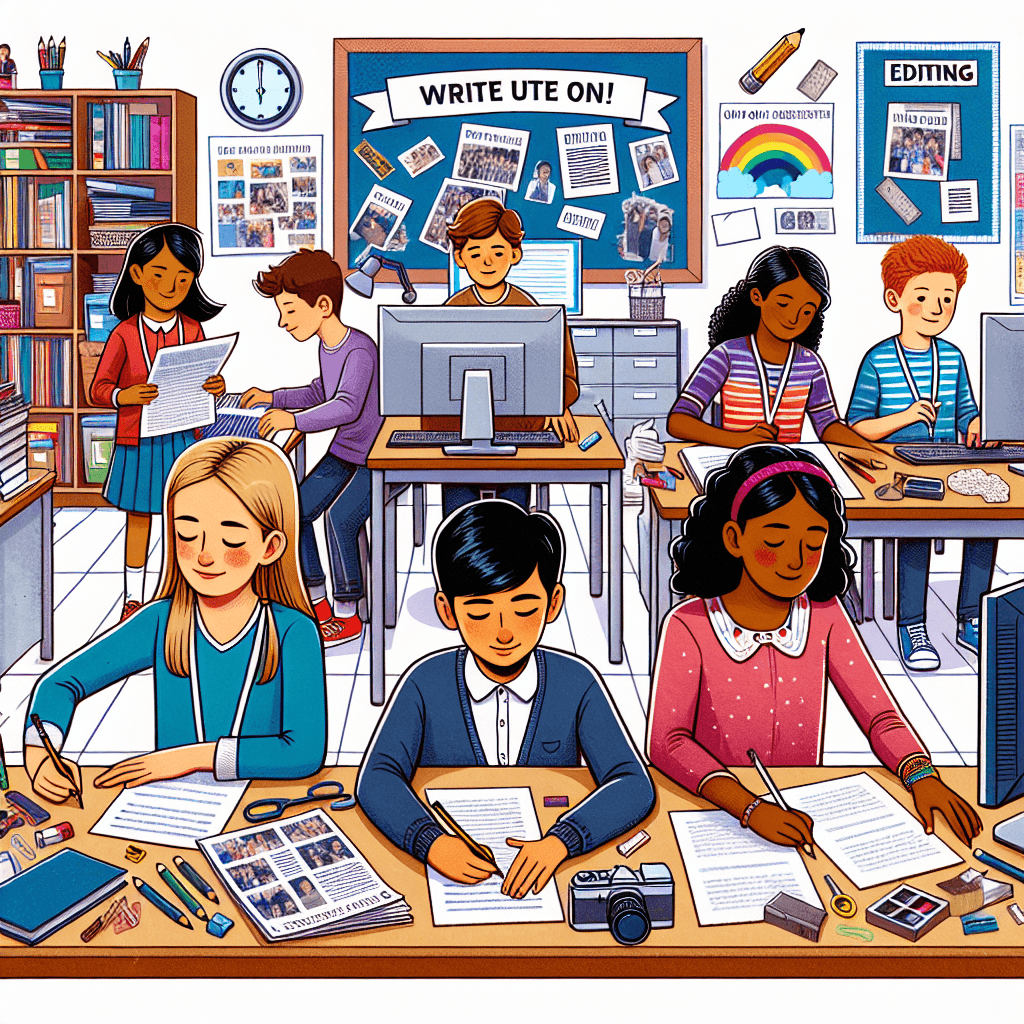
Write On! Creating Our School Newspaper
Inquiry Framework
Question Framework
Driving Question
The overarching question that guides the entire project.How can we create a school newspaper that informs, engages, and reflects the diverse voices and interests of our entire student body?Essential Questions
Supporting questions that break down major concepts.- How can we make the school newspaper interesting and relevant to all students?
- How do we gather information and conduct interviews for our articles?
- What are the different types of articles we can write (e.g., news, opinion, features, sports)?
- How do we write clear, concise, and engaging articles?
- How do we edit and revise our articles to improve their quality?
Standards & Learning Goals
Learning Goals
By the end of this project, students will be able to:- Students will be able to write various types of newspaper articles, including news, opinion, and feature articles.
- Students will gather and synthesize information through research and interviews efficiently.
- Students will develop their editing and revision skills to enhance the quality of their writing.
- Students will understand the structure and purpose of different types of articles (news, opinion, feature, sports, etc.).
- Students will engage in collaborative activities to share ideas and gather diverse perspectives for their articles.
- Students will learn to present information clearly and logically, both in writing and speaking.
Common Core Standards
Entry Events
Events that will be used to introduce the project to studentsEditorial Board Simulation
**Editorial Board Simulation:** Divide the class into editorial board teams, each responsible for a different section of the newspaper. Each team receives a set of potential article topics and must pitch their ideas, debate their importance, and collaboratively decide which articles to pursue, mirroring a real editorial process.Portfolio Activities
Portfolio Activities
These activities progressively build towards your learning goals, with each submission contributing to the student's final portfolio.Sound Off: The Opinion Column
Students will choose a school-related issue and write an opinion piece, expressing their viewpoint with supporting reasons and evidence.Steps
Here is some basic scaffolding to help students complete the activity.Final Product
What students will submit as the final product of the activityA completed opinion article draft, including an introduction with a clear thesis, body paragraphs with supporting evidence, and a conclusion.Alignment
How this activity aligns with the learning objectives & standardsCovers CCSS.ELA-LITERACY.W.6.1 (Write arguments to support claims) and CCSS.ELA-LITERACY.L.6.3 (Use knowledge of language and its conventions).Feature Focus: The Interview Article
Students will conduct an interview with a school staff member or student and write a feature article based on the interview.Steps
Here is some basic scaffolding to help students complete the activity.Final Product
What students will submit as the final product of the activityA completed feature article draft, including an engaging introduction, interview excerpts, descriptive details, and a concluding thought.Alignment
How this activity aligns with the learning objectives & standardsCovers CCSS.ELA-LITERACY.W.6.3 (Write narratives) and CCSS.ELA-LITERACY.SL.6.1 (Engage in collaborative discussions).Pitch Perfect: The Editorial Presentation
Students will prepare and deliver a short presentation of their article idea to the class, simulating an editorial board meeting.Steps
Here is some basic scaffolding to help students complete the activity.Final Product
What students will submit as the final product of the activityA prepared presentation, including a summary of the article, its relevance, and why it should be included in the school newspaper.Alignment
How this activity aligns with the learning objectives & standardsCovers CCSS.ELA-LITERACY.SL.6.4 (Present claims and findings) and CCSS.ELA-LITERACY.L.6.1 (Demonstrate command of standard English).News Flash: The Basic News Report
Students will select a relevant school event or topic and write a brief news report, focusing on factual reporting.Steps
Here is some basic scaffolding to help students complete the activity.Final Product
What students will submit as the final product of the activityA short news article draft, including a headline, lead paragraph, body, and a concluding statement.Alignment
How this activity aligns with the learning objectives & standardsCovers CCSS.ELA-LITERACY.W.6.2 (Write informative/explanatory texts) and CCSS.ELA-LITERACY.L.6.1 (Demonstrate command of standard English).Rubric & Reflection
Portfolio Rubric
Grading criteria for assessing the overall project portfolioSchool Newspaper Project Rubric
Writing Quality
Assessing the effectiveness of writing across different article types, including clarity, structure, and engaging content.Structure and Organization
Evaluates the logical arrangement and flow of content in articles.
Exemplary
4 PointsThe article is exceptionally well-organized, with a clear and engaging structure that enhances readability.
Proficient
3 PointsThe article is well-organized and follows a logical structure, making it easy to understand.
Developing
2 PointsThe article shows basic structure, but organization is sometimes unclear.
Beginning
1 PointsThe article lacks clear structure and is difficult to follow.
Content and Ideas
Assesses the depth and originality of ideas and how well they are communicated.
Exemplary
4 PointsPresents insightful ideas and innovative angles with comprehensive supporting details.
Proficient
3 PointsCommunicates clear and relevant ideas with supporting details.
Developing
2 PointsPresents basic ideas with limited details.
Beginning
1 PointsIdeas are unclear or underdeveloped, lacking detail.
Grammar and Conventions
Measures the use of correct grammar and adherence to standard language conventions.
Exemplary
4 PointsDemonstrates outstanding command of grammar and conventions with no errors.
Proficient
3 PointsUses grammar and conventions correctly with minor errors that do not impede understanding.
Developing
2 PointsDisplays limited control of grammar and conventions with noticeable errors.
Beginning
1 PointsShows little control over grammar and conventions with frequent errors.
Research and Evidence
Evaluating the gathering and integration of information and evidence to support writing.Use of Evidence
Assesses how effectively evidence is used to support arguments and narratives.
Exemplary
4 PointsIntegrates evidence seamlessly and effectively supports arguments.
Proficient
3 PointsUses relevant evidence appropriately to support arguments.
Developing
2 PointsProvides some evidence, but integration is weak or inconsistent.
Beginning
1 PointsLittle to no use of evidence to support ideas.
Collaboration and Communication
Assessing participation in collaborative activities and the clarity of oral communication.Collaborative Engagement
Evaluates students' ability to engage in and contribute to group activities.
Exemplary
4 PointsLeads group efforts, facilitates discussions, and incorporates diverse viewpoints.
Proficient
3 PointsActively participates in group activities and respects others' ideas.
Developing
2 PointsParticipates in group activities with limited contributions.
Beginning
1 PointsMinimal participation in group activities.
Oral Presentation
Assesses the delivery and clarity of oral presentations.
Exemplary
4 PointsDelivers clear, engaging presentations with strong command of language.
Proficient
3 PointsDelivers clear presentations with good clarity and engagement.
Developing
2 PointsPresents with some clarity but struggles to engage the audience.
Beginning
1 PointsPresents with minimal clarity and engagement.