
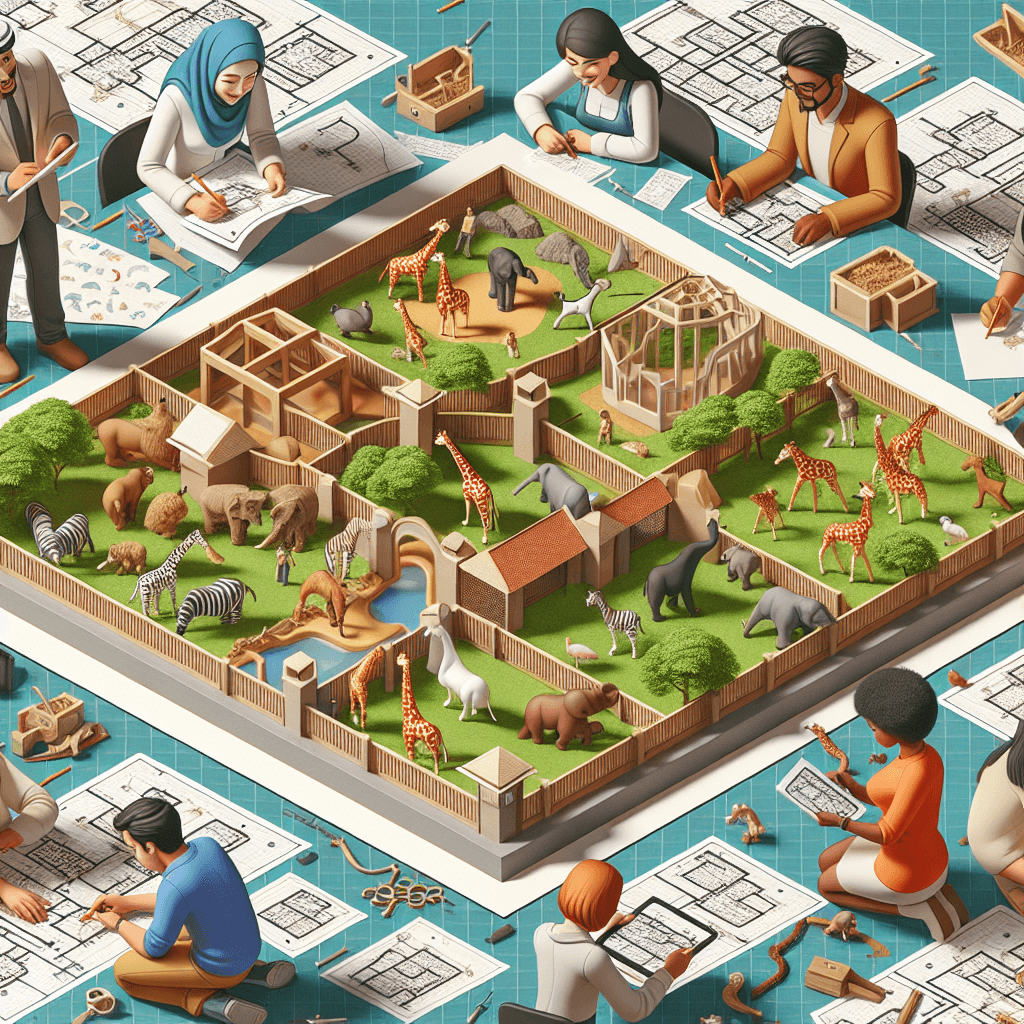
Inquiry Framework
Question Framework
Driving Question
The overarching question that guides the entire project.How can we design and build a zoo enclosure that provides the best possible environment for our chosen animal while considering ethical, sustainable, and scientific principles?Essential Questions
Supporting questions that break down major concepts.- What are the specific needs and preferences of my chosen animal?
- How can I design an enclosure that meets these needs while also being enriching and stimulating?
- What materials and resources are best suited for constructing a safe and sustainable enclosure?
- How can I calculate the appropriate dimensions and layout of the enclosure?
- What are the ethical considerations surrounding animal welfare and conservation in zoos?
- How can I present my design proposal effectively to stakeholders?
- How can I incorporate persuasive language and visual aids to support my proposal?
- What scientific principles can I apply to optimize the enclosure's design (e.g., animal behavior, environmental science)?
- How can I calculate the costs involved in building and maintaining the enclosure?
- How can I incorporate mathematical concepts like area, perimeter, and volume into my design?
- How do the design elements of a zoo enclosure connect with the overarching goals of conservation and education?
Standards & Learning Goals
Learning Goals
By the end of this project, students will be able to:- Students will be able to research and identify the specific needs of a chosen animal, including habitat, diet, social behavior, and enrichment requirements.
- Students will be able to design a zoo enclosure that meets the identified needs of their chosen animal, incorporating appropriate dimensions, layout, materials, and enrichment features.
- Students will be able to apply mathematical concepts, including area, perimeter, volume, and cost calculations, to their enclosure design.
- Students will be able to justify their design choices using scientific principles related to animal behavior, environmental science, and sustainability.
- Students will be able to develop and deliver a persuasive presentation to stakeholders, incorporating effective communication techniques, visual aids, and persuasive language.
- Students will be able to evaluate the ethical considerations of keeping animals in zoos and discuss the role of zoos in conservation and education.
Australian Curriculum: English
Australian Curriculum: Mathematics
Australian Curriculum: Science
Entry Events
Events that will be used to introduce the project to studentsMysterious Crate Arrival
Students encounter a mysterious crate arriving at the school, labeled "Top Secret Animal Transport." Inside, they find a single, cryptic clue related to their chosen animal's needs and habitat. They must decipher the clue to begin designing a suitable enclosure.Zoo Design Committee Meeting
Students participate in a mock "Zoo Design Committee" meeting where they pitch their initial enclosure ideas to classmates. Constructive feedback and debate help refine designs and consider diverse perspectives on animal welfare.Digital Zoo Enclosure Exploration
Students use a digital simulation tool to explore various pre-designed zoo enclosures. They analyze the strengths and weaknesses of each design and use this knowledge to inspire their own unique enclosure plan.Portfolio Activities
Portfolio Activities
These activities progressively build towards your learning goals, with each submission contributing to the student's final portfolio.Persuasive Animal Needs Presentation
Students will step into the shoes of zoologists and create a persuasive 'Animal Needs' presentation.Steps
Here is some basic scaffolding to help students complete the activity.Final Product
What students will submit as the final product of the activityA persuasive presentation outlining the specific needs and preferences of their chosen animal, using visuals and persuasive language.Alignment
How this activity aligns with the learning objectives & standardsACELY1704 - Plan, draft and publish imaginative, informative and persuasive texts...Enclosure Blueprint & Calculations
Students will calculate the area and perimeter of their enclosure, ensuring it's the right size for their animal.Steps
Here is some basic scaffolding to help students complete the activity.Final Product
What students will submit as the final product of the activityA scaled blueprint of the enclosure with accurate area and perimeter calculations, demonstrating practical application of math skills.Alignment
How this activity aligns with the learning objectives & standardsACMMG109 - Calculate perimeter and area of rectangles...Adaptation-Focused Enclosure Design
Students will research and document their animal's adaptations and link them to specific features within their enclosure design.Steps
Here is some basic scaffolding to help students complete the activity.Final Product
What students will submit as the final product of the activityA detailed report explaining the animal's adaptations and how the enclosure design caters to these adaptations.Alignment
How this activity aligns with the learning objectives & standardsACSSU043 - Living things have structural features and adaptations...Zoo Enclosure Design Presentation
Students bring their entire project together, creating a digital presentation to pitch their zoo enclosure design.Steps
Here is some basic scaffolding to help students complete the activity.Final Product
What students will submit as the final product of the activityA comprehensive digital presentation showcasing the enclosure design, animal needs, mathematical calculations, and ethical considerations.Alignment
How this activity aligns with the learning objectives & standardsACELY1714 - Use a range of software...to create digital presentations...Rubric & Reflection
Portfolio Rubric
Grading criteria for assessing the overall project portfolioZoo Enclosure Design Rubric
Research and Analysis
Evaluates the students' ability to research, analyze, and interpret information about their chosen animal's needs and apply this understanding to the enclosure design.Understanding Animal Needs
Assesses the depth of understanding of the chosen animal’s habitat, diet, social behavior, and enrichment needs.
Exemplary
4 PointsDemonstrates comprehensive understanding of the animal’s needs with extensive details and supporting evidence from multiple sources.
Proficient
3 PointsShows thorough understanding of the animal’s needs with clear and relevant details from multiple sources.
Developing
2 PointsDisplays emerging understanding of the animal’s needs with some relevant details but lacking depth.
Beginning
1 PointsShows minimal understanding of the animal’s needs with insufficient or irrelevant details.
Connection to Enclosure Design
Measures how effectively the research informs the design of the enclosure.
Exemplary
4 PointsInnovatively applies research insights to create a well-integrated enclosure design, meeting all identified animal needs.
Proficient
3 PointsEffectively applies research insights to design a coherent enclosure meeting most animal needs.
Developing
2 PointsAttempts to apply research insights, leading to a partial fulfillment of animal needs in the design.
Beginning
1 PointsStruggles to connect research insights to the enclosure design, resulting in unmet animal needs.
Mathematical Application
Assess students' competency with mathematical concepts such as area, perimeter, and volume in the context of enclosure design.Accuracy of Calculations
Evaluates the precision and correctness of area, perimeter, and volume calculations.
Exemplary
4 PointsAll calculations are accurate and applied correctly to the context of the design, showing sophisticated mathematical understanding.
Proficient
3 PointsCalculations are mostly accurate and correctly applied to the design context, showing good mathematical understanding.
Developing
2 PointsCalculations have some inaccuracies and are inconsistently applied to the design context.
Beginning
1 PointsCalculations are mostly inaccurate and poorly applied to the design.
Integration of Mathematical Concepts
Measures how well mathematical concepts are incorporated into the design and justification of the enclosure.
Exemplary
4 PointsEffectively integrates mathematical concepts into the design, with clear and logical explanations and justifications.
Proficient
3 PointsIntegrates mathematical concepts into the design with clear explanations and justifications.
Developing
2 PointsAttempts to integrate mathematical concepts, but explanations and justifications are unclear or incomplete.
Beginning
1 PointsBarely integrates mathematical concepts into the design, with vague or absent explanations.
Scientific Understanding and Ethical Considerations
Evaluates students' understanding of scientific principles related to animal adaptations and the ethical considerations of zoo environments.Scientific Application to Design
Assesses how well students apply scientific knowledge about animal adaptations and environments to the enclosure design.
Exemplary
4 PointsDemonstrates advanced application of scientific principles, showcasing a deep understanding of animal adaptations.
Proficient
3 PointsEffectively applies scientific principles, demonstrating a good understanding of animal adaptations.
Developing
2 PointsShows some application of scientific principles with basic understanding of animal adaptations.
Beginning
1 PointsStruggles to apply scientific principles, showing minimal understanding of animal adaptations.
Ethical Considerations in Design
Measures the extent to which ethical considerations are addressed within the enclosure design.
Exemplary
4 PointsComprehensively addresses ethical considerations with innovative solutions in the design.
Proficient
3 PointsAddresses ethical considerations effectively with thoughtful solutions.
Developing
2 PointsAttempts to address ethical considerations but lacks depth or thoroughness.
Beginning
1 PointsBarely addresses ethical considerations, lacks viable solutions.
Presentation Skills
Assesses the ability to communicate design concepts effectively through oral and digital presentations.Clarity and Coherence
Evaluates how clearly and logically ideas are presented in both written and oral formats.
Exemplary
4 PointsPresents ideas in a clear, well-structured, and engaging manner, demonstrating superior communication skills.
Proficient
3 PointsPresents ideas clearly and coherently, with few lapses in clarity or structure.
Developing
2 PointsPresents ideas with some clarity, but many sections are difficult to follow or lack coherence.
Beginning
1 PointsPresentation of ideas lacks clarity and coherence, making it difficult to understand.
Use of Persuasive and Visual Elements
Measures the effectiveness of using persuasive language and visual aids to support the design proposal.
Exemplary
4 PointsSkillfully uses persuasive language and visual elements to enhance the proposal and engage the audience.
Proficient
3 PointsEffectively uses persuasive language and visual elements to support the proposal.
Developing
2 PointsUses some persuasive language and visual elements, but not consistently effective.
Beginning
1 PointsStruggles to use persuasive language and visual elements effectively, impacting the proposal's strength.