
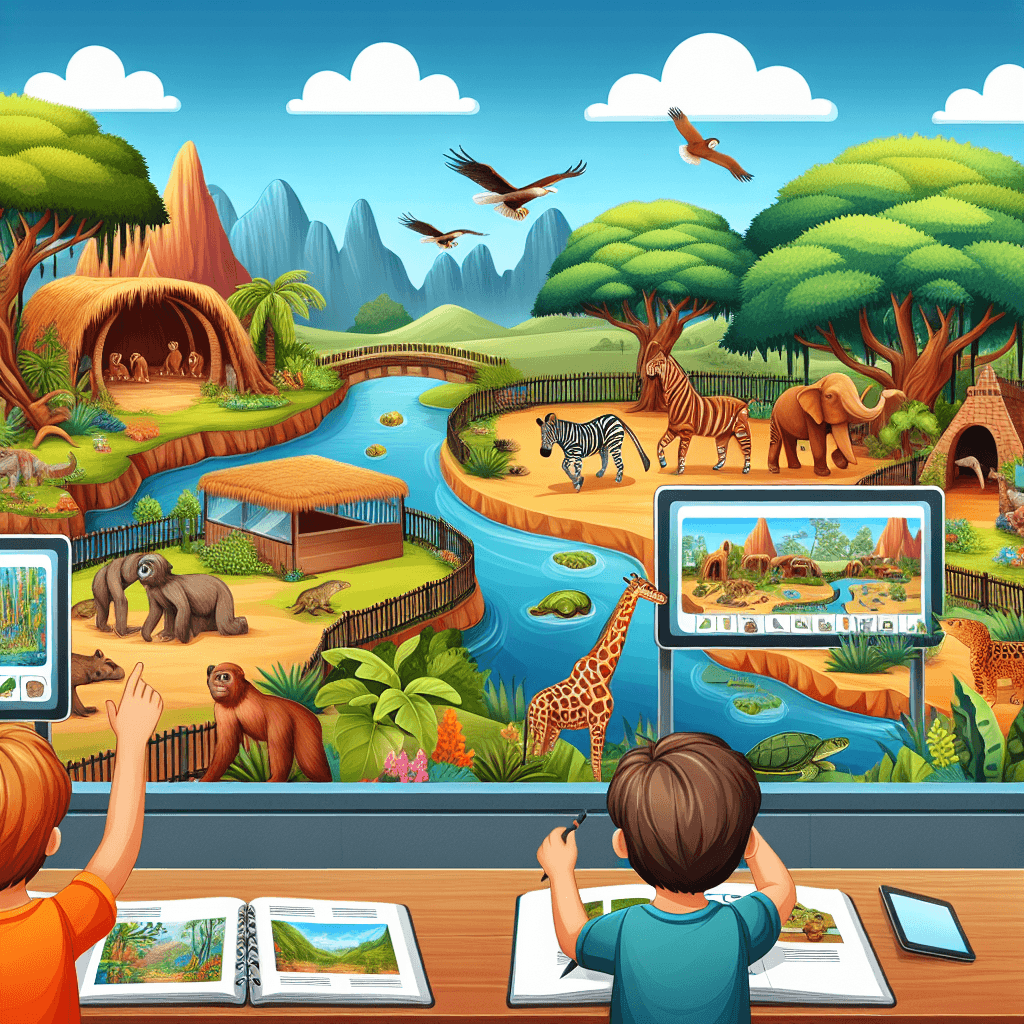
Zoo Habitat Exploration
Inquiry Framework
Question Framework
Driving Question
The overarching question that guides the entire project.How can we, as young zoologists, design a zoo habitat that meets the basic needs and supports the well-being of its animal inhabitants?Essential Questions
Supporting questions that break down major concepts.- What characteristics define an animal's natural habitat and how do these affect their basic needs for survival?
- How can we measure and calculate the size of an enclosure, including height, weight, and area, needed for different animals in a zoo?
- How do animals' height, weight, and living space requirements contribute to their free movement and general well-being in captivity?
- What are the major stages of growth for certain animals and how do they impact their life span and health in a zoo environment?
- How does understanding animal behavior and diet contribute to their well-being in zoos?
Standards & Learning Goals
Learning Goals
By the end of this project, students will be able to:- Students will understand and describe the basic needs of animals for survival and well-being.
- Students will design a zoo habitat that meets the specific needs of an animal species.
- Students will measure and calculate the area of zoo enclosures using mathematical operations.
- Students will identify the stages of an animal's life cycle and its impact on habitat requirements.
- Students will engage in collaborative discussions to share ideas and improve habitat designs.
Next Generation Science Standards
Common Core Standards
Entry Events
Events that will be used to introduce the project to studentsVirtual Safari Adventure
Students embark on a virtual safari guided by a vivid, interactive video that tours various ecosystems. They observe animals in their natural habitats and compare these with a zoo setting, instantly sparking their curiosity about the needs and environments of different species.Design a Zoo Exhibit Challenge
The classroom transforms into a strategic design team responsible for creating the most suitable zoo exhibit for a newly discovered animal. This opportunities students to collaboratively brainstorm habitat needs, including space and resources, while applying math and science principles.Animal Habitat Mystery Boxes
Each group receives a mystery box containing different item clues (e.g., model trees, fabrics, rocks) for assembling a miniature habitat. As they guess which animal fits their habitat, they explore the basic living conditions and geographical needs of varying species.Zoologist Guest Speaker
A real-life zoologist visits the class to share fascinating stories and findings from their fieldwork. Students can engage directly by asking questions, setting the stage for their investigative process into animal habitats and life cycles.Animation Exploration: A Day in the Life
Using animation tools, students create a short film portraying a day in the life of a zoo animal. This creative project allows them to delve into the animal's daily needs, behaviors, and environmental interactions.Portfolio Activities
Portfolio Activities
These activities progressively build towards your learning goals, with each submission contributing to the student's final portfolio.Virtual Safari Observation Log
Students engage in a virtual safari to explore different ecosystems. They will document their observations focusing on the similarities and differences between animals' natural habitats and zoo settings.Steps
Here is some basic scaffolding to help students complete the activity.Final Product
What students will submit as the final product of the activityAn observation log comparing natural and zoo habitats of three animals.Alignment
How this activity aligns with the learning objectives & standardsAligns with NGSS.3-LS4-3 by comparing natural habitats to zoo settings, focusing on survival needs.Zoo Exhibit Design Blueprint
In this activity, students will create a blueprint for a zoo exhibit that meets the needs of a specific animal species, considering their habitat requirements, space, and resources.Steps
Here is some basic scaffolding to help students complete the activity.Final Product
What students will submit as the final product of the activityA detailed blueprint of a zoo exhibit for a chosen animal species.Alignment
How this activity aligns with the learning objectives & standardsAligns with NGSS.3-5-ETS1-1 and Common Core Art 3.VA:Cr1.1 as students define a design problem and create visual elements collaboratively.Math Measurement Mission
Students will apply math skills to calculate the area of zoo enclosures needed for animals using multiplication and addition.Steps
Here is some basic scaffolding to help students complete the activity.Final Product
What students will submit as the final product of the activityCalculated measurements of area for the zoo exhibit design.Alignment
How this activity aligns with the learning objectives & standardsAligns with Common Core Math 3.MD.C.7 by applying multiplication and area calculations.Life Cycle Storyboard
Students create a storyboard to depict the life cycle stages of their chosen animal, highlighting how each stage affects habitat needs in zoo environments.Steps
Here is some basic scaffolding to help students complete the activity.Final Product
What students will submit as the final product of the activityA visual storyboard of the animal's life cycle and related habitat needs.Alignment
How this activity aligns with the learning objectives & standardsAligns with NGSS.3-LS1-1 for understanding growth stages and habitat design.Collaborative Habitat Debate
Through collaborative discussions, students will present their zoo exhibit designs and debate to identify the best features for animal well-being.Steps
Here is some basic scaffolding to help students complete the activity.Final Product
What students will submit as the final product of the activityA collaborative presentation and class list of best practices for zoo habitat design.Alignment
How this activity aligns with the learning objectives & standardsAligns with Common Core ELA.SL.3.1 by engaging in collaborative discussions and sharing ideas.Rubric & Reflection
Portfolio Rubric
Grading criteria for assessing the overall project portfolioZoo Habitat Design and Analysis Rubric
Conceptual Understanding of Animal Habitats
Measures students' grasp of animals' natural habitats and their survival needs.Identification of Habitat Characteristics
Ability to accurately identify and describe animal habitat characteristics related to their survival needs.
Exemplary
4 PointsProvides detailed descriptions with nuanced understanding of habitat characteristics for survival.
Proficient
3 PointsAccurately identifies and describes core habitat characteristics necessary for survival.
Developing
2 PointsIdentifies some habitat characteristics with partial understanding of survival relevance.
Beginning
1 PointsProvides limited or inaccurate descriptions of habitat characteristics.
Comparison of Natural to Zoo Habitats
Ability to compare and contrast natural habitats to zoo settings.
Exemplary
4 PointsInsightfully contrasts natural and zoo habitats with detailed comparative analysis.
Proficient
3 PointsAccurately compares natural and zoo habitats with clear, relevant points.
Developing
2 PointsOffers basic comparison with some relevant points but lacking depth.
Beginning
1 PointsAttempts comparison with limited success and clarity.
Mathematical Application in Zoo Design
Assesses the application of multiplication and addition in calculating areas for zoo exhibits.Area Calculation Accuracy
Precision in calculating the area for zoo enclosures using measurements.
Exemplary
4 PointsCalculates area with high precision, clearly applying mathematical operations accurately.
Proficient
3 PointsCalculates area accurately using mathematical operations.
Developing
2 PointsCalculates area with occasional errors or misconceptions affecting accuracy.
Beginning
1 PointsStruggles to calculate area accurately, with frequent errors.
Design Creativity and Visual Presentation
Evaluates innovativeness and clarity of visual design for zoo exhibits.Blueprint Design Innovation
The creativity and realism reflected in the zoo exhibit design.
Exemplary
4 PointsBlueprint reflects high creativity, thoughtful innovation, and realism in exhibit design.
Proficient
3 PointsBlueprint showcases creativity and well-thought-out design elements.
Developing
2 PointsBlueprint includes basic creative elements but lacks coherence or detail.
Beginning
1 PointsBlueprint lacks creativity or coherent design, mostly basic attempts.
Understanding of Animal Life Cycles
Assesses comprehension of animal life cycles and its impact on habitat design.Life Cycle Knowledge and Application
Understanding and applying knowledge of an animal's life cycle stages in designing habitats.
Exemplary
4 PointsComprehensively illustrates life cycle stages and effectively integrates this in habitat design.
Proficient
3 PointsAccurately describes life cycle stages and integrates knowledge into habitat design.
Developing
2 PointsDescribes life cycle stages with partial integration into habitat design.
Beginning
1 PointsDescribes life cycle stages with minimal understanding and integration into habitat design.
Collaboration and Communication Skills
Evaluates students' ability to engage in discussions and contribute to group tasks effectively.Participation in Collaborative Discussions
Engagement and contribution in discussions during collaborative activities.
Exemplary
4 PointsEngages thoroughly, builds on peers' ideas, and leads discussions constructively.
Proficient
3 PointsEngages effectively and contributes constructively to discussions.
Developing
2 PointsParticipates occasionally with limited contributions to discussions.
Beginning
1 PointsParticipates minimally and struggles with effective contribution in discussions.